
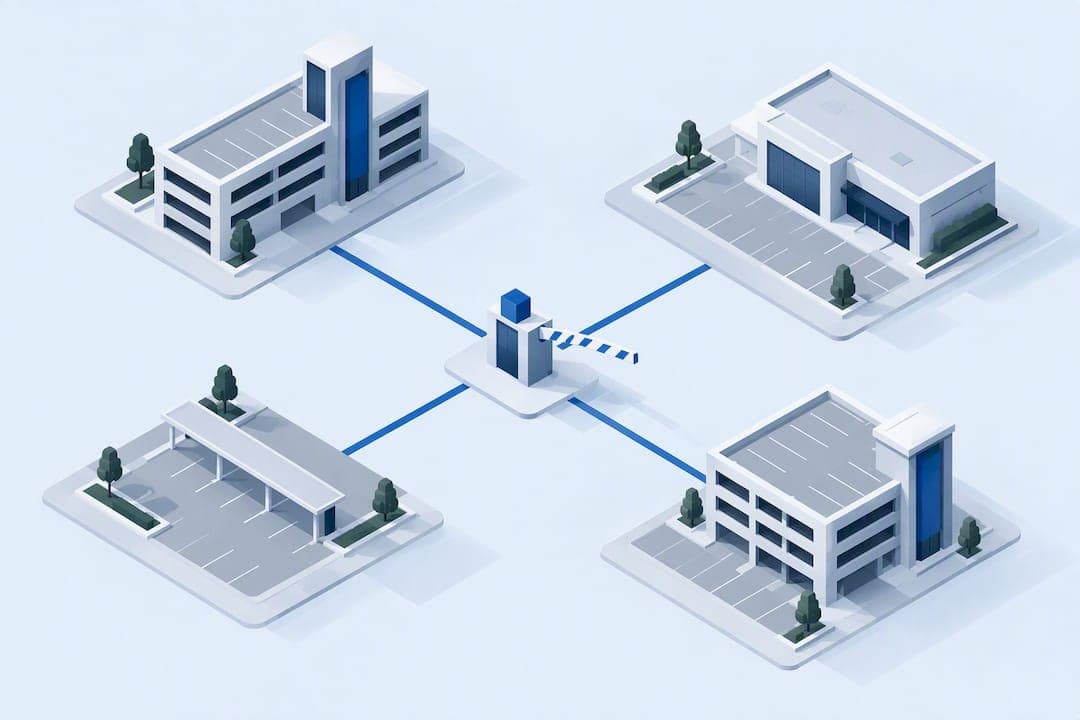
A cross-property ban flags a specific vehicle, usually by license plate, across every site in a portfolio so it is denied access or marked for action wherever it shows up. It works well for repeat-offender control when the program is governed by clear policy and real security controls, as demonstrated by PARKING SOPOT CENTRUM PROPARK in their operator-facing parking management. It carries real constraints too: data minimization rules, retention limits, and local towing and signage requirements still apply at each site.
TL;DR:
- Cross-property bans rely on centralized blacklists updated via license plate detection methods like ALPR, mobile scanning, or manual entry.
- Data collection and storage must follow privacy regulations, including purpose limitation, retention policies, and encryption, with access restricted to roles.
- Enforcement actions require human confirmation with photographic evidence before towing or immobilization to reduce liability.
- Regular audits, dispute resolution processes, and clear signage are essential to maintaining legal compliance and operational integrity.
- MyParkingMgr streamlines management by integrating enforcement history across sites, offering flexible deployment options and comprehensive audit trails.
Table of Contents
- How cross-property bans work: detection, synchronization, and workflows
- Legal and privacy constraints you need to know
- Operational controls and governance for safe portfolio bans
- Technical implementation checklist for IT and ops
- Enforcement and dispute handling: minimize liability and resolve mistakes
- Operator perspective: what teams learn when they roll out portfolio bans
- How MyParkingMgr supports cross-property bans and next steps
- Primary sources and recommended policies to consult
- Sources
- FAQ
How cross-property bans work: detection, synchronization, and workflows
A portfolio ban starts with detection. Properties typically use one or more of three methods: automated license plate readers (ALPR) mounted at gates or driving lanes, mobile apps that let staff scan plates on foot, and manual plate entry at kiosks or back-office terminals. Each method feeds the same destination: a centralized blacklist that every managed site can query in real time.
The workflow usually runs in a consistent sequence:
- An incident is captured at one property, often with a photo or ticket attached as evidence.
- A reviewer checks the incident and confirms it meets the criteria for a portfolio-wide flag.
- The vehicle is added to the shared watchlist with a reason code and an expiration date.
- Other sites receive an alert the next time that plate is detected on their property.
- Staff at the flagged site take the appropriate action, from a warning notice to towing, depending on local policy.
Integration points determine how smoothly this moves. Gates and access-control systems need to query the blacklist before granting entry. Towing vendors need a clean handoff that includes the reason and supporting evidence. Payment systems and permit modules should cross-check the same vehicle records so a banned plate does not accidentally get issued a new guest pass or permit at another site in the portfolio.
Legal and privacy constraints you need to know
License plate and vehicle data sit close to driver record restrictions, so portfolio operators need to understand the boundaries before centralizing this information. The federal Driver's Privacy Protection Act, codified at 18 U.S.C. §2721, limits how motor vehicle records can be obtained and used, and it matters for any program that links plate data back to registered owner information rather than just the plate itself.
The Federal Trade Commission's guidance on protecting personal information recommends collecting only what a legitimate business purpose requires and documenting retention tied to that purpose, with encryption and inventory controls applied whenever sensitive data moves through outside carriers. The FTC Safeguards Rule goes further for covered entities, requiring a written information security program built on a data inventory, a documented risk assessment, and periodic reassessment of where information lives and how it is protected.
The FTC's Safeguards Rule requires a written security program covering inventory, risk assessment, and incident response, which gives portfolio operators a workable template for a cross-property ban policy even outside the rule's strict scope.
Practical steps that follow from this guidance:
- Document the specific purpose for each category of data collected.
- Set a retention window and purge data automatically once it expires.
- Encrypt plate and vehicle data at rest and in transit.
- Log every access to the blacklist, including who viewed what and when.
Operational controls and governance for safe portfolio bans
Technology alone does not make a cross-property ban defensible. Governance does. Three roles typically anchor the program:
- Site operators who capture incidents and apply enforcement at their own property.
- Portfolio admins who maintain the consolidated blacklist and approve additions across sites.
- Compliance reviewers who audit the program and handle disputes.
Least-privilege access keeps the system honest: site staff should see only the active bans relevant to their own property, not full histories tied to other locations. Portfolio admins manage the consolidated list, and only compliance reviewers need visibility into the full audit trail.
Automated detection should never trigger enforcement on its own. A human reviewer needs to confirm the match before a tow truck is called or a gate is locked out, and that reviewer's ID should be captured in the audit trail alongside the decision.

Pro Tip: Publish your retention schedule, dispute process, and signage templates in one internal document so every site manager works from the same rules.
Technical implementation checklist for IT and ops
A clean data model makes audits fast and disputes easier to resolve. Each ban entry should capture the plate, capture time, location, data source, reviewer ID, reason code, and an expiration date tied to the retention schedule.
Security controls matter as much as the fields themselves:
- Encrypt data at rest and in transit, not just during transfer between sites.
- Maintain audit logs for every query and every edit to the blacklist.
- Run a periodic data inventory and risk assessment, consistent with Safeguards Rule-style practice.
- Reconcile site-captured plates against the master list weekly to catch false positives before they cause a wrongful tow.
Integrations worth configuring up front include gates and access-control hardware, kiosks, payment processors, towing vendor systems, and permit modules, so a flagged vehicle cannot slip through a side door that was never connected to the blacklist.
| Checklist area | What to verify |
|---|---|
| Data fields | Plate, timestamp, location, source, reviewer, reason, expiration |
| Security | Encryption at rest and in transit, access logs |
| Integrations | Gates, kiosks, payment systems, towing vendors, permits |
| Testing | False-positive audits, reconciliation runs, dispute drills |
Testing should include scheduled dispute drills, not just technical uptime checks, so the human side of the process gets exercised as often as the software does.
Enforcement and dispute handling: minimize liability and resolve mistakes
Enforcement is where a well-designed ban can still go wrong if the human-in-the-loop step gets skipped. A plate match from an ALPR camera or a manual flag should always be confirmed by a person before towing or immobilization happens, with a photograph and a time-stamped audit entry recorded at the moment of action.
A few practices reduce liability sharply:
- Require photographic evidence attached to every enforcement action, not just the original incident.
- Build a dispute intake process that reviews unfounded bans quickly and purges them from the record once resolved.
- Put clear contractual language in place with towing vendors covering liability, insurance, and evidence-sharing obligations.
- Keep site-level signage and authorization current, since a portfolio flag does not override local towing requirements.
A blacklist entry tells a site that a vehicle has a history elsewhere. It does not replace the signage, posted authorization, or local towing rules that property still has to satisfy on its own.
Operator perspective: what teams learn when they roll out portfolio bans
The benefit shows up fast: enforcement gets consistent across sites, and repeat offenders get caught on their second attempt instead of their twentieth. What surprises most teams is the upkeep. Plate image quality varies by camera and weather, local towing rules differ property to property, and someone has to own the unglamorous work of cleaning stale entries out of the list every week. A platform built for multi-property operations, like MyParkingMgr's portfolio tools, makes that upkeep manageable instead of a side project nobody owns.
— MyParkingMgr
How MyParkingMgr supports cross-property bans and next steps
Running a cross-property ban program on spreadsheets and phone calls between site managers is slow and error-prone. MyParkingMgr centralizes guest access, permits, violations, payments, and towing activity in one platform, so a flagged vehicle at one property shows up automatically at every other site in your portfolio.
A few things make this practical for day-to-day operations:
- A unified record system ties enforcement history to the vehicle rather than to whichever site happened to catch it first.
- Audit trails and customizable workflows help compliance reviewers without slowing down site staff.
- The deployment can be configured as hosted SaaS, client-hosted, or white-label, depending on organizational needs.
Onboarding is available. If you manage parking across multiple properties and want a program that holds up to scrutiny, request a proposal and see how it fits your portfolio.
Primary sources and recommended policies to consult

For deeper reading, consult the FTC's Safeguards Rule guidance, the Library of Congress overview of ALPR legal issues, and the DHS/ICE privacy impact assessment on commercial LPR data, which documents query limits, reason codes, and auditing practices worth adapting for a private portfolio program.
Sources
- Protecting Personal Information: A Guide for Business | Federal Trade Commission
- ALPR Usage and Privacy Policy (Caruso) — updated July 2026
- Congress
- ICE acquisition and use of LPR data from a commercial service — PIA (June 2021) | DHS
FAQ
What counts as a cross-property vehicle ban?
A cross-property vehicle ban flags a specific vehicle, typically by license plate, across every property in an operator's portfolio so staff at any site can see its history and respond consistently. It relies on a centralized blacklist fed by ALPR cameras, mobile scanning, or manual entry at individual sites.
Is it legal to share license plate data across properties?
Sharing plate data across your own properties is generally workable when you avoid pulling full motor vehicle records restricted under the Driver's Privacy Protection Act and follow data minimization practices like those described in FTC guidance. Document your purpose, limit retention, and restrict access to named roles to keep the program defensible.
How long should license plate data be retained?
Retention windows vary by operator and purpose, and one example from a large operator's published ALPR policy sets a 90-day retention period for nonmembers. A shorter, clearly documented window tied to a legitimate business purpose is generally easier to defend than open-ended storage.
Does a portfolio ban override local towing rules at each site?
No. A cross-property ban flags a vehicle for review, but each site still needs to meet its own signage, posted authorization, and local towing requirements before acting. The portfolio list informs enforcement decisions; it does not replace site-level legal compliance.
How does MyParkingMgr handle cross-property vehicle bans?
MyParkingMgr centralizes guest access, permits, violations, payments, and towing records in one platform so a vehicle flagged at one property is visible across the rest of the portfolio. The platform supports hosted, client-hosted, or white-label deployment along with audit trails for reviewing enforcement decisions.