

Event parking management, in the operational sense that matters to portfolio operators, means software that centralizes guest access, permits, enforcement, payments, towing, and audit trails across every property you run. The right approach is a unified platform rather than a patchwork of spreadsheets, standalone gate hardware, and paper permits. Platforms like MyParkingMgr are built for exactly this: one system of record instead of five disconnected tools.
TL;DR:
- Portfolio management platforms must unify guest access, permits, enforcement, and payments across properties to ensure consistent rules and streamlined dispute resolution.
- Core features include license plate recognition, permit waitlisting, offline enforcement tools, transparent fee structures, and traceable audit trails for legal compliance.
- States impose varying towing signage, authorization, and notification requirements; confirming compliance before towing is essential to avoid liability.
- Vendor evaluation should involve scenario testing with real data, integration validation, support assessment, and a pilot project before full deployment.
- Using a single system like MyParkingMgr simplifies enforcement, offers clear audit trails, and supports flexible deployment options, reducing manual patchwork solutions.
Table of Contents
- What Event Parking Management Actually Covers
- The Core Features Your Platform Needs
- Legal and Compliance Checkpoints Before You Tow
- How to Evaluate and Roll Out a Vendor
- Keeping Enforcement Defensible Across Every Property
- Why Audit Trails Change the Dispute Conversation
- Where MyParkingMgr Fits Into Your Parking Operation
- Sources
- FAQ
What Event Parking Management Actually Covers
Event parking management, as multifamily operators and hotel teams use the term, is not the temporary valet or traffic-control logistics you'd hire for a single concert or festival. It's the ongoing software layer that runs guest access, permits, enforcement, and billing across a portfolio of properties, day in and day out, event or no event.
That distinction matters because the tools are different. A single-event logistics vendor solves a one-day problem. Portfolio parking software solves a recurring one: a resident hosting a birthday party this weekend, a hotel handling a conference block next month, an HOA managing a holiday surge every December. Centralizing that workload changes how disputes get resolved, too. When enforcement, guest lists, and payment records live in one database, a challenged citation takes minutes to verify instead of a week of emailing between the front desk and the towing vendor.
Portfolio-grade platforms deliver benefits ad hoc tools can't match:
- Consistent enforcement rules across every property, ensuring uniform treatment of residents
- A unified financial ledger consolidating fines, permits, and towing fees across sites
- Quicker dispute resolution through linking enforcement actions to permits or credentials
- Centralized reporting to assist owners and boards managing multiple locations
The Core Features Your Platform Needs
A platform that can't handle the full lifecycle of a parking event, from guest arrival to citation appeal, will leave gaps your staff has to patch manually. Here's what to require before you sign anything.
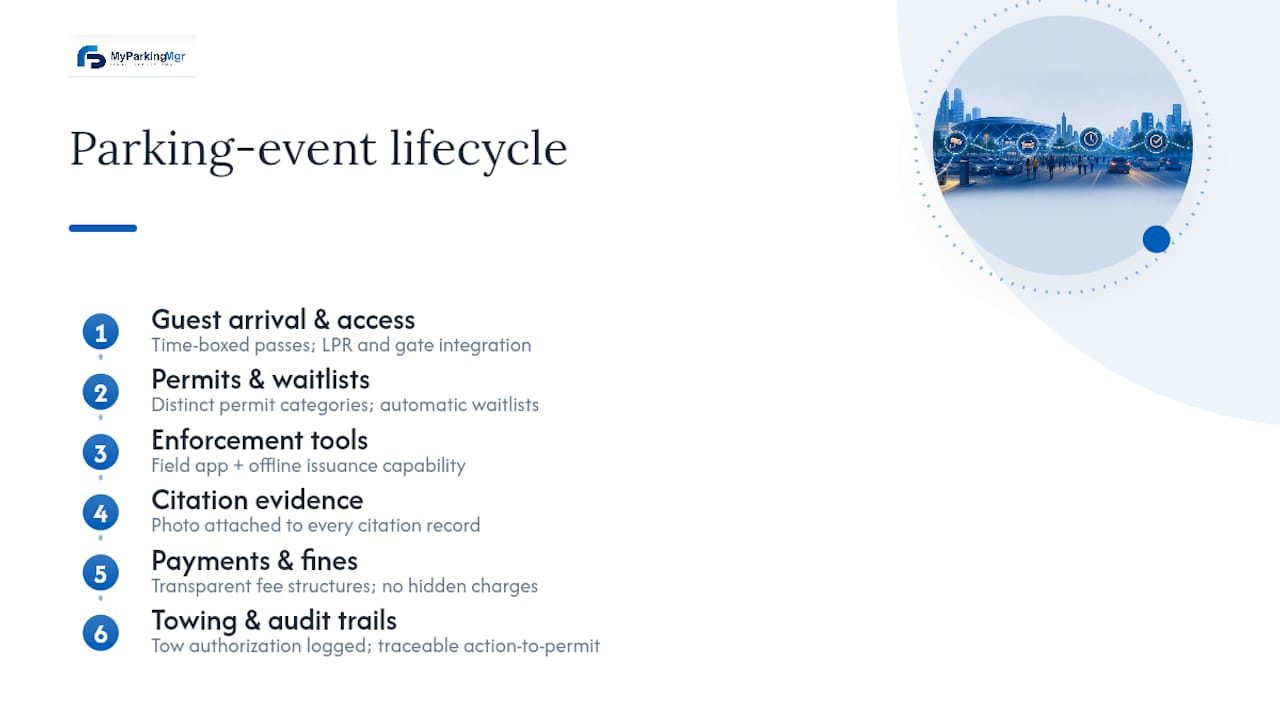
Access control and guest passes. The system should generate time-boxed guest credentials and integrate with license plate recognition (LPR) cameras and gate controllers, so a visitor's car is recognized the moment it rolls in, no manual lookup required — making it easy to find a golf tournament parking event or other access credentials tied to the event record.
Permit types and waitlists. Residents, vendors, and event guests need distinct permit categories, and the software should handle waitlist logic automatically when a lot hits capacity, rather than making your leasing office track it by hand.
Enforcement tools. Mobile apps for field staff, photo evidence attached to every citation, and offline issuance capability for lots with weak signal are non-negotiable. A ticket without photo evidence is a ticket you'll lose on appeal.
Payments and fines. Fee structures should be transparent to both the operator and the driver, with no hidden per-transaction surprises buried in the fine print.
Towing and immobilization workflows that log who authorized the tow and when.
Audit trails. Every enforcement action, from citation to tow, should be traceable to a permit or credential. That audit trail requirement is consistently flagged as the difference between integrations that hold up under dispute and ones that don't.
Pro Tip: Ask any vendor to show you a single enforcement action end to end, from the citation photo to the final payment record. If they can't pull that chain in under a minute, your staff won't be able to either.
Legal and Compliance Checkpoints Before You Tow
Towing and immobilization sit at the top of your liability list, and the rules vary sharply by state. Florida requires conspicuous tow-away signage with specific size and wording, and failing to meet that standard can expose the property owner to liability under Florida Statutes §715.07. California's AB-2174 goes further, specifying sign placement, requiring written authorization for many private-property tows, and mandating notification to law enforcement. Georgia caps how far automatic surveillance can go in triggering a tow and requires licensed towing firms and conspicuous notice under Georgia Code § 44-1-13, while Texas layers on its own permitting and storage-reporting framework for towing operators under Chapter 2308 of the Texas Occupations Code.
No two states handle this the same way, so treat these as examples, not a checklist you can copy into your lease. Before you authorize a single tow, confirm:
- Your signage meets your state's size, wording, and placement rules
- You have written, dated authorization on file for every nonconsensual tow
- Photo evidence and permit records are retained long enough to survive an appeal or a legal challenge
- Your local municipality doesn't layer additional notice requirements on top of state law
Talk to local counsel before finalizing your enforcement policy. Statutes change, and a signage template that worked in one city can fall short two counties over.
How to Evaluate and Roll Out a Vendor
Buying event parking management software without a structured process is how properties end up locked into a system that can't handle their actual permit logic. Follow a sequence instead of a gut call.
- Run an internal requirements workshop. Pull in enforcement staff, finance, IT, and property operations before you talk to a single vendor. Each group has different failure points, and you need all of them in the room.
- Issue a focused RFP to three to five vendors, then insist on scripted demos using your own scenarios, not the vendor's polished sandbox. Demo environments routinely lack the large permit databases and conflicting waitlist logic that real properties generate, which is exactly why buyer guides recommend testing against your own messy data.
- Validate integrations and migration. Confirm the platform connects to your existing LPR hardware, gate controllers, and property-management or finance systems, and get specifics on how vehicle and permit history migrates over.
- Confirm support and total cost of ownership. Ask about escalation paths, support hours, and whether pricing includes per-transaction fees that balloon at scale. Run the numbers over three years, not one.
- Pilot at one property first. Train staff, set a rollback plan if something breaks, and only expand portfolio-wide once the pilot clears a full billing cycle.
Pro Tip: Call at least one reference customer who isn't on the vendor's suggested list. The gaps that show up in year two rarely show up in a scripted demo.
Keeping Enforcement Defensible Across Every Property
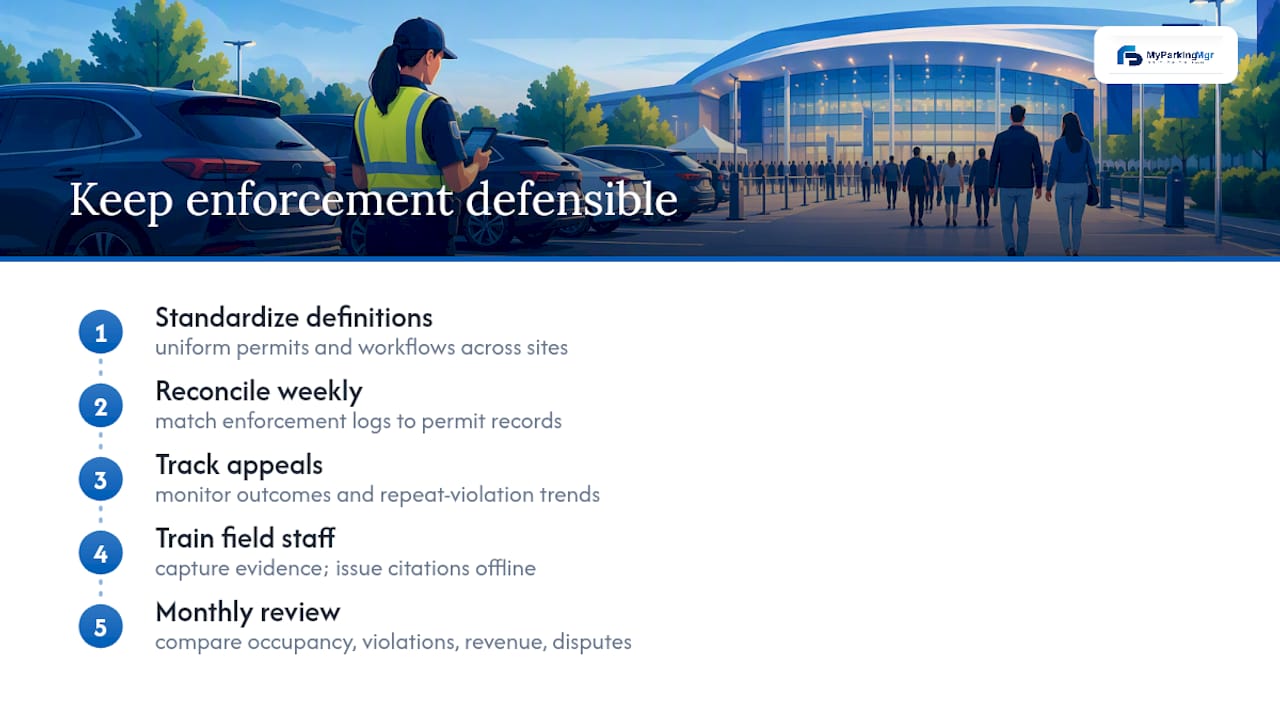
Software solves half the problem. The other half is discipline in how your teams use it. Standardize permit definitions and enforcement workflows across every site in your portfolio, so a visitor pass means the same thing in Phoenix as it does in Charlotte.
Reconcile enforcement logs against permit records on a weekly basis rather than waiting for a dispute to force the issue. Track appeal outcomes over time. If the same violation type keeps generating successful appeals, that's a signage or signage-placement problem, not a driver problem. Train field staff explicitly on evidence capture, including how to issue citations offline when a lot has no signal, so a dead network connection never becomes an excuse for a missing photo.
Set a monthly review of four numbers: occupancy, violation counts, revenue collected, and disputes filed. Watching those side by side, month over month, tells you faster than any single metric whether a property's enforcement policy is working or quietly generating resentment among residents.
Why Audit Trails Change the Dispute Conversation
We built our view of this problem around one recurring failure point: enforcement actions that can't be traced back to an authorization record. A tow without a written authorization on file is a liability claim waiting to happen, and a citation without photo evidence tied to a specific permit is an appeal you'll probably lose.
Unified logging closes that gap. When every enforcement action reconciles automatically to a guest pass, resident permit, or vendor credential, disputes that used to take a week of back-and-forth get resolved by pulling one record. Whether that record lives in a hosted SaaS environment, a client-hosted deployment, or a white-label instance depends on your IT posture and how much control your legal team wants over data residency, not on which option is inherently better.
— MyParkingMgr
Where MyParkingMgr Fits Into Your Parking Operation
If you're comparing spreadsheets, standalone gate software, and a paper citation book against a single platform, the math isn't close. MyParkingMgr replaces that patchwork with one system covering guest access, resident and vendor permits, enforcement, payments, and towing, tied to a full audit trail on every vehicle record across your portfolio.
The platform offers multiple deployment options including hosted SaaS, client-hosted, or white-label configurations to fit different IT requirements. Every enforcement action, from a guest pass issued at check-in to a citation appeal, reconciles back to a single vehicle record, so your team can answer any dispute without digging through three systems. Onboarding is free, with no cost to get your properties set up on the platform. If you're managing enforcement across more than one site, start with the multi-property platform overview or reach out through the contact page to see how the migration path would work for your existing permit data.
Sources
Confirm your local rules against these before finalizing an enforcement policy:
- Parking access audit trail requirements | Parking Equipment Guide
- Parking
- Florida Statutes §715.07 (private property towing rules)
State and municipal rules change often, so verify current requirements with local counsel before writing them into your enforcement policy.
FAQ
What Is Event Parking Management Software?
It's a portfolio-level platform that handles guest access, resident and vendor permits, enforcement, payments, towing, and audit trails across multiple properties. It's distinct from single-event logistics services, which handle traffic and staffing for one-off events rather than ongoing multi-property operations.
What Features Should I Require From a Vendor?
At minimum, require access control with LPR integration, flexible permit types with waitlist logic, mobile enforcement tools with photo evidence, transparent payment processing, towing workflows with authorization tracking, and a complete audit trail for every enforcement action. Anything missing one of these creates a gap your staff will end up patching manually.
Do I Need Written Authorization Before Towing a Vehicle?
In most states, yes. California's AB-2174 requires written authorization and recordkeeping for many private-property tows, and Florida and Georgia impose their own signage and notice rules, so check your specific state statute before authorizing a tow.
How Much Does MyParkingMgr Cost?
Pricing depends on portfolio size and deployment model, and current rates are available directly on the MyParkingMgr site. Onboarding itself is free, with no cost to get your properties set up on the platform.
How Long Does Implementation Typically Take?
Timelines depend on portfolio size and how much legacy permit and vehicle history needs migrating, which is why buyer guides recommend piloting at a single property before rolling out portfolio-wide. A one-property pilot through a full billing cycle is a reasonable way to validate the system before expanding further.