
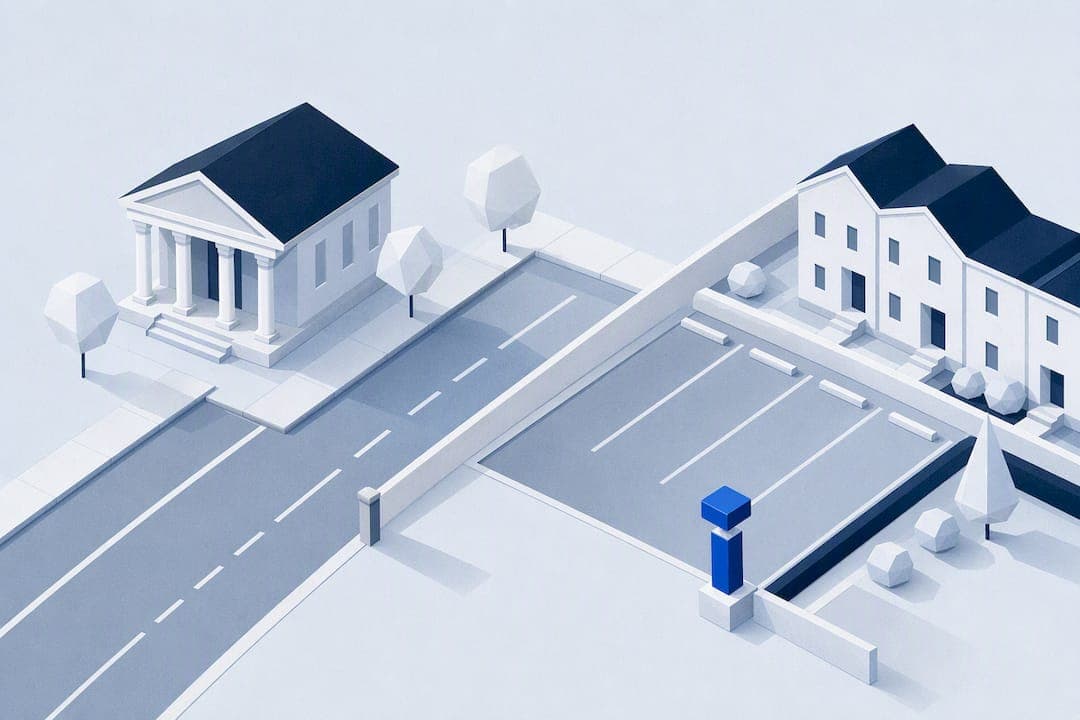
Homeowners associations can generally set and enforce parking rules on private roads, driveways, and common areas, but their authority typically stops at the curb of a public street. Whether a specific rule holds up depends on your recorded CC&Rs, your state's statutes, and who legally owns the pavement outside your door. Federal disability law can also override a strict parking policy. Before you pay a fine or argue with your board, pull your CC&Rs and check your street's ownership status with the county or city.
TL;DR:
- HOAs can enforce parking rules only on private roads and areas they own, not on dedicated public streets controlled by local governments.
- Clear, narrowly tailored rules with proper notice are essential for enforceability and to minimize disputes or legal challenges.
- Documenting enforcement actions with signage, notices, timestamps, and permits significantly reduces wrongful towing or ticketing claims.
- Federal law requires HOAs to provide reasonable accommodations for residents with disabilities, even if rules are enforced uniformly.
- Using specialized management platforms helps ensure compliance, maintain records, and defend against disputes more effectively than manual tracking.
Table of Contents
- Where HOA parking authority comes from: CC&Rs, bylaws, and board rules
- Public vs private streets: the single most important distinction
- How associations lawfully enforce parking: signs, notice, hearings, fines, and towing
- Federal limits: Fair Housing Act and reasonable accommodations for parking
- Practical steps homeowners should take to dispute a fine or towing
- How boards and managers reduce disputes: practical tools and workflows
- The real impact of parking rules on residents and visitors
- How HOAs amend or create new parking rules
- How parking rules intersect with insurance and liability issues
- Common parking violations and how HOAs identify them
- Balancing enforcement with community relations
- Balancing safety, fairness, and legal compliance
- Put your parking enforcement on solid ground
- Sources
- FAQ
Where HOA parking authority comes from: CC&Rs, bylaws, and board rules
An HOA's power to regulate parking is not automatic. It comes from the Declaration of Covenants, Conditions, and Restrictions (CC&Rs) recorded against the property, supplemented by bylaws and any rules the board adopts under authority those documents grant. If the CC&Rs are silent on parking, the board usually cannot invent a sweeping restriction out of nowhere. Adding a genuinely new restriction, such as banning a category of vehicle the CC&Rs never mentioned, often requires a formal amendment and a membership vote. A narrower clarifying rule, like specifying visitor permit hours, is more often within a board's existing rule-making power.
Common parking restrictions found in HOA documents include:
- No overnight street parking for residents' extra vehicles or guests
- Bans or time limits on commercial vehicles, trailers, and RVs in driveways
- Mandatory visitor or guest parking permits displayed in the windshield
- Reserved or assigned spaces tied to specific units
Precision matters here. A rule banning "commercial vehicles" without defining the term by weight, signage, or vehicle class invites disputes the board cannot easily win. The Community Associations Institute recommends that boards adopt narrowly tailored rules with clear notice and hearing procedures, since vague or overreaching restrictions are the ones most likely to end up in litigation.
Public vs private streets: the single most important distinction
This is the fact that decides almost every parking dispute. When a street inside a community has been dedicated to and accepted by a city or county, it becomes public right-of-way, and the municipality, not the HOA, controls parking on it. When the association retains ownership and maintenance responsibility, the street is private, and the CC&Rs can generally govern who parks there and how.
States do not treat this the same way. A 2026 advisory opinion from the Utah Department of Commerce concluded that associations cannot impose restrictions on public streets, and that any governing document language attempting to do so is unenforceable when it conflicts with state law. Other states have produced mixed outcomes: some courts have upheld CC&R parking restrictions even on dedicated streets, while others have sided with residents, often depending on the specific language used at dedication and whether the association retained any reservations.
To figure out where your street stands, check:
- The subdivision plat and original deed for dedication language
- County or city records confirming acceptance of the street for public maintenance
- Who actually plows, patches, and repaves the road
- Your municipal code for any street-parking ordinances that might apply regardless of HOA rules
Pro Tip: Call your county recorder's office and ask directly whether your street was "accepted" for public maintenance. That one phrase often resolves the entire question faster than reading the CC&Rs.
How associations lawfully enforce parking: signs, notice, hearings, fines, and towing
Enforcement authority and enforcement procedure are two different things, and boards often get the second one wrong even when they have the first. Most states that allow towing from private property attach conditions to it. California's Vehicle Code Section 22658 requires posted signage at property entrances and specific notice procedures before a vehicle can be removed, with narrow exceptions for emergencies blocking access.
A defensible towing program generally includes:
- A board resolution formally authorizing towing as an enforcement tool
- Entrance signage that meets the state's size, wording, and placement requirements
- A written notice procedure before towing, except in true emergencies
- A signed contract with a licensed tow operator that includes indemnification language
- Photographic evidence and a timestamp retained for every enforcement action
A well-run towing program pairs signed vendor contracts with photographic timestamps for every removal, a combination that reduces an association's exposure to wrongful-tow claims because the paper trail exists before a resident disputes the tow.
Homeowners who get cited or towed should ask the towing company for an itemized receipt, note the exact location and time, and photograph the posted signage before leaving the scene. A tow that happened without the required signage or notice is often the easiest kind to challenge.
Federal limits: Fair Housing Act and reasonable accommodations for parking
A parking rule that applies evenly to everyone can still be illegal if it fails to accommodate a resident with a disability. Under guidance jointly issued by HUD and the Department of Justice, housing providers, including HOAs, must grant reasonable accommodations when necessary for a resident to use and enjoy their home. That includes carving out exceptions to first-come, first-served parking policies.
Uniform enforcement of a parking rule does not excuse an association from the duty to accommodate a resident's disability-related request; the two obligations exist side by side.
A common example: a community with unassigned parking may still need to designate and reserve an accessible space near a resident's unit if that resident has a mobility impairment, even if no one else gets a reserved spot. When facilities restripe existing lots or add new spaces, the ADA's guidance on restriping sets minimum counts, dimensions, and signage for accessible spaces relative to the total number of spaces.
Boards receiving an accommodation request should:
- Acknowledge the request in writing
- Ask only for the medical information necessary to establish the need, when the disability isn't obvious
- Engage in a genuine back-and-forth to find a workable solution
- Document the final decision and any alternatives that were considered
Practical steps homeowners should take to dispute a fine or towing
Move fast. Evidence disappears, and deadlines for appeals are often short.
- Photograph everything at the scene: the vehicle's position, nearby signage, curb markings, and any posted notice, with timestamps if your phone supports them.
- Collect the towing paperwork, including the company name, the invoice, and the exact time of removal.
- Pull your CC&Rs and confirm the specific rule you're accused of violating actually exists and was properly adopted, with notice given to residents.
- Request a hearing with the board in writing, citing the rule, the notice requirement, and any procedural gap you found.
- If the tow involved a public street or violated state towing statutes, file a complaint with the municipality or your state's consumer protection office.
- Consider small claims court for towing fees and fines under the jurisdictional limit, and consult an attorney if the amount or the pattern of enforcement looks like a larger fair-housing or selective-enforcement problem.
Pro Tip: Ask the board, in writing, for the date the specific parking rule was adopted and the notice that was sent to residents. Associations that cannot produce that paperwork has a much weaker case.
How boards and managers reduce disputes: practical tools and workflows
Most parking disputes trace back to the same weak spot: nobody can produce a clean record of who was warned, when, and with what evidence. Boards that maintain resident parking permit registries and structured violation management workflows tend to have fewer arguments that escalate because the documentation already exists.
Useful pieces of that system include:
- A permit registry tied to unit and vehicle records, so authorized cars are never mistaken for violators
- Violation logs with timestamped photos and automated notice to the resident, supporting the due-process paper trail described earlier
- Integrated towing records and payment history that reduce billing confusion after a tow
- Audit trails that let a board show, months later, exactly how a fine was calculated and communicated
Manual, spreadsheet-based enforcement tends to break down once a community grows past a handful of buildings or vehicles. A board managing multiple properties or a large lot often reaches the point where dedicated software makes the audit trail practical rather than aspirational.
The real impact of parking rules on residents and visitors
Parking rules shape daily life in a community far more than most residents expect until they get their first citation. A guest who parks overnight without a permit, a resident who leaves a work van in the driveway too long, or a visitor who takes a reserved space can trigger a fine, a warning letter, a tow, or in repeat cases, a lien process tied to unpaid assessments.
The consequences scale with severity and repetition. A first offense typically brings a written warning. Repeated violations often escalate to fines that accumulate per incident or per day, and persistent nonpayment of those fines can, in some associations, become a lien against the property under the same mechanism used for unpaid dues. Towing carries its own immediate cost and inconvenience, plus the risk of damage to the vehicle during removal.
Visitors face a different set of stakes. They rarely read the CC&Rs, so an association's guest parking policy only works if it is communicated clearly through signage, permits, or a simple guest registration process. A visitor towed from a spot they had no way of knowing was restricted creates exactly the kind of dispute that damages an association's relationship with residents, even when the tow was technically authorized.

How HOAs amend or create new parking rules
Adding a genuinely new parking restriction is different from tweaking an existing one, and the difference matters legally. Most CC&Rs distinguish between amendments to the recorded declaration, which usually require a supermajority vote of the membership, and board-adopted rules, which the board can typically approve on its own if the CC&Rs already grant that authority for the topic at hand.
A well-run rule change process generally includes:
- Drafting the proposed rule with specific, measurable language rather than vague terms
- Circulating the proposal to residents for comment before a vote, even when not strictly required
- Holding an open board meeting where residents can raise concerns on the record
- Documenting the vote count and the effective date, then distributing written notice to every household
Skipping resident input does not always make a rule unenforceable, but it makes it far more likely to be challenged, and boards that document a fair process have a much stronger position if a resident later disputes a fine tied to that rule.
How parking rules intersect with insurance and liability issues
Parking enforcement carries liability exposure that boards sometimes underestimate. A wrongful tow, meaning one carried out without proper signage, notice, or authorization, can expose the association and its towing vendor to claims for damages, and the association's general liability policy may or may not cover that exposure depending on how the towing arrangement is structured.
The towing contract itself is the first line of defense. An indemnification clause that shifts liability to a licensed, insured tow operator protects the association if a vehicle is damaged during removal or if the tow is later found improper. Boards should confirm the vendor carries adequate insurance and ask for proof before signing anything.
Liability also runs the other direction. If an association fails to enforce basic safety-related parking rules, such as keeping fire lanes and hydrant access clear, and that failure contributes to an injury or a delayed emergency response, the association itself can face a negligence claim. That risk is part of why safety-focused parking rules tend to be easier to defend than broad convenience-based bans.
Common parking violations and how HOAs identify them
The violations that generate the most fines and disputes are rarely exotic. Overnight street parking without a permit, expired or missing guest passes, vehicles parked in fire lanes or blocking hydrants, oversized trucks or trailers left in driveways, and cars parked across the line into a neighbor's assigned space make up the bulk of enforcement activity in most communities.
Associations identify these violations through a mix of resident complaints, routine walk-throughs or drive-throughs by a property manager or contracted patrol, and increasingly, camera or license-plate recognition systems tied to a permit database. The strongest programs cross-reference a vehicle's plate against a registry of authorized residents and guests before issuing a citation, which cuts down on false positives where a legitimately permitted car gets flagged in error.

The weakest programs rely on a single board member's visual memory of "whose car that is," which is exactly the kind of inconsistent enforcement that invites claims of selective treatment against one household and not another.
Balancing enforcement with community relations
Rules enforced without judgment turn neighbors into adversaries, and that outcome costs an association more in board turnover and legal fees than the fines ever recover. The boards with the fewest disputes tend to lead with a warning before a fine, explain the reasoning behind a rule when a resident asks, and reserve towing for genuine safety issues or repeat offenders rather than a first-time paperwork lapse.
Consistency matters as much as leniency. A board that waives a rule for one homeowner and enforces it strictly against another is building the exact record a resident's attorney would want to see in a selective-enforcement complaint. Written policies, applied the same way every time, protect the board as much as they protect residents.
Communication closes the loop. A newsletter reminder before a holiday weekend, a clear sign at the guest parking area, and a straightforward appeals process cost an association very little and prevent most of the friction that turns a parking ticket into a community-wide grievance.
Balancing safety, fairness, and legal compliance
The strongest parking policies are narrow and safety-driven: fire lanes, hydrant access, and ADA spaces protected without exception, while everything else leaves room for judgment. Broad, catch-all bans generate resentment and lawsuits in roughly equal measure.
Consistency and paperwork prevent more disputes than any fine ever will. A board that documents every notice, hearing, and decision rarely loses an argument it should win. Software can organize that record, but it never replaces a lawyer's read on a genuinely gray situation.
— MyParkingMgr
Put your parking enforcement on solid ground
Boards that manage parking with a shared spreadsheet and a folder of phone photos usually discover the gaps only after a resident challenges a fine and nobody can produce the notice history. MyParkingMgr gives HOA boards and property managers a single record of permits, violations, payments, and towing activity, so the documentation this article describes exists automatically instead of being reconstructed after the fact.
The platform's violation management tools timestamp photos and evidence as they're captured, and resident permit registries make it clear at a glance which vehicles are authorized. For communities that want a deployment matched to how they operate, The platform supports hosted, client-hosted, or white-label setups, with an initial onboarding process available.
If your association is ready to replace scattered notes with an audit trail, visit our HOA and gated community parking management page or contact us to talk through what your community actually needs.
Sources
- California Vehicle Code §22658 — Towing from private property
- Reasonable Accommodations under the Fair Housing Act (HUD/DOJ)
- Advisory Opinion No. 2026-15 — Utah Department of Commerce
- Community Associations Institute — Rules development and enforcement guidance
- ADA: Restriping parking spaces — compliance brief
FAQ
What are the rules for parking in a homeowners' association in Florida?
Florida HOAs can generally regulate parking on private roads and common areas through their CC&Rs, but authority over public streets belongs to the municipality or county, not the association. Homeowners should check their specific declaration for towing and enforcement procedures, since requirements vary by community and by whether the street is publicly dedicated.
Do HOAs allow street parking?
It depends on whether the street is private, meaning owned and maintained by the association, or public, meaning owned by a city or county. Many HOAs restrict street parking on private roads through their CC&Rs, but they typically cannot enforce parking rules on a street that has been dedicated to and accepted by a municipality.
Can an HOA enforce parking on a public street in NC?
Generally no. Once a street is dedicated to and accepted by a municipality, control over parking on that street shifts to local government, and an HOA's governing documents cannot override that authority. State advisory opinions in other states, including a 2026 Utah opinion, have reached the same conclusion about public streets more broadly.
What are the HOA parking laws in Arizona?
Arizona HOAs can typically set parking rules for private streets and common areas through their CC&Rs, subject to the same public-versus-private street distinction that applies nationwide. Associations must also honor federal fair housing requirements, including reasonable accommodations for residents with disabilities, regardless of what the parking policy otherwise states.
Can an HOA tow my car without warning?
Most states that permit towing from private property require posted signage and some form of notice before a tow, with exceptions for emergencies blocking access or fire lanes. California's Vehicle Code Section 22658 is one example of a state law spelling out those signage and notice requirements for private property towing.