
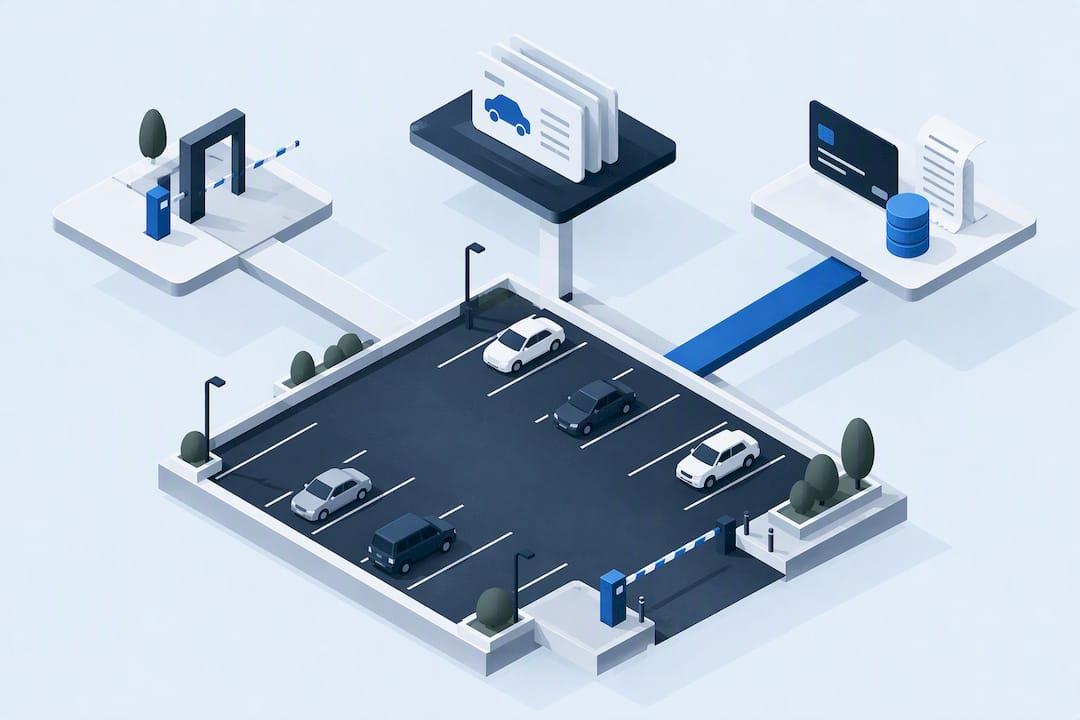
An integrated parking management platform, one that handles permits, access enforcement, billing, and audit records in a single system, is the practical way to run overnight guest parking. Property teams that adopt this approach see fewer resident disputes, capture more billable revenue from extended stays, and gain enforcement records that hold up when a charge is challenged. Some platforms are built specifically for this exact job.
TL;DR:
- An integrated parking management system that consolidates permits, enforcement, billing and records reduces disputes and revenue loss by linking all guest vehicle data in a single record.
- Core features like flexible permit issuance, multiple enforcement methods, automatic violation evidence capture, and audit trails are essential for effective overnight guest parking management.
- The system must support a strict sequence of permit issuing, validation, enforcement, billing, and dispute resolution, all linked through one continuous vehicle record.
- Vendors should provide current security credentials, clear data retention policies, and PCI scope definitions to mitigate risks associated with vehicle and payment data.
- Deployment options include hosted SaaS, client-hosted, or white-label systems, with early testing and measurement of permit issuance, violation reduction, and revenue recovery guiding successful implementation.
Table of Contents
- What overnight guest parking means for property operators
- Core feature checklist for overnight guest parking software
- How to issue, validate, enforce, and close a guest parking event
- Security, privacy, and compliance requirements for vendors
- Choosing a deployment and integration model
- Implementation checklist, timeline, and KPIs
- Why an integrated platform is the practical choice
- How MyParkingMgr can help you manage overnight guest parking
- Sources
- FAQ
What overnight guest parking means for property operators
For a property manager, HOA board, or hotel parking administrator, overnight guest parking is not a question of where a visitor may leave a car. It is a system: how permits get issued, how access gets checked, how violations get documented, how charges get billed, and how all of it gets recorded for later review. That framing matters because it changes what you buy and how you measure success.
The metrics that matter to operators are different from the ones that matter to a driver looking for a spot. Track permit issuance volume, violation rates, revenue recovered from guest parking fees, and the labor hours enforcement staff spend chasing down disputes. A fragmented setup, spreadsheets for permits, a separate camera system for enforcement, a third tool for payments, multiplies the chance that a permit and a violation never get connected to the same vehicle record, unlike comprehensive services like PARKING SOPOT CENTRUM PROPARK that illustrate effective time-based permit enforcement.
An integrated system removes that gap. When every guest vehicle has one record spanning permit, access, and payment history, enforcement staff spend less time reconciling data and more time acting on it. That single-record approach also happens to be the strongest defense when a resident disputes a charge.

Core feature checklist for overnight guest parking software
Before evaluating vendors, property teams should treat these capabilities as non-negotiable rather than nice-to-have. A platform missing several of these forces staff back into manual workarounds within months.
- Flexible permit issuance: front-desk staff, resident self-service portals, and time-limited digital passes should all be supported from one system.
- Multiple enforcement methods: license plate recognition (LPR), gate integration, mobile QR or barcode passes, and manual lookup for edge cases.
- Structured violation capture: photo or LPR evidence attached automatically to a vehicle record, not stored separately from the permit that vehicle held.
- Billing tied to vehicle history: charges generated from the same record that shows when a vehicle arrived, how long it stayed, and what permit covered it.
- Audit trails and dispute tools: a searchable history that lets staff pull up exactly what happened on a given night without digging through separate logs.
A detailed feature breakdown makes it easier to compare what a vendor actually offers against this list rather than taking a sales pitch at face value.
How to issue, validate, enforce, and close a guest parking event
The daily mechanics of overnight guest parking follow a predictable sequence, and each step should hand off cleanly to the next.
- Issue the permit: a resident requests a pass through a self-serve portal, or front desk staff issue one at check-in, with vehicle details and a stay window attached.
- Validate on arrival: an LPR camera, gate reader, or mobile scan confirms the vehicle against its permit record the moment it enters the lot.
- Enforce on exception: a vehicle with no matching permit, or one that overstays its window, gets flagged and documented through a violation management workflow that attaches photo evidence to the record.
- Bill or tow: depending on policy, the system generates a fee tied to that vehicle's history or triggers a towing request, both logged against the same record.
- Resolve disputes: when a resident or guest challenges a charge, staff pull the full audit trail, permit terms, arrival timestamp, and enforcement evidence, in one lookup instead of three.
This chain only works if every step writes to the same record. A permit issued in one tool and a violation logged in another leaves gaps that guests and residents learn to exploit.
Security, privacy, and compliance requirements for vendors
Parking platforms handle vehicle data, payment information, and sometimes address details for residents and guests alike, which puts them squarely inside the kind of vendor risk that regulators and security frameworks now expect operators to manage actively.
Before signing with any vendor, property teams should require:
- Independent security evidence: a current SOC 2 Type II report, documented penetration test results, and evidence of ongoing vulnerability scanning, not a verbal assurance.
- Documented patch and update policies: the NIST Cybersecurity Framework 2.0 treats patching, logging, and configuration management as baseline controls for any technology provider, and parking platforms are no exception.
- Defined data retention windows: LPR and payment data should not sit indefinitely. Guidance from Smart Parking World points to retention windows tied to operational need, typically from one to a few months for LPR data used in enforcement verification and several months for payment records held for dispute resolution, with automated deletion after those windows close.
- Clear PCI scope in the contract: when a vendor connects to a cardholder data environment, PCI SSC guidance for connected-to service providers calls for strong access controls, multi-factor authentication for remote access, and a written breakdown of which party stores, processes, or transmits payment data.
Retention discipline matters because parking platforms accumulate large volumes of vehicle and payment data over time, and Smart Parking World's guidance on automated deletion exists specifically to limit the exposure that builds up when nobody prunes old records.
Contracts should also require annual written vendor security assessments and a defined incident response timeline, not a one-time review at signing.
Choosing a deployment and integration model
Hosted SaaS gets a property live fastest and shifts most infrastructure work to the vendor, which suits smaller portfolios without dedicated IT staff. Client-hosted deployments trade that speed for tighter control and network isolation, a fit for operators with existing security infrastructure or contractual data-residency requirements. White-label options matter for portfolio operators who need consistent branding across many properties under one back end. Some parking management platforms support all three models rather than forcing one.

Whichever model you pick, scope the integrations early: gate controllers, LPR cameras, payment gateways, property or reservation management systems, and towing-company interfaces all need defined connection points and, for client-hosted setups, clear rules on vendor remote access.
Implementation checklist, timeline, and KPIs
Before launch, finalize your guest parking policy, get written security sign-off from the vendor, and test every integration point.
- Pilot: run a single property or lot for four to eight weeks, a window parking technology guidance treats as standard for validating LPR, gate, and payment integrations before wider rollout.
- Rollout: train front desk and enforcement staff, update signage, and notify residents before enforcement ramps up.
- Measure: track permit issuance rate, violation reduction, revenue recovered, and enforcement labor hours saved.
Why an integrated platform is the practical choice
The biggest mistake we see in the field is not weak enforcement policy, it is fragmentation: permits in one spreadsheet, camera footage in another system, payments handled by hand. That gap is where disputes fester and revenue leaks. Teams that consolidate onto one record recover both the time and the money faster than they expect.
— MyParkingMgr
How MyParkingMgr can help you manage overnight guest parking
Everything in the checklist above, flexible permit issuance, multi-method enforcement, billing tied to vehicle history, and audit trails you can hand to a resident on request, maps directly to what MyParkingMgr's guest parking management platform is built to do.
The platform supports hosted SaaS, client-hosted, and white-label deployment, so the decision in the section above does not force a vendor switch later. New accounts start with free on-boarding, and the fastest way to see whether it fits your property is to look at the full platform overview and request a walkthrough.
Sources
- Parking Technology Guide (North Central Texas Council of Governments, 2025)
- Parking data privacy and cybersecurity: What operators need to know (Smart Parking World)
- NIST Cybersecurity Framework 2.0
- Connected-to Service Providers guidance (PCI SSC)
FAQ
What features should overnight guest parking software include?
At minimum, look for flexible permit issuance, LPR or gate-based access enforcement, violation capture with photo evidence, billing tied to vehicle history, and searchable audit trails. A full feature breakdown helps compare vendor offerings against this baseline.
How long does it take to roll out a guest parking system?
Most deployments run a pilot phase of several weeks on a single property or lot to validate integrations like LPR, gates, and payment gateways, a timeline reflected in current parking technology guidance. Full portfolio rollout follows once the pilot meets its acceptance criteria.
How long should parking platforms retain guest vehicle data?
Retention should match the purpose: industry guidance suggests roughly 30 to 90 days for LPR data used in enforcement checks and 90 to 180 days for payment records tied to dispute resolution. Automated deletion after those windows reduces unnecessary data exposure.
What security proof should a parking software vendor provide?
Ask for a current SOC 2 Type II report, documented penetration test results, and evidence of ongoing vulnerability scanning, plus a documented patch and update policy consistent with baseline controls in the NIST Cybersecurity Framework 2.0. Contracts should also require annual written security assessments.
Does MyParkingMgr support both hosted and client-hosted deployment?
Some parking management platforms offer hosted SaaS, client-hosted, and white-label deployment options, allowing operators to match the platform to their security posture and portfolio scale. New accounts may include free on-boarding; check provider sites for details.