
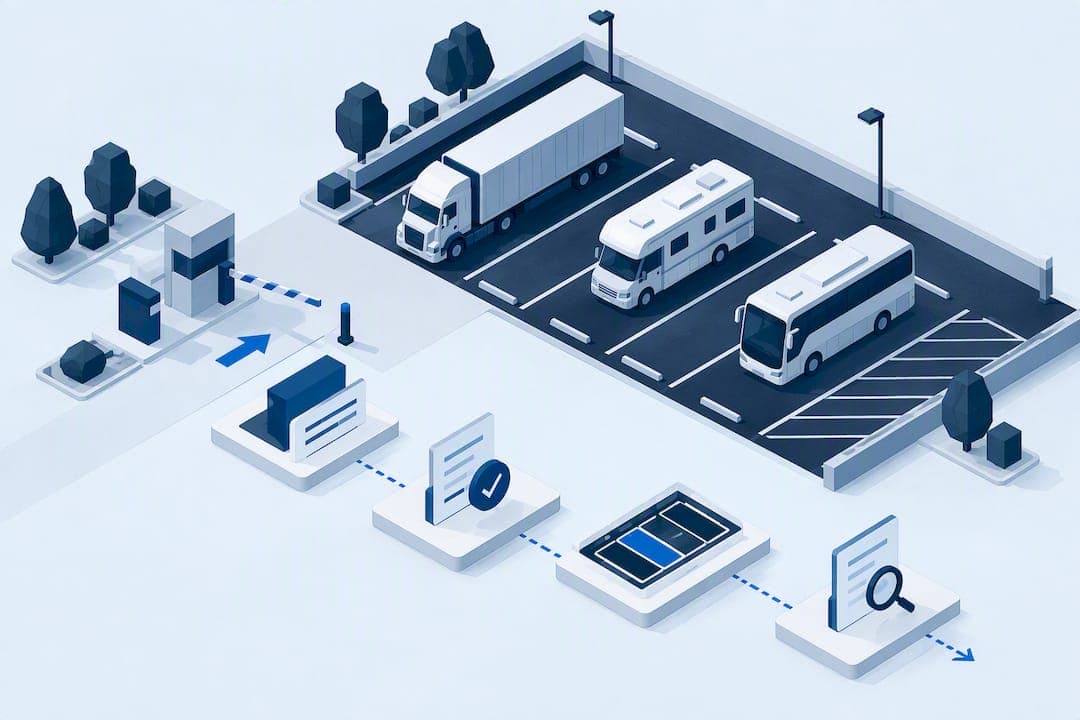
An oversized vehicle parking program only works when every RV, box truck, or trailer is tied to a single permit record that links the vehicle, the assigned zone, the property, and any violation history. That record needs to sync with detection hardware and route exceptions to a human before anyone issues a citation or calls a tow truck. MyParkingMgr, along with procurement frameworks like UNLV's iParq specification and ALPR guidance from institutions like Cal State L.A., point to the same architecture. The sections below cover the feature checklist, the data model, integration testing, enforcement steps, and how to pilot it before rollout.
TL;DR:
- A defensible oversized vehicle parking system must link each permit to the vehicle, property, zone, account holder, and permit status, with immutable records of all actions.
- ALPR systems require confidence scoring, image retention, and real-time synchronization with permit data to prevent false readings and ensure accurate enforcement.
- Towing or citations should only occur after human verification of flagged violations, with clear documentation including images, timestamps, and permit records to withstand legal challenges.
- Pilot testing must confirm correct permit expirations, low false positive rates, and reliable API synchronization before full deployment to avoid costly mistakes.
- Multi-property programs should maintain property-specific rules within a centralized role-based system, with comprehensive reporting on violations, permit revenue, and repeat offenders to minimize disputes.
Table of Contents
- What Features Does an Oversized Vehicle Parking Program Need?
- How Should Permits and Records Be Structured?
- What Do LPR, Sensors, and APGS Need to Do Together?
- How Should Enforcement and Towing Actually Work?
- Testing the System Before You Roll It Out Everywhere
- Managing Oversized Parking Across Multiple Properties
- Why Unified Systems Cut Disputes and Costs
- Get Your Oversized Vehicle Program Running Without the Guesswork
- Sources
- FAQ
What Features Does an Oversized Vehicle Parking Program Need?
A workable program needs more than a spreadsheet and a tape measure. Procurement documents from campuses running large fleets of visitor and resident vehicles converge on a short list of required capabilities, and skipping any one of them tends to show up later as a dispute nobody can resolve.
- Permit lifecycle management. Issue, renew, expire, and revoke permits with a searchable permit ID tied to every action.
- Vehicle attributes on file. Class, documented dimensions or clearance needs, and the specific zone or space assigned.
- Detection and occupancy integration. ALPR/LPR cameras, single-space sensors, and automated permit and guidance systems (APGS) connected through two-way APIs.
- Enforcement actions. A human-review queue, photo evidence, citation issuance, towing triggers, and a formal appeals path.
- Reporting and audit. Time-stamped events, financial reconciliation, and repeat-offender tracking across the property.
Programs that only cover the first two items on this list tend to work fine on paper and fail the first time a plate misreads. Parking enforcement software built around all five closes that gap before it becomes a liability.
How Should Permits and Records Be Structured?
Plate number alone is not a permit record, and treating it like one is where most oversized vehicle programs fall apart under a legal challenge. A defensible system links the permit to the account holder, the property, the specific vehicle, an order number, and a status field, so a manager can trace any enforcement action back to its origin in seconds.
- Anchor every permit to five things: account or resident, property, vehicle record, order number, and current status.
- Capture the fields that matter for oversized classes: vehicle class and dimensions, assigned zone or space, effective start and end dates, supporting documents (insurance, registration), and a barcode or unique permit ID.
- Log every touch immutably: timestamped events, images tied to specific violations, user action history, and appeal outcomes.
UNLV's procurement specification treats exactly this structure as baseline, not an upgrade. Municipal programs echo the pattern; Manhattan Beach's oversized vehicle permit rules require an application and documentation step before any permit is granted, which is the same discipline a private property needs internally.
Pro Tip: Build a mandatory human-review step into the workflow for exception cases: bad LPR reads, duplicate plates, and guest vehicles that haven't been added to the system yet. Skipping this step is how legitimate residents end up disputing citations that never should have been issued.
What Do LPR, Sensors, and APGS Need to Do Together?
A plate-read camera that just logs a photo is not doing enough. ALPR/LPR systems need to deliver a plate read, a confidence score, a timestamp, geolocation, and an image, all tied back to the permit record automatically. Anything less forces staff into manual lookups every time a vehicle enters an oversized zone.
- Confidence thresholds that flag low-certainty reads instead of auto-processing them.
- False-read handling that routes disputed plates to a human queue, not a citation.
- Retention controls that define how long images and read data stay in the system.
- A synchronization cadence, so permit status and sensor data never drift out of alignment.
The two-way relationship is the part most operators underbuild. Permit status should change how a sensor or gate behaves, and every sensor event should update the permit record in real time, not overnight. Procurement guidance from the University of Arkansas specifically calls for two-way API integration between plate-based permit systems and parking sensors so occupancy and permit classification stay synchronized. University of Nebraska–Lincoln's LPR policy adds the piece most vendors leave out: documented retention windows and authorized-user roles for every camera on the property.
How Should Enforcement and Towing Actually Work?
Automatic tow-on-plate-read sounds efficient until the system misreads a guest's plate or fails to register a permit renewal from that morning. Cal State L.A.'s ALPR policy treats plate reads as a tool for verification, never as a standalone trigger for towing. That distinction should be built into the workflow, not left to staff judgment in the moment.
The escalation path that holds up under a dispute looks like this:
- Detection flags a vehicle without a matching active permit.
- A staff member verifies the flag in an exception queue before anything else happens.
- If verification confirms a violation, the system issues a notice or citation.
- Towing happens only after verification, with signage and internal authorization documented.
State and local towing rules add real legal weight here. Florida's statute on towing from private property sets specific notice, signage, and post-tow notification requirements, and similar rules exist in most states. Every tow or citation needs an image, a timestamp, a location, a reviewer ID, and the stored permit record to back it up.
Pro Tip: Keep standardized signage and an internal authorization log at every property. When a towing decision gets challenged, and eventually one will, that paper trail is what keeps the property manager out of small claims court.
Testing the System Before You Roll It Out Everywhere
Skipping a pilot is how properties discover their exception path is broken on the same day a resident's RV permit expires and gets towed by mistake. Run this sequence before turning the system loose on live traffic:
- Issue a permit, then let it expire naturally and confirm the system flags it correctly.
- Register a guest vehicle mid-cycle and verify it doesn't trigger a false violation.
- Force a bad plate read and confirm it routes to the exception queue instead of auto-escalating.
- Create a violation, route it through an appeal, and close the case.
- Check that every one of those events shows up in one audit trail, with no gaps.
Confirm the API sync held throughout and that staff could resolve every exception without losing data. UNLV's pilot and audit-trail guidance treats this exact sequence as the acceptance test before go-live, and it's worth training staff on rollback steps in case any stage fails.
Managing Oversized Parking Across Multiple Properties
A portfolio operator running ten properties doesn't want ten separate rulebooks, but forcing one rigid policy on every site usually backfires too. The fix is property-level rule sets and zone mappings sitting under a central role-based access structure, so each site keeps its own oversized-vehicle zones and hour restrictions while a regional manager still sees everything at once.
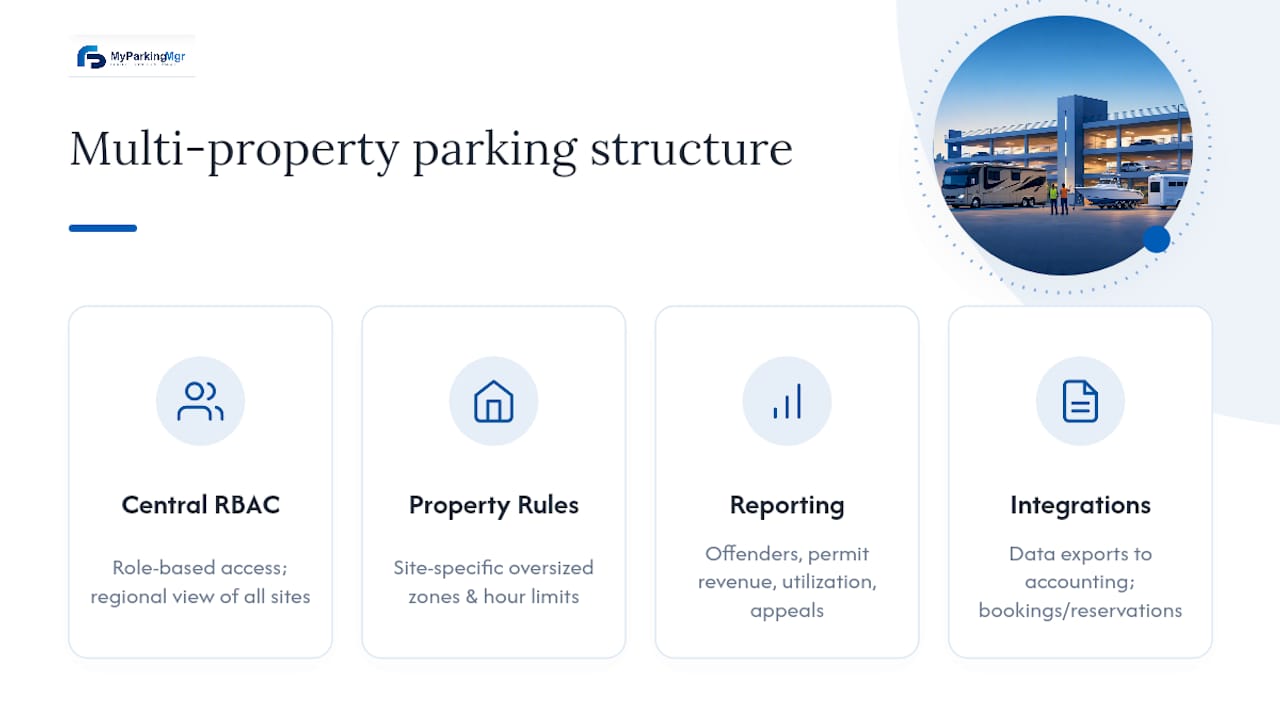
Central reporting should surface repeat offenders across properties, permit revenue by site, space utilization for oversized zones, and appeals pending review anywhere in the portfolio. Multi-property parking management tools built for this handle the data exports that feed accounting systems directly, which matters more than it sounds once you're reconciling permit fees across a dozen locations. Reserved-space booking systems, like the hourly reservation model Park Sopot Centrum ProPark runs for its lots, show how sensor-driven occupancy data can extend to reservation and booking workflows on top of permit enforcement.
Why Unified Systems Cut Disputes and Costs
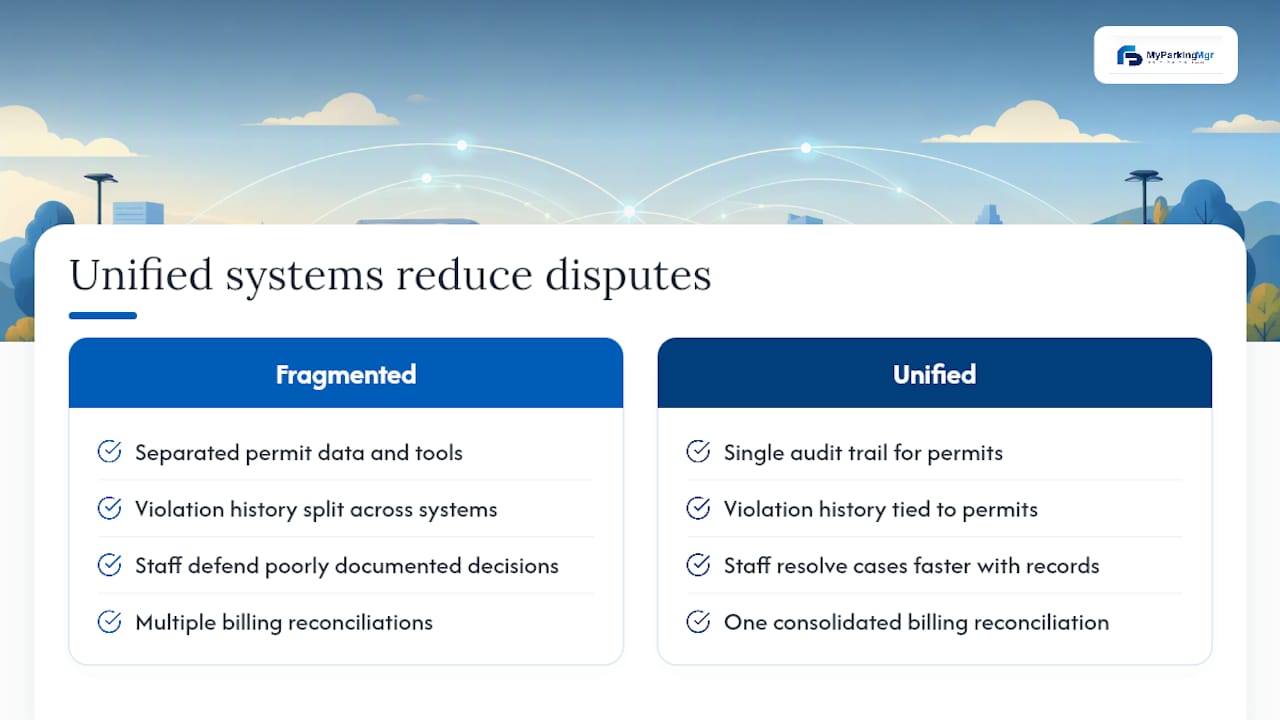
Fragmented systems create fragmented liability. When permit data, violation history, and towing authorization live in three different tools, every dispute becomes a scavenger hunt, and staff end up defending decisions they can't fully document. A single audit trail changes that math: fewer appeals succeed on procedural grounds, resolution takes less staff time, and billing consolidates into one reconciliation instead of three.
,, and all point toward the same operational logic that procurement documents from campuses and municipalities have already worked out independently.
— MyParkingMgr
Get Your Oversized Vehicle Program Running Without the Guesswork
MyParkingMgr is built around the exact checklist covered above, not a simplified version of it. Permit lifecycle management, ALPR integrations, a human-review enforcement queue, and a single searchable audit trail linking permits, vehicles, violations, payments, and towing all live in one platform instead of three disconnected tools.
Deployment flexibility matters too: MyParkingMgr supports hosted SaaS, client-hosted installs, or white-label options, so a hotel chain, an HOA, and a multi-property parking operator can each configure it around their own rules without rebuilding the system from scratch. Running a pilot on your oversized-vehicle zones before a full rollout is a recommended way to confirm the exception path holds up on your own property. Visit MyParkingMgr to see how the features map to your current permit process, or check the full feature list to compare against what you're running now.
Sources
- UNLV parking management procurement/spec (iParq)
- Cal State L.A. ALPR policy
- University of Arkansas parking-system RFP
- University of Nebraska–Lincoln LPR use and privacy policy
FAQ
What Should an Oversized Vehicle Permit Record Include?
At minimum, it needs vehicle class and dimensions, an assigned zone or space, effective start and end dates, a linked account holder, and a unique permit ID or barcode. UNLV's procurement specification treats this structure as the standard for defensible enforcement.
Can an ALPR Camera Trigger a Tow Automatically?
No, not safely. Cal State L.A.'s ALPR policy recommends routing every flagged plate through human review first, since misreads, expired-but-renewed permits, and unregistered guest vehicles are common enough to make automatic towing a legal risk.
How Do Two-Way APIs Improve Oversized Vehicle Enforcement?
A two-way API means permit status changes sensor behavior in real time, and sensor events update the permit record just as fast, instead of syncing overnight. University of Arkansas's parking-system RFP specifies exactly this kind of synchronized integration for occupancy accuracy.
Does MyParkingMgr Support Multi-Property Oversized Vehicle Rules?
Yes. MyParkingMgr lets each property keep its own zone mapping and permit rules while giving portfolio managers centralized, role-based reporting across every site. Pricing details can be found on the MyParkingMgr site, and onboarding is free to get started.
What Should Happen Before Towing an Oversized Vehicle?
Towing should only follow a verified violation, with an image, timestamp, location, reviewer ID, and the stored permit record documented. Signage and internal authorization logs also matter for compliance with rules like Florida's private-property towing statute.