
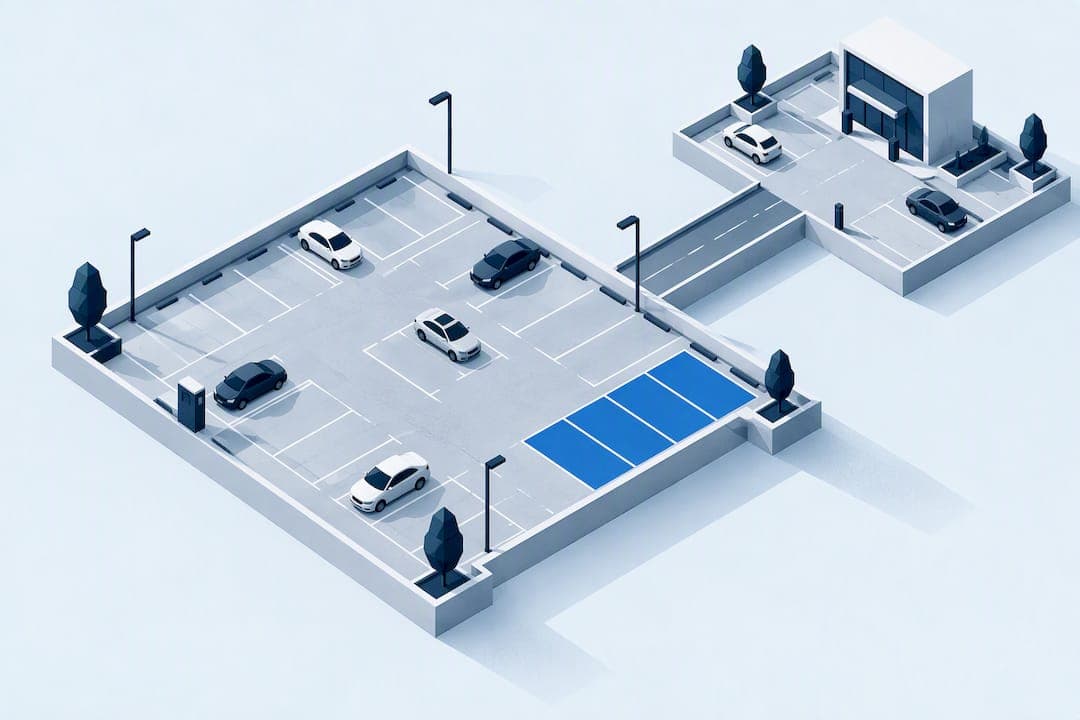
Parking capacity planning is an operational process, not a one-time design exercise: inventory every stall, set occupancy targets, allocate permits and guest access against those targets, enforce consistently, and monitor the results. The Accredited Parking Organization standard from IPMI and the widely used 85% occupancy benchmark both point the same way: capacity planning works best when it runs through a single software platform, which is a recommended approach for integrated parking management platforms.
TL;DR:
- Keep peak occupancy near 85%; levels above it for over three hours on multiple days should trigger pricing, time limits, or stronger enforcement.
- Multifamily properties commonly reserve 10% to 20% of stalls for guests, with time limits of 24 to 72 hours; adjust allocation to visitor patterns.
- Track individual stalls for turnover and lots or blocks for occupancy trends; operators may need both levels, depending on the question they need answered.
- Allow 24 to 48 hours after a warning with a photo and timestamp; cite continued violations, and reserve towing for documented noncompliance.
- Require API links among leasing, permits, enforcement, and payments, then pilot one property for a full billing cycle before expanding across the portfolio.
Table of Contents
- Inventorying Parking Resources and Choosing a Tracking Resolution
- Occupancy vs. Turnover: Setting Targets Including the 85% Rule
- Designing Permit and Guest-Access Policies That Scale
- Enforcement Workflows and Escalation Policies
- Integration and Technical Requirements for Enforcement Tools
- KPIs and Monitoring Cadence for Capacity Planning
- Implementation Checklist: Pilot to Portfolio-Wide Rollout
- What Procurement Teams Get Wrong About Parking Software
- Where MyParkingMgr Fits Into Your Capacity Plan
- FAQ
- Sources
Inventorying Parking Resources and Choosing a Tracking Resolution
Start by walking every lot and structure with a tablet or a simple spreadsheet, recording stall type, assignment status, and any special designation. The Oregon TGM parking jumpstart guide notes that tablets and spreadsheets speed up this process considerably compared with paper counts, and sample templates are available from state transportation offices.
The right resolution depends on what question you're answering. If you need turnover data, you have to track stall by stall.
Capture these fields at minimum:
- Stall ID and location (building, row, or block)
- Assignment type: reserved, pooled, guest, vendor, or accessible
- Vehicle attributes: EV charging need, accessible placard requirement
- Time limit, if any, and the permit or pass tied to the stall
Occupancy vs. Turnover: Setting Targets Including the 85% Rule
Occupancy measures how full a lot is at a given moment. Turnover measures how often a stall changes hands over a day or week.
The 85% occupancy target drawn from parking management practice means keeping one or two stalls open per block or row so drivers aren't circling for a spot. The Portland parking management manual treats sustained occupancy near or above 85% as the trigger point for a policy response, whether that's pricing, time limits, or tighter enforcement.
Translate that into guest and time-limit policy. Multifamily operators typically reserve a portion of inventory for guest parking, commonly enforced with time limits generally ranging from one to three days, according to Parking Professional's multifamily guide.

Designing Permit and Guest-Access Policies That Scale
Permit structure determines how much administrative friction you carry later. Assigned permits tie one vehicle to one stall and work well for low-turnover residential buildings. Pooled or unassigned permits let more residents share fewer stalls when occupancy data shows slack capacity. Lease-time assignment, where the permit expires with the lease, cuts down on stale records.
- Build guest passes as a digital request with a fixed time window, not a paper tag.
- Require every guest pass to log a timestamp, unit number, and license plate for the audit trail.
- Keep vendor permits separate from resident and guest categories so enforcement staff can tell them apart at a glance.
- Price permits to reflect demand. Operators in tight markets often tier pricing by stall type rather than bundling parking into rent.
Administrative overhead for a well-run permit program is mostly staff time and the tracking system itself, and the Oregon TGM guide points to examples where permit pricing is structured to be revenue-neutral or modestly positive once the system is running. Our resident parking permits tools and guest parking management workflows are built around exactly this kind of digital, auditable process.
Enforcement Workflows and Escalation Policies
Enforcement only works when it's predictable. A staged escalation protects both the property and the resident relationship:
- Issue a warning notice when a violation is first logged, with a photo and timestamp attached.
- Give a 24 to 48 hour compliance window before any further action, consistent with practice described in Parking Professional's multifamily guide.
- Escalate to a citation if the vehicle remains out of compliance after the window closes.
- Tow only as a last resort, after documented noncompliance and a paper trail showing the earlier steps occurred.
Staffing costs scale with enforcement frequency and whether you use handheld scanners or manual plate entry; properties running LPR-assisted patrols typically cover more ground per enforcement shift than those relying on manual checks. Transparent, documented enforcement reduces disputes and the legal exposure that comes with contested tows.
Pro Tip: Keep every warning notice and citation timestamped in the same system that issues permits, so a disputed tow can be resolved with one record instead of three.
Integration and Technical Requirements for Enforcement Tools
Fragmented systems create duplicate vehicle records and gaps in reporting. A platform built for multi-property operations should sync data across every tool your staff touches.
- Vehicle records need API-based sync between leasing, permit issuance, and enforcement so a plate entered once appears everywhere.
- License plate recognition cameras and handheld scanners need to write violations into the same record the permit lives in, not a separate log.
- Payment processing for permit sales and fine collection should post directly to the resident or unit account.
- Role-based audit trails let you see who issued a permit, who logged a violation, and when, which matters if a tow or fine is ever challenged.
Our parking violation management tools are built around this kind of synchronized record, so enforcement staff and leasing staff are always looking at the same data.
KPIs and Monitoring Cadence for Capacity Planning
A short, consistent KPI set tells you more than a long one nobody checks. Track peak occupancy, turnover rate, guest-space utilization, violation rate, permit wait-list length, and parking revenue.
| KPI | Cadence | Action trigger |
|---|---|---|
| Peak occupancy | Daily | Sustained above 85% for 3+ hours, multiple days |
| Turnover rate | Weekly | Sharp drop signals assigned-stall hoarding |
| Guest-space utilization | Weekly | Consistently full means raise guest allocation |
| Violation rate | Weekly | Rising trend means review enforcement staffing |
| Permit wait-list length | Monthly | Growing list signals inventory or reassignment need |
| Parking revenue | Monthly | Compare against permit pricing tiers |
Daily dashboards catch occupancy spikes before they become complaints. Weekly checks catch enforcement drift. Monthly reviews are where you decide whether to adjust guest allocation, time limits, or pricing tiers.
Implementation Checklist: Pilot to Portfolio-Wide Rollout
Moving from spreadsheet chaos to a live system works best in stages, not an all-at-once switch.
- Complete a baseline inventory and brief stakeholders on the current occupancy and turnover picture.
- Map the integration plan: which systems need to talk to the new platform and who owns that work.
- Select one pilot property, ideally one with clear occupancy or enforcement pain points.
- Launch permit issuance and guest-access workflows at the pilot site, with resident communications sent ahead of go-live.
- Run enforcement under the new system for at least one full billing cycle before expanding.
- Set a KPI review schedule, build a resident feedback loop, and document policy changes as they happen.
- Expand to the rest of the portfolio once the pilot's KPIs stabilize.
What Procurement Teams Get Wrong About Parking Software
The most common mistake we see is under-specifying integration requirements in an RFP, which leaves leasing, enforcement, and reporting running on three disconnected tools months after go-live. The second is skipping enforcement workflow design entirely, as if permits and towing will sort themselves out. The third is deploying portfolio-wide without a pilot, which turns every configuration mistake into a multi-property problem at once.
A unified record system, where permits, guest access, violations, and payments live in one place, avoids most of this. Require API support, multi-property reporting, and a staged pilot in any vendor evaluation, whether or not you end up working with us.
Where MyParkingMgr Fits Into Your Capacity Plan
Once your inventory, targets, and policies are set, the work of running them day to day is what determines whether the plan holds up. A platform that keeps permits, guest access, violations, and payments in one unified record, tied to historical vehicle data, helps staff avoid reconciling separate systems to answer occupancy questions.
Capabilities built directly around the operational process covered above may include multi-property reporting that rolls occupancy, violations, and revenue up across a portfolio; unified permit, guest, and violation records tied to vehicle history; flexible deployment options; and role-based audit trails for permits and violations.
Free onboarding options may be available to assist with inventory and policy configuration. Property operators managing grounds and amenities alongside parking sometimes work with specialists like Water Landscapes for waterfront and pond maintenance on the same properties.
See the full platform on our parking management software page, review feature details on our features page, or request a proposal to start a staged pilot at one property.
FAQ
What is the 85% occupancy rule in parking management?
The 85% rule sets a target where lots stay about 85% full at peak, leaving one or two open stalls per block so drivers find parking without excessive searching. It comes from parking management practice described in the Portland parking management manual, where sustained occupancy near or above that level triggers a policy response.
How much parking should be reserved for guests?
Multifamily properties commonly reserve 10 to 20% of total inventory for guest parking, often paired with time limits between 24 and 72 hours, according to Parking Professional's multifamily guide. The right figure within that range depends on visitor patterns and how much assigned inventory sits unused.
Should I track parking stall by stall or by lot?
Track stall by stall when you need turnover data, and track by lot or block when occupancy trends are the main question, per guidance from the Oregon TGM jumpstart guide. Most multi-property operators end up using both resolutions depending on the report they're building.
How long should a warning notice window be before towing?
A compliance window of about one to two days after a warning notice is common practice before escalating to citation or tow, as described in industry guidance on multifamily enforcement. Towing is treated as a last resort after documented, repeated noncompliance.
What features should parking management software include?
Look for unified permit, guest, and violation records, multi-property reporting, API-based integration to avoid duplicate vehicle entries, and role-based audit trails. Some parking management platforms cover these features within configurable systems across various deployment models.
Sources
- Multifamily Residential Parking: Tenant Management, Guest Access, and Revenue Models | Parking Professional
- Parking Management Jumpstart Guide (Oregon TGM)
- Portland parking management manual
- Accredited Parking Organization (APO) - IPMI