
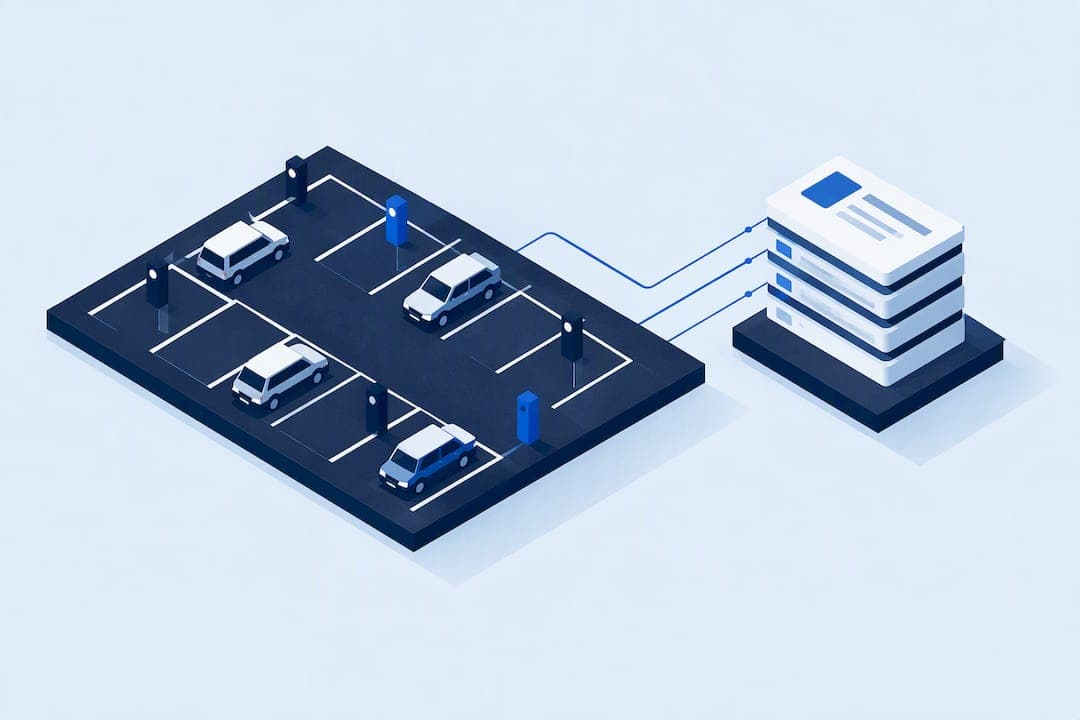
Parking space numbering, in a modern management platform, is the canonical digital ID that ties a physical stall to a permit, a vehicle, an enforcement record, and a billing line. Get this wrong and every downstream process (guest access, fines, towing, reporting) inherits the mess. The fix isn't a new sign. It's a unified registry, and modern management platforms build entire enforcement and billing workflows around exactly that structure.
TL;DR:
- A unified digital record for parking spaces ensures consistent referencing across permits, enforcement, and billing, reducing errors and revenue loss.
- The space registry should include a canonical ID, location details, EV readiness, reserved status, and a timestamped change log to support accurate enforcement and dispute resolution.
- Using zone-based or alphanumeric schemes helps scale across multiple properties, while decoupling physical signs from digital IDs prevents re-mapping during renovations or rebranding.
- Robust enforcement relies on attaching violations, evidence, and notices to specific space IDs, which is critical for legitimate fine collection and resident dispute handling.
- Phased implementation, starting with lot surveys, building a registry, and piloting enforcement, minimizes disruption and ensures data accuracy before full portfolio deployment.
Table of Contents
- What Digital Parking Space Numbering Actually Means
- What Core Components Does a Numbering System Need?
- Best Practices for Designing a Numbering Schema
- How Do You Map an Existing Lot Into Software?
- Enforcement and Monetization: The Numbering Lifecycle
- Planning for EV Charging and Multi-Property Growth
- MyParkingMgr's Approach to Unified Space Records
- How to Pilot MyParkingMgr on Your Property
- Sources
- FAQ
What Digital Parking Space Numbering Actually Means
Physical signage tells a driver where to park. Digital parking space numbering does something different: it gives that same stall a permanent record inside your software so every system, permit, plate, ticket, and payment, can reference it consistently.
This distinction matters because most parking problems aren't about paint. They're about data that doesn't connect. A resident's registered vehicle doesn't match the enforcement officer's scan. A guest pass expires but nobody flags the stall as open again. A vendor uses a reserved space and there's no record of who approved it.
Parking is frequently treated as an afterthought rather than a managed asset, and that undervaluation shows up directly in lost revenue and lower tenant satisfaction, according to IREM's guidance on parking management. Digital numbering is what turns a parking lot from a liability into something you can actually report on.
What breaks without it:
- Unregistered guests occupying spaces with no record of who authorized them
- Duplicate permits issued for the same stall because there's no single source of truth
- Enforcement staff unsure whether they have authority to ticket or tow a given space
- No clean audit trail when a resident disputes a fine
Successful rollouts depend on what IREM calls "connective" efficiency, meaning software that links tenant communication, lease records, and on-site enforcement into one workflow instead of three disconnected ones, per IREM's Front Lines transcript. Numbering is the connective tissue that makes that link possible.
What Core Components Does a Numbering System Need?
A numbering scheme is only as useful as the data structure sitting behind it. Before you evaluate any platform, check that it actually contains these five pieces.
- Space registry: a canonical ID per stall, plus metadata like level, row, dimensions, and whether it is EV-ready
- Permit and vehicle mapping: templates for resident, vendor, and guest permits, each with its own expiration logic
- Enforcement workflows: evidence capture, an appeals path, and clear tow trigger rules
- Payment and fine integration: a direct link from violation to invoice to accounting export
- Audit logs and role-based access: a record of who changed what, and limits on who can change it
Pro Tip: If a platform can't export a clean audit log on demand, don't buy it. Disputed fines without a timestamped trail are the fastest way to lose in small-claims court or in front of an HOA board.
APTA's recommended practice on identity and access management specifically calls for robust authentication and authorization when systems handle access and identity data, a standard worth holding your parking platform to, not just your building's door locks, per APTA SS-ECS-RP-005-25. Role-based access isn't a nice extra here. It's the difference between an enforcement officer who can issue a citation and a leasing agent who can only view occupancy.
Best Practices for Designing a Numbering Schema
Get the schema right once, and you stop fighting your own data for years. Get it wrong, and every new building, every renovation, and every EV retrofit forces a re-map you didn't budget for.
- Build a stable canonical ID with a property prefix. Something like
PHL-L2-047tells you the property, the level, and the stall without ambiguity, and it survives a repaint or a renumbering of the physical signs. - Decouple the canonical ID from the visible sign. The number painted on the curb can change for aesthetic or wayfinding reasons; the digital ID behind it should not, or every record tied to that stall breaks.
- Record attributes, not just location. EV capability, reserved-space type, size class, and access notes belong in the record, not in someone's memory or a spreadsheet footnote.
- Keep a versioned change log. Every edit to a space record should be timestamped and attributable, which is what makes an appeal defensible months later.
- Run automated duplicate and orphan checks. A stall with two active permits, or a permit pointing to a stall that no longer exists, should throw a flag before it becomes a billing dispute.
Sequential numbering (1, 2, 3...) works fine for a single small lot. Zone-based schemes (A1 through A40, B1 through B40) scale better across garages with multiple levels. Alphanumeric prefixes tied to the property itself are what make portfolio-wide reporting possible once you're managing more than one site.
How Do You Map an Existing Lot Into Software?
Rolling out a digital numbering system doesn't mean shutting down a lot for a week; instead, consider using a parking na godziny system to manage reservations and space allocation efficiently. It means sequencing the work so bad data never reaches production.
- Survey and baseline. Walk the property, collect existing labels, pull current permit lists, and note peak-usage patterns before you touch a database.
- Build the canonical registry. Use a structured CSV template with required fields (ID, level, zone, dimensions, EV status) so every space enters the system the same way.
- Assign business rules. Define permit types, guest policies, EV reservation windows, and vendor access rules before you go live, not after the first dispute.
- Integrate enforcement tools and pilot. Connect your evidence capture and appeals workflow, then run a limited pilot to test both.
- Train staff and reconcile. Compare pilot data against the physical lot, fix mismatches, then scale to additional properties on a fixed audit schedule.
Phased rollouts, one lot first, then a pilot, then a full-portfolio scale, consistently produce cleaner data at go-live and less disruption for residents, a pattern IREM's own parking guidance backs up directly (see the IREM parking management course). What you're checking for in the pilot:
- Do enforcement photos attach correctly to the right space ID?
- Does an appeal actually pull the full audit trail, or just a partial one?
- Does the payment step reconcile automatically with your accounting export?
Enforcement and Monetization: The Numbering Lifecycle
Every violation follows the same shape once space numbers are canonical: detection, evidence, notice, then payment or tow. Miss the space ID at any step and the whole chain becomes unenforceable.
Detection happens manually or through license-plate recognition cameras. Either way, the event needs to attach to a specific space ID, not a vague lot description. Evidence, usually a photo plus a timestamp, gets logged against that same ID. The notice references the exact record, and payment or towing closes the loop with an accounting entry.

Appeals live or die on the audit trail. A resident disputing a fine needs to see the same timestamped record your enforcement staff used, and if that trail is incomplete, you lose the dispute by default.
Numbering also drives the revenue side directly:
- Permit tiers (resident, reserved, premium) priced differently against the same space inventory
- Guest passes sold or comped against a specific stall for a specific window
- Event pricing for temporary high-demand periods
- Fines that flow straight into your accounting export instead of a separate manual ledger
Rotating or shared spaces (a vendor space that's open to guests on weekends, for instance) need a temporary-hold status rather than a permanent reassignment, so the canonical ID never actually changes hands.
Planning for EV Charging and Multi-Property Growth
The mistake most operators make is numbering for the lot they have today, not the lot they'll have in three years. EV retrofits are the clearest example: case work on ultra-fast charging rollouts shows that demand for those spaces changes fast enough to force expensive rework when the numbering scheme wasn't built to flex, according to IREM's case study on EV charging.
A few integration choices head that off before it happens:
- Connect the registry to access control and LPR camera feeds so occupancy reconciles automatically instead of through manual walk-throughs
- Tag EV-ready spaces with charger type and reservation windows now, even if only a handful of spaces need it today
- Use a multi-property identifier structure from day one if you manage more than one site, so portfolio dashboards work without a re-map later
- Choose platforms with open APIs and configurable exports, which is what lets you plug in accounting and lease-management systems without a rebuild (multi-property reporting tools depend entirely on this)
AI-assisted workflows are increasingly showing up in property platforms to speed up triage on maintenance and accounting tasks, and that same automation logic is starting to apply to parking enforcement queues, per IREM's bonus episode on AI in real estate.
MyParkingMgr's Approach to Unified Space Records
MyParkingMgr was built around the idea that fragmented tools are the real problem, not the lack of another app. Its platform puts guest access, permits, violations, and payments on a single interface tied to the same canonical space record, deployable as hosted SaaS, client-hosted, or white-label depending on how a property or portfolio wants to run it. Audit capabilities and customizable workflows sit underneath that same registry, giving property teams financial oversight without stitching together three separate systems.
— MyParkingMgr
How to Pilot MyParkingMgr on Your Property
Some solutions offer an alternative to managing parking with spreadsheets, paper permits, and separate towing services by enabling phased rollouts starting with one lot or building, mapping spaces into a canonical registry, and then scaling after initial enforcement and billing testing.
Before you commit to a pilot, ask any platform, including this one, to show you four things in a live demo: how it imports your existing space and permit data, what enforcement integrations it supports (LPR, cameras, gate hardware), how deep its audit trail actually goes, and which deployment model, hosted, client-hosted, or white-label, fits your property. The features page walks through each of these in detail, and onboarding is free, so testing the fit doesn't require a budget line before you've seen it work.
If you run a multi-property portfolio, the multi-property management page is worth a look before you scale past your first site. Start with the MyParkingMgr homepage to request a demo and see how your own lot maps into a working registry.
Sources
Two references worth bookmarking: IREM's parking management guidance on treating parking as an operational asset, and APTA SS-ECS-RP-005-25 on identity and access management practices.
FAQ
What Is Parking Space Numbering in a Management Platform?
It's a canonical digital ID assigned to each stall that links directly to permits, vehicle records, enforcement events, and billing. Physical signage can change without breaking this record, since the ID lives in the software, not on the curb.
How Is Digital Numbering Different From Painted Space Numbers?
Painted numbers are wayfinding for drivers; digital numbering is a database record for your systems. A platform like MyParkingMgr keeps the two decoupled, so repainting a lot never requires rebuilding permit or enforcement history.
What Fields Should a Space Registry Include?
At minimum: a canonical ID, level and zone location, dimensions, EV-readiness, reserved-space type, and current status (active, out of service, or reserved). Skipping the status field is one of the most common causes of enforcement conflicts.
Can Numbering Handle Shared or Rotating Spaces?
Yes, through temporary-hold statuses rather than permanent reassignment, so the canonical ID stays fixed while usage rotates between a vendor, a guest, or a resident. This keeps the audit trail intact even when who's parked there changes weekly.
What Does MyParkingMgr Cost to Try?
Onboarding is free, and current pricing for the platform itself is available directly on the MyParkingMgr site. Deployment options include hosted SaaS, client-hosted, and white-label, so cost depends on which model fits your property or portfolio.