

Temporary parking permits are short-term, time-bound credentials that property managers issue to guests, vendors, or event visitors, distinct from resident or monthly parking programs. The safest operational approach in 2026 is a digital permit tied to the vehicle's license plate, with automatic expiration and a full audit trail. If you're still running paper passes or a spreadsheet, the next move is a pilot rollout on one property before you standardize across a portfolio.
TL;DR:
- Digital license plate permits are safest for gated properties with LPR cameras, while printed decals remain necessary for open lots without camera coverage.
- Permit issuance must include automated expiration, notifications, and an audit trail to prevent disputes and ensure compliance.
- Restrictions on permit duration, location, and quantity are vital to prevent overuse, enforce space limits, and avoid unauthorized access.
- A unified platform linking permit, violation, and enforcement data across multiple properties reduces manual errors and improves auditability.
- Ensure vendor PMS integration is verified with references and support for parallel testing to avoid post-installation dissatisfaction.
Table of Contents
- What Temporary Parking Permits Mean for Properties
- When Temporary Permits Fit, and How They Interact With Resident Programs
- How to Issue, Track, and Expire Temporary Permits
- Enforcement, Violations, and Towing Without the Disputes
- Implementation Checklist and Rollout Timing
- Eligibility Criteria and How to Apply for a Temporary Permit
- Common Restrictions on Temporary Parking Permits
- What Temporary Parking Permits Cost
- Vendor Perspective: Pitfalls to Avoid Before You Sign
- A Unified Platform for Temporary-Permit Programs
- Sources
- FAQ
What Temporary Parking Permits Mean for Properties
In property management, a temporary parking permit has nothing to do with city-issued street permits for residents parking overnight on public roads. It is a credential your team issues, controls, and expires, tied to a specific vehicle and a specific window of time, whether that window is four hours or two weeks.
Four formats cover almost every scenario a multifamily building, hotel, HOA, or lot operator will encounter:
- Plate-linked digital permits — no physical item at all; the license plate itself becomes the credential, matched against a database at the gate or by a license plate recognition (LPR) camera.
- QR or barcode passes — sent by text or email, scanned at a kiosk, gate, or by an enforcement officer's handheld device.
- Temporary decals or dashboard tickets — physical items for lots without gate hardware or camera coverage.
- Temporary credentials — key fobs or access cards issued for a set number of days, common for contractors working a multi-week job.
Gated properties with LPR cameras get the most value from plate-linked permits since there's nothing to hand out or lose. Open surface lots without camera coverage often still need a printed decal enforcement staff can visually check. Hotels sit in between, frequently pairing a digital permit with PMS integration so a guest's parking charge posts straight to their room folio.
When Temporary Permits Fit, and How They Interact With Resident Programs
Temporary permits exist to cover the gaps a resident or monthly parking program can't. The decision usually comes down to three factors: how long the vehicle needs access, how many permits you're issuing at once, and whether your enforcement setup can actually verify a short-lived credential before it expires.
Common use cases include:
- Guest visits — a resident's overnight or weekend visitor, typically capped by a household quota.
- Contractors and vendors — plumbers, movers, delivery drivers, and maintenance crews needing single-day or multi-day access.
- Events — a clubhouse rental, a hotel conference, or an HOA community gathering with a defined start and end time.
- Overflow and staging — construction staging, seasonal demand spikes, or valet holding areas.
The friction point most operators hit is quota management: if guest permits aren't tracked against household limits, residents start issuing unlimited passes and your visitor lot fills with vehicles that never leave. A multi-property parking platform that ties temporary permits to the same vehicle and household records as resident permits closes that gap automatically, instead of relying on a front desk log nobody checks against the resident roster.
How to Issue, Track, and Expire Temporary Permits
A permit workflow only works if every step, from request to expiration, is documented the same way every time. Here's the sequence that holds up under audit:
- Accept the request. Give residents, front desk staff, or vendors more than one channel: a resident portal, a text or voice line, a front desk terminal, or a dedicated vendor portal for contractors who visit repeatedly.
- Capture the required fields. At minimum, record the license plate, the host or requesting unit, the exact time window, and the reason for the visit. Skipping the plate field is the single most common cause of enforcement disputes later.
- Issue the credential. Match the format to the property: a plate-linked digital permit for gated LPR sites, a QR pass for hotels and mixed-use lots, or a printed decal for uncovered surface lots.
- Connect enforcement rules. LPR cameras, gate controllers, and handheld enforcement apps all need to read the same permit database in real time, not a nightly export. Digital guest permit systems commonly tie plate capture directly to expiry enforcement so a permit that lapses at 11:00 p.m. stops working at 11:00 p.m., not the next morning shift.
- Set automatic expiration and notifications. The permit should deactivate itself without staff intervention, and the host should get a notice before and after expiry.
- Post ledger entries. Any fee, deposit, or charge-back tied to the permit needs to land in the financial ledger the same day it's issued, not batched at month-end.
- Log the audit trail. Who issued the permit, when, from which device, and what evidence (photo, plate scan, signed form) backs it up.
Pro Tip: Build the expiration rule into the permit at the moment of issuance, not as a separate step. A permit that requires a second action to expire will eventually get forgotten, and an "expired" vehicle sitting in your lot for three extra days is the fastest way to trigger a resident complaint.
Enforcement, Violations, and Towing Without the Disputes
Every enforcement action starts with verification, not judgment. Before anyone tags a windshield or calls a tow truck, the system needs to confirm the plate against the permit database, check the expiration timestamp, and, where possible, ping the host to confirm the visit is still active.
From there, a defensible violation workflow needs a few things in place:
- Progressive violation rules — a warning on the first infraction, a fine on the second, towing eligibility only after that, unless the lease or bylaws specify otherwise.
- Photo evidence at every step — timestamped images of the plate, the space, and any signage violated.
- Direct links between violations, payments, and towing — a violation record that doesn't automatically generate the associated fine or towing ticket forces staff to re-enter the same data twice, which is where most reconciliation errors creep in.
- A complete audit trail — issuance record, enforcement action, and payment status all tied to one vehicle history.
Cloud-managed platforms with LPR and PMS folio integration have become standard in newer hotel parking deployments largely because they cut the front-desk friction of manually matching a towed vehicle to a guest account. The same principle applies to a 400-unit apartment portfolio just as much as a 200-room hotel: the fewer manual handoffs between enforcement and billing, the fewer disputes you'll have to adjudicate after the fact.
Implementation Checklist and Rollout Timing
Rolling out a temporary permit program, or replacing an existing one, goes smoother with a defined sequence rather than a flip of the switch on a random Tuesday. Follow this order:
- Define requirements first. Decide which credential types you need (digital, QR, decal), which property-management system you need to integrate with, and what enforcement rules apply at each site.
- Run a pilot. Choose one property or one lot, train the front-line staff who'll issue permits daily, and send residents or guests a short notice explaining the change.
- Operate in parallel. Keep the old process running alongside the new one for a defined window; this catches data mismatches before they become resident complaints. Scheduling the full cutover during a lower-traffic period, rather than a holiday weekend, meaningfully reduces disruption.
- Validate before cutover. Confirm every active resident and vendor record migrated correctly, and that enforcement hardware reads the new permit format.
- Assign ongoing governance. Name one owner responsible for the audit schedule, monthly reporting cadence, and any recurring reconciliation between violations and payments.
For portfolios spanning multiple sites, centralized credential provisioning matters more than any single feature on the vendor's spec sheet, since a permit deactivated at one property needs to disappear from every property at once.
Eligibility Criteria and How to Apply for a Temporary Permit
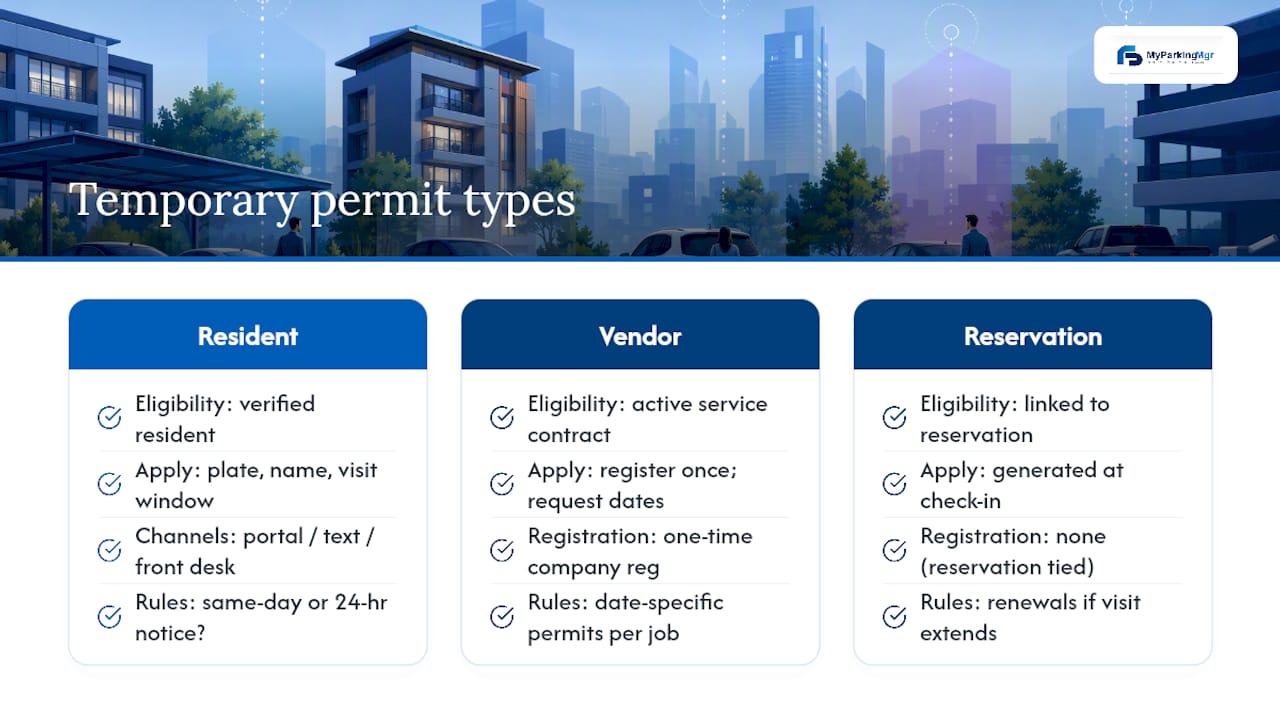
Eligibility for a temporary permit is set by the property, not by any outside authority, which gives operators more flexibility than municipal permitting but also more responsibility for consistency. Most properties tie eligibility to one of three things: the requester is a verified resident or unit holder, the requester is a vendor with an active service contract, or the visit is tied to a booked event or reservation.
The application procedure itself is usually short by design. A resident submits the visitor's plate, name, and visit window through a portal, text line, or front desk request. A vendor typically registers once with the property, then requests individual date-specific permits as jobs come up, rather than re-submitting company information every time. Hotels often skip a separate application entirely, generating the permit automatically at check-in and linking it to the reservation.
The details that trip up applicants most often are the ones properties don't advertise clearly: whether a permit can be requested same-day or needs 24-hour notice, whether there's a cap on how many guest permits one unit can request per month, and whether a permit needs renewal if the visit runs longer than planned. Spelling these out in the resident handbook or vendor onboarding packet, rather than leaving staff to explain them case by case, cuts down on the phone calls asking why a permit didn't work at the gate.
Common Restrictions on Temporary Parking Permits
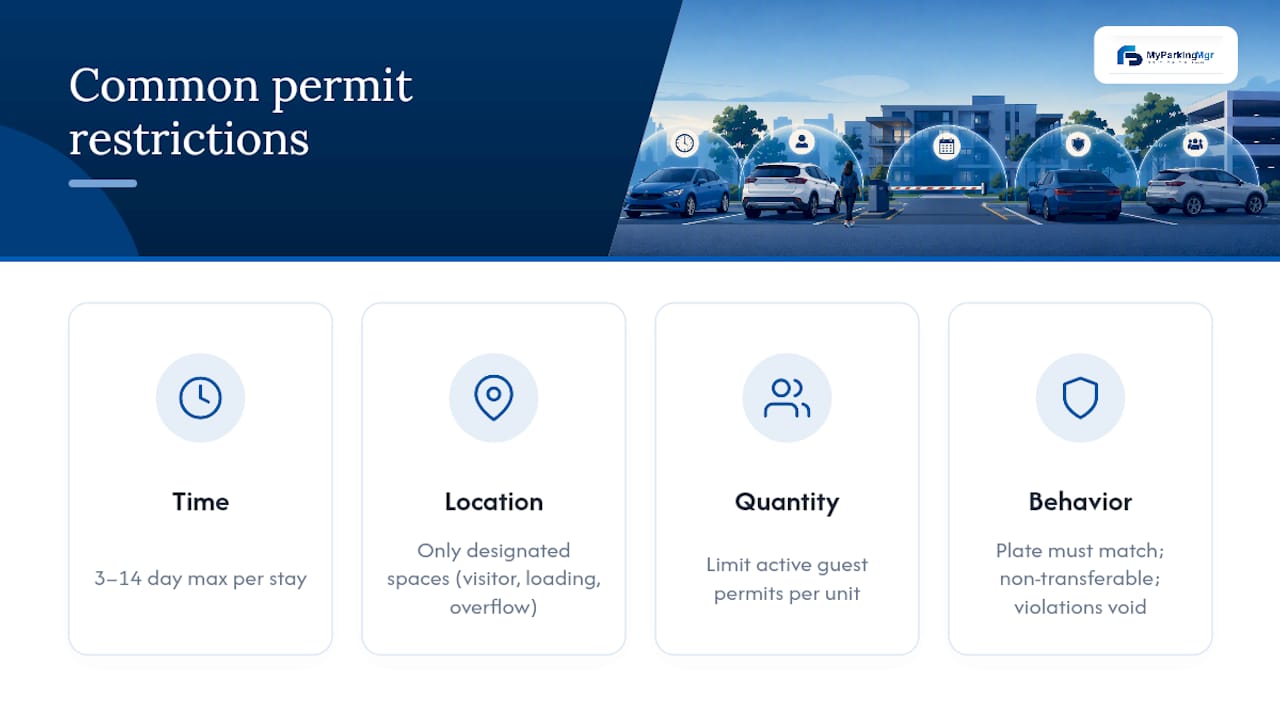
Every temporary permit comes with conditions attached, and the restrictions exist to protect the exact resource the permit grants access to: a limited number of parking spaces.
Time-based restrictions are the most universal. A permit is valid from a specific start time to a specific end time, and most systems reject renewal requests that would extend a guest stay past a property's defined maximum, often somewhere between three and fourteen days depending on the lease terms.
Location restrictions come next. A temporary permit rarely grants access to every space on a property. Guest permits typically restrict the vehicle to designated visitor spaces, contractor permits might restrict access to a loading zone or service entrance, and event permits often route attendees to an overflow lot rather than the main resident lot.
Quantity restrictions matter just as much, particularly for guest permits. Properties commonly cap the number of active guest permits per unit at any one time, both to prevent one resident from monopolizing visitor parking and to keep the visitor count aligned with the actual number of visitor spaces available.
Finally, most properties attach a behavioral condition: the vehicle must be registered to the plate on file, the permit is non-transferable, and violation of any lease or bylaw term (unauthorized subletting of a parking space, for instance) can void the permit immediately regardless of the time remaining on it.
What Temporary Parking Permits Cost
Fees for temporary parking permits vary widely because the cost structure reflects the property's own policy decisions, not any regulated rate. Some properties issue a set number of guest permits free each month as part of the lease, then charge a flat daily fee, often in the range of a few dollars to $15 to $25 per day, once a resident exceeds that allotment.
Vendor and contractor permits are frequently billed differently, sometimes as a flat administrative fee per permit and sometimes rolled into the vendor's service contract rather than charged per visit. Event permits tend to be priced per vehicle or as a bulk block rate negotiated ahead of the event date.
The costs that catch operators off guard aren't the permit fees themselves, they're the downstream charges: a towing fee for an expired permit, a late fee for an overstayed guest vehicle, or an administrative charge for a lost physical decal that needs replacing. Building these charges into the same ledger that tracks the permit issuance, rather than handling them through a separate invoice process, is what keeps monthly financial reconciliation from turning into a manual reconstruction project every time an owner or board asks for a report.
Vendor Perspective: Pitfalls to Avoid Before You Sign
The biggest mistake we see in permit-system procurement is treating a vendor's PMS integration claim as a checkbox instead of something to verify. PMS integration failures are the leading source of post-installation dissatisfaction, so ask for references from properties running the exact PMS version you use, not a generic case study.
Second, resist mixing credential technologies across a portfolio. Standardized credentials prevent the orphaned-access problem where an old fob still opens a gate months after a tenant moved out.
Third, confirm the platform supports a genuine parallel run. Skipping that step, or understaffing enforcement during cutover, is how properties end up with two weeks of conflicting records nobody can reconcile.
— MyParkingMgr
A Unified Platform for Temporary-Permit Programs
Most of the friction described above traces back to one root problem: permits, enforcement, payments, and towing living in separate tools that don't talk to each other. A unified parking management platform should be built around a single record for every vehicle and every permit across the entire portfolio, so a plate flagged for a violation at one property shows up instantly at every property that vehicle has ever visited.
The platform supports hosted SaaS, client-hosted, or white-label deployment, which matters if your IT policy requires data to stay on your own infrastructure or if you're managing the system under your own brand for owners. Configurable workflows can enable guest, vendor, and event permits to each follow their own rules without forcing every property into an identical template, and a built-in audit trail can provide finance and ownership a reconciliation record without a separate spreadsheet. If your current setup can't answer "who issued this permit and when" in under a minute, it's worth seeing how a unified system handles it. Request a proposal to see how it maps to your properties.
Sources
For deeper detail on the integration and procurement issues covered here, see Parking Tech's guide to multi-facility permit management and Hotel Facility Guide's parking revenue management systems decision guide, both referenced throughout this article.
- Parking Tech — Multi-facility parking management
FAQ
What Is a Temporary Parking Permit in Property Management?
It's a short-term, time-limited parking credential a property issues to a guest, vendor, or event visitor, tied to a specific vehicle and expiration window. It's separate from resident permits and unrelated to city-issued street parking permits.
How Long Do Temporary Parking Permits Usually Last?
Temporary parking permits usually last for a range of durations depending on the property's policy and the reason for the visit, typically from a few hours up to longer periods. Guest permits skew shorter, while contractor permits tied to a multi-week job tend to run the full length of the contract.
Can One Resident Request Unlimited Guest Permits?
No. Most properties cap the number of active guest permits per unit to keep visitor parking available for everyone, and a permit platform can enforce that quota automatically rather than relying on staff to track it manually.
Do Temporary Permits Need to Integrate With a Property Management System?
Integration isn't strictly required, but it's what makes charges, folio posting, and guest validation work without manual data entry. Hotels especially benefit since PMS integration lets a parking charge post directly to the guest's room bill.
What Does MyParkingMgr Charge for Onboarding?
MyParkingMgr offers free onboarding to get properties set up on the platform. Beyond onboarding, current pricing details are available directly on the MyParkingMgr website.