
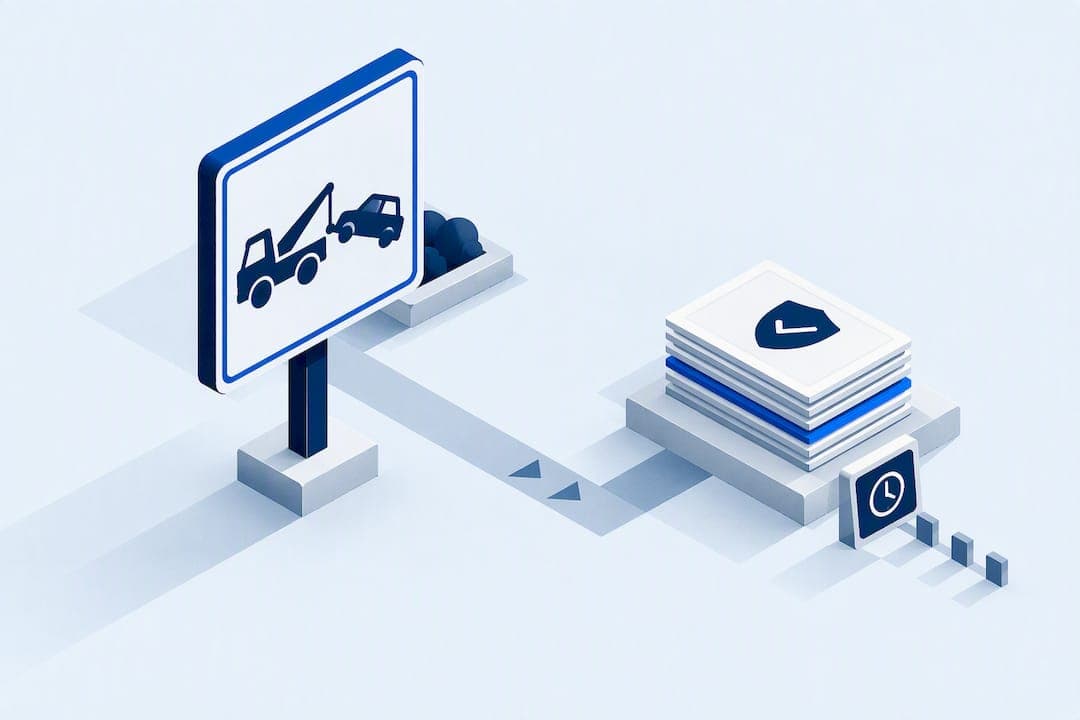
A compliant towing sign typically needs conspicuous placement at every vehicular entrance, minimum dimensions around 18 by 24 inches, clear wording that unauthorized vehicles will be towed at the owner's expense, and a 24-hour contact number for vehicle release. Most states also require a signed authorization from the property owner before a non-consensual tow can happen. Exact dimensions, wording, and posting rules vary by state and city, so treat this as a starting checklist, not a substitute for your local statute.
TL;DR:
- Most jurisdictions require signs at every entrance within about 10 feet of the right-of-way, mounted 3 to 8 feet high, and permanently affixed on sturdy materials.
- Sign dimensions typically must be at least 18 by 24 inches with 4-inch letters for key messages, and weather-resistant aluminum with reflective sheeting is standard.
- Signs must include specific wording such as towing warnings, contact information, storage location, charges, and enforcement hours to be legally valid.
- A signed, timestamped authorization from the property owner or designated agent is necessary for a tow to be enforceable, and records should be systematically stored and audited.
- Signage and recordkeeping requirements vary by state and city, so always verify local laws and ensure proper ADA signage for accessible spaces in addition to tow notices.
Table of Contents
- Where you need to install tow signs for them to hold up legally
- Minimum sign sizes, letter heights, and materials that meet code
- What the sign's wording and data actually need to say
- Written authorization and the records that protect you later
- How towing sign rules differ from state to state
- ADA signage is a separate requirement from tow signs
- A practical checklist for installing and maintaining compliant signs
- Why disciplined signage and recordkeeping actually matter
- How MyParkingMgr keeps your towing records organized
- Where to verify the exact rules for your property
- Sources
- FAQ
Where you need to install tow signs for them to hold up legally
Placement determines whether a tow sign actually does its job. Most jurisdictions require a sign at each vehicular entrance, commonly within about 10 feet of the public right-of-way, so a driver sees it before pulling into a space. When a lot has no defined entrances, such as an open commercial lot, signs typically need to be posted at regular intervals or positioned so they are readable from every stall.
Mounting height matters too. Guidance commonly places the sign centerline between 3 and 8 feet off the ground, with some jurisdictions setting a minimum bottom edge of 3 to 4 feet. Signs should be mounted permanently, on a pole or wall rather than a stake that can shift or fall.
- Post signage at every vehicular entrance, not just the main one.
- Confirm signs are visible from every parking space or spaced per local code.
- Keep signage clear of landscaping, parked vehicles, or debris that blocks the view.
- Photograph installed signs with timestamps as proof of visibility on a given date.
Portland's private property impound towing policy requires signage readable from every parking space or posted at set intervals, and any newly installed or replaced sign must stay up for a minimum period before enforcement can resume.
Minimum sign sizes, letter heights, and materials that meet code
Dimensions and lettering show up in almost every statute, and they differ enough between states that guessing is risky. Texas guidance from the Texas Department of Licensing and Regulation commonly calls for signs at least 18 by 24 inches, with minimum letter heights and sample sign language spelled out for operators to copy directly.
- Common minimum sizes: 18 by 24 inches is the most frequently cited figure; some municipal policies specify 17 by 22 inches or 24 by 18 inches for particular sign types.
- Letter heights: main messages such as "Tow-Away Zone" often require around 4-inch letters, with 1 to 2 inch letters for supporting text.
- Tow symbol: some codes specify a red towing silhouette at a minimum height, an approach seen in Utah's posted requirements.
- Materials: weather-resistant aluminum with reflective sheeting, mounted securely enough to survive wind and repeated handling.
Sign dimensions of at least 18 by 24 inches are a common baseline under Texas tow-away signage guidance, which also specifies minimum letter sizes and sample sign text operators can use as a template.
What the sign's wording and data actually need to say
Beyond size and placement, statutes routinely dictate the specific information a sign must carry. Missing even one required line can undermine an otherwise properly placed sign.
- A clear statement that unauthorized vehicles will be towed at the owner's expense, along with who is authorized to park.
- The name and 24-hour telephone number of the tow company or property contact responsible for vehicle release.
- The storage facility address and redemption hours, when the statute requires disclosure of where a towed vehicle will be held.
- Posted towing and storage charges, plus a phone number for a consumer protection agency where local law mandates it.
- Permit instructions and enforcement hours, if the property enforces permit-only parking.
New Jersey's towing regulations go further than many states, requiring disclosure of purpose, hours, tow company name and phone number, storage charges, and storage location directly on the sign, according to New Jersey's private property towing rules.
Written authorization and the records that protect you later
A sign alone rarely justifies a tow. Most states require a written, time-stamped authorization signed by the property owner or a designated agent at or before the tow, documenting the vehicle's details, the reason for removal, and the time of authorization. Oregon's towing policy is explicit on this point: the tower must possess a signed authorization showing vehicle location, make, model, license plate, reason, signature, and timestamp before hook-up, under the Oregon State Board of Towing's public policy.
Regulators in several states also draw a hard line on who can make the call. Tow companies generally cannot serve as the property owner's agent for identifying or authorizing a tow, since that blurs accountability and can invalidate the removal if challenged.
- Keep signed authorizations on file, tied to a specific vehicle, date, and time.
- Retain time-stamped photos showing both the offending vehicle and the sign's visibility.
- Log tow company hook-up records separately from your own authorization records.
- Export and archive audit trails on a schedule, not only when a dispute arises.
Pro Tip: Store your signed authorization and photo evidence together in one record, not two separate systems, so you can produce a complete file in minutes if a tow is contested.
How towing sign rules differ from state to state
No single national standard governs tow sign content, so the same lot chain operating in five states may need five slightly different signs. A few examples illustrate the range.
- Texas: commonly 18 by 24 inch minimums, specified letter heights, and sample sign language published by TDLR.
- Utah: prescribed two-sign layouts with exact towing-logo dimensions, colors, and a required reference to the state's towing website under UDOT's non-consent towing signage rules.
- Oregon and Portland: signage must be readable from every parking space, paired with signed authorization forms and pre-posting timing requirements.
- California: Vehicle Code 22658 sets a 17 by 22 inch minimum with lettering no smaller than one inch, plus release-information phone numbers.
- New Jersey and Florida: larger signage and added disclosure requirements, including storage location, charges, and consumer contact information.
These are representative excerpts, not a complete legal summary. Always confirm the exact statute or municipal code for the property's location before finalizing signage.
ADA signage is a separate requirement from tow signs
Accessible parking signage follows its own federal standard and does not overlap with towing enforcement signs. Under ADA parking guidance, accessible spaces require the International Symbol of Accessibility, tactile and braille specifications for certain sign types, and defined mounting heights and contrast rules that differ from standard tow signage.
A tow sign, no matter how compliant, does not satisfy ADA obligations for an accessible stall. Both sign types need to be present and properly mounted. Before finalizing a lot's signage plan, confirm accessible spaces carry ADA-compliant signs in addition to, not instead of, towing notices.

A practical checklist for installing and maintaining compliant signs
Compliance is not a one-time install. It is an ongoing routine that protects you when a tow gets challenged.
- Before towing: confirm signage meets local code, photograph the sign and the vehicle with timestamps, and obtain a signed authorization at the time of the tow.
- Ongoing maintenance: schedule inspections for fading, bending, or obstructions, keep spare compliant signs on hand, and log repairs or replacements.
- Enforcement coordination: require your tow vendor to supply signed hook-up records with timestamps, maintain one exportable audit trail, and consult counsel for unusual or contested removals.
- If a physical constraint prevents meeting a requirement, request a local variance and document the approval before enforcing any tow.
Pro Tip: Treat a faded or knocked-over sign as a compliance gap, not a maintenance afterthought. A single missing sign can unravel an otherwise valid tow.
Why disciplined signage and recordkeeping actually matter
Signage gets the attention, but a signed, time-stamped authorization is usually what settles a dispute. Property owners who treat inspections and photo documentation as routine, not reactive, end up with a defensible record instead of a scramble after a vehicle owner calls a lawyer. Consistency, more than any single sign dimension, is what limits liability.

How MyParkingMgr keeps your towing records organized
Chasing down a signed authorization form or a photo from three months ago should not take longer than the dispute itself. MyParkingMgr centralizes signed authorizations and time-stamped photo evidence alongside the rest of your parking records, so a challenged tow has a complete file attached to it rather than scattered emails and phone logs.
- Signed-authorization workflows tied to a specific vehicle, time, and authorizer.
- Time-stamped photo storage linked directly to each tow record.
- Multi-property audit trails you can export on demand.
- Configurable enforcement workflows that match your property's local requirements.
Properties managing towing across multiple sites can see how the vehicle storage context at Island Park Storage provides an external example of signage and storage-location references, or go straight to request a demonstration to walk through signage and authorization tracking with your own portfolio in mind.
Where to verify the exact rules for your property
Check your state statute, municipal code, and the ADA parking standards before finalizing signage.
Sources
- Tow-Away Signage in Parking Facilities - Texas.gov
- Portland
- State Board of Oregon private property impound policy (public policy)
- Private property and non-consensual towing law and public safety - NJ Consumer Affairs
FAQ
Can a car be towed without signage?
In most states, no: a lawful non-consensual tow from private property typically requires conspicuous signage warning drivers before they park. Some jurisdictions allow exceptions, such as a vehicle blocking a fire lane or driveway, but those exceptions are narrow and state-specific.
What is the 80/20 rule in towing?
There is no universal statute defining a specific percentage rule for towing signage, and definitions vary by source. Rather than relying on an informal rule, check your state's towing statute and municipal code for the specific placement and content requirements that apply to your property.
What are the requirements for towing signage in Texas?
Texas guidance from the Texas Department of Licensing and Regulation commonly calls for signs at least 18 by 24 inches, specific minimum letter heights, weather-resistant materials, and sample sign language that property owners can use directly.
What are the towing laws in New York State?
New York does not appear among the state statutes detailed in this research, and requirements can vary by municipality within the state. Property owners in New York should confirm signage and authorization rules with their local municipal code before enforcing any private property tow.
Do accessible parking spaces need towing signs too?
Accessible parking spaces need their own ADA-compliant signage in addition to standard towing notices, since the two serve different legal purposes. Review ADA parking requirements separately from your towing signage plan to confirm both are properly installed.