
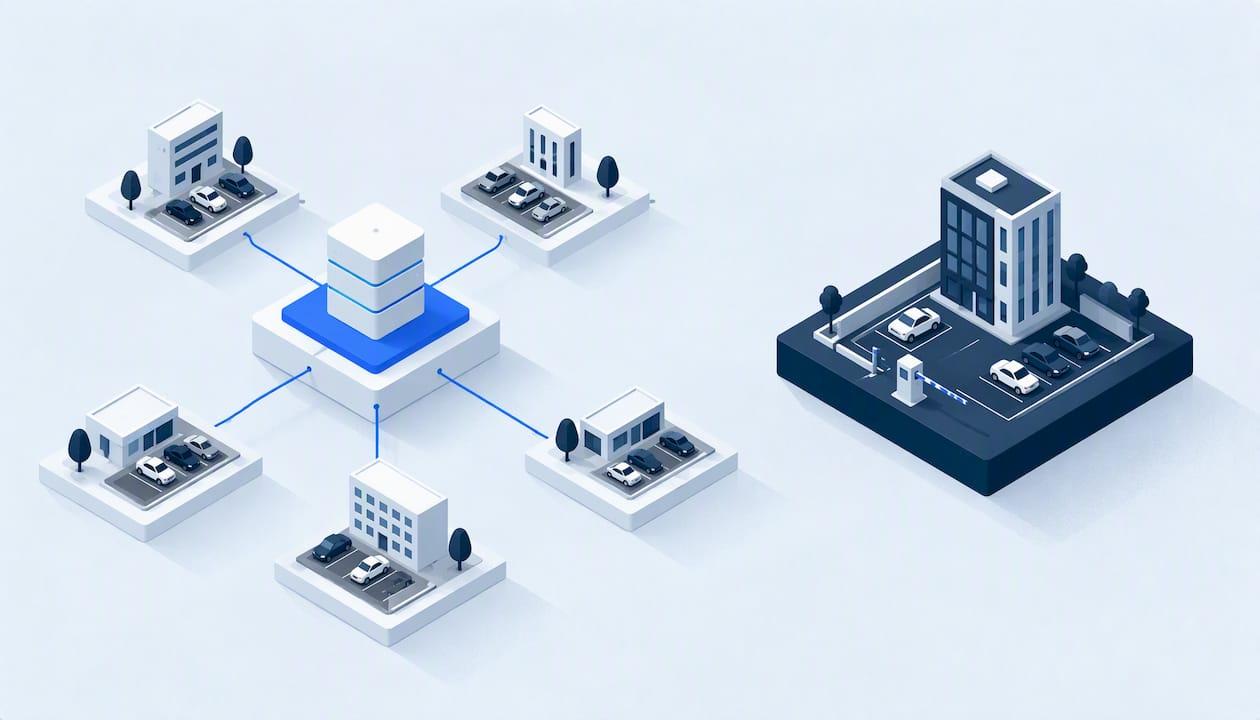
For most property managers, white label is the better starting point. It launches in weeks, costs far less up front, and gives residents and guests a branded experience. Custom makes sense when your parking data and workflows are themselves a strategic asset, and you can fund a build and its maintenance for years. The real question is not "which technology?" but "do we want to rent a proven platform or own the code?"
This guide is for people who run parking, not people who write software: multifamily and HOA managers, hotel operators, and multi-property portfolio owners. It covers cost, timing, data isolation, security duties and a decision checklist. It also covers a third path that gets lost in the white label vs. custom debate.
TL;DR
- White label means a vendor's finished platform under your name. Industry guides put a standard rebrand at roughly 4 to 8 weeks, against 6 months to 2 years for a custom build.
- Custom gives you ownership of the code and roadmap, but you pay for the build, then for upkeep, estimated at 15 to 20% of the initial cost per year.
- Theming is not the same as isolation. If properties need separate data for compliance, ask exactly how the vendor separates it before you sign.
- Security duties stay with you either way. NIST's secure development guidance frames the buyer as an acquirer who must check the vendor's practices.
Table of Contents
- What each option actually means
- Cost: the numbers behind the choice
- Speed and rollout
- Data isolation: where cheap white label breaks
- Security and compliance: you cannot outsource the responsibility
- Which one fits which operator
- The third path: configurable platforms with flexible deployment
- Our perspective
- What to look for in any platform
- Where MyParkingMgr fits
- A short vendor checklist
- FAQ
- Sources
What each option actually means
A white label parking app is a platform built by a vendor and licensed to many customers. You apply your logo, colors and name. Residents, guests and vendors see your brand, while the vendor runs the engine underneath: permits, payments, violations, reporting.
A custom parking app is software built for you, by an in-house team or a contractor. You decide every screen and rule. You also own the result, the bugs, the hosting, the app store submissions and the security patches.
A widespread misconception is that white label is just a brandable shell. TeaCode's analysis describes the choice as being a tenant or an owner. A tenant gets running quickly and shares a roadmap with other customers. An owner controls the roadmap and carries the cost.

Cost: the numbers behind the choice
Published ranges vary a lot, so treat them as orders of magnitude, not quotes.
| White label | Custom build | |
|---|---|---|
| Typical initial cost | $5,000 to $75,000 | $50,000 to over $1M |
| Time to launch | 4 to 8 weeks for a standard rebrand | 6 months to 2 years |
| Extra branded instance | Often 1 to 3 weeks once the core platform exists | A new project unless the architecture was built for it |
| Ongoing cost | Recurring license or per-user fees, sometimes revenue share | Maintenance, hosting, security, app store upkeep |
| Roadmap control | Shared with the vendor's other customers | Yours |
The same TeaCode guide says revenue-sharing models in white label are typically 5 to 10% of revenue, and that fees of this kind can pass custom maintenance costs as a portfolio grows. It puts the break-even point between 18 and 24 months, depending on scale. That is a guideline from a vendor-side source, not a law. For a 12-building portfolio collecting modest guest and permit fees, break-even may never come.
A worked example
Say you manage 40 communities. A custom build at the low end of the range is $50,000. Add maintenance at 15% and you spend $7,500 a year just keeping it alive. That excludes the developer time to add features, handle store review rejections and respond to a vulnerability report. A white label license costs you a recurring fee, but that fee includes the people doing the work. The question is whether your portfolio is big and stable enough that owning beats renting. For most operators it is not, at least not at the start.
The costs people forget
Both models carry app store overhead. Apple's developer program is 99 USD per membership year, and Google Play has its own developer account. If each community gets its own branded app, each one needs its own listing and bundle ID, plus update compliance. Ask whether the vendor handles this or hands it to you.
Speed and rollout
A white label platform is already tested against real parking problems: a resident registers a vehicle, a guest gets a pass, an enforcement officer scans a plate, a violation is issued and paid. You are configuring, not inventing.

Custom timelines are longer because of what a multi-property environment demands. Bolder Apps points to multi-tenant data isolation, LPR hardware integrations and cross-property reporting dashboards as drivers of complexity. Those are not features you add in a weekend.
Data isolation: where cheap white label breaks
This is the most common failure point. Practitioners cited by Bolder Apps warn that entry-level white labeling is often just theming: new colors and logos on a shared database. That works until one property needs its own secure database so resident data does not mix with another's.
Before you sign with any vendor, ask:
- Is each property's data logically or physically separated?
- Can a role-based user at Property A ever see Property B's vehicles or payments?
- Can I export a single property's full record if we sell it or change vendors?
- Who holds the audit trail, and can I see who changed what and when?
If the answers are vague, the low price is hiding a risk.
Security and compliance: you cannot outsource the responsibility
Choosing a vendor does not move the liability away from you. NIST's Secure Software Development Framework describes practices that software producers should follow, and it is written so that buyers can ask for evidence of them. In practice, that means asking a vendor for:
- A description of its secure development process.
- A software bill of materials (SBOM) on request.
- A clear vulnerability disclosure policy.
- A written split of duties for payment security, incident response and attestations.
Payment and resident records bring in PCI-DSS and state privacy law such as CCPA for California properties. Those duties are shared between you and the provider. Put the split in the contract, and have your counsel or compliance lead review it, particularly if you operate in California or take card payments on site.
The same applies to a custom build, except now you are the producer too, and the whole secure development burden is yours.
Which one fits which operator
White label fits when
- You manage multifamily, HOA, hotel or lot properties and want consistent operations across them quickly.
- You want residents and guests to see your brand, not a generic parking vendor's.
- Your parking rules follow common patterns: guest passes, resident and vendor permits, violations, towing, fines.
- You have no software team and do not want one.
Custom fits when
- Your workflow is genuinely unusual and no configurable platform can model it.
- You want to sell the software itself as a product, or treat your parking data as a core asset.
- You have budget for years of engineering, security and support, not just the first release.
- Vendor lock-in is unacceptable to your board or investors.
The three questions to settle it
- What happens in year three? Who updates the app for new iOS and Android releases, and who pays?
- What can you walk away with? Your data, your branding, your user list, your records.
- How much of this is really different? If 90% of your parking process matches how other properties work, you are paying custom prices for the other 10%.
The third path: configurable platforms with flexible deployment
The white label vs. custom framing leaves out a middle option: a platform that is configurable enough to match your workflows without a code build, and deployable the way your risk team prefers. Pharos Production's guide, for example, says the decision rule is ownership, not price. A flexible platform lets you decide how much ownership you want without paying for a ground-up build.
That is the position we built MyParkingMgr around, and we explain it in the next section.
Our perspective
We talk to property managers who arrive at this question having been burned by one extreme or the other. Some bought a branded shell that fell apart when a second property needed its own rules. Others started a custom project and discovered that parking is not just an app: it is permits, payments, violations, towing, audit history and reporting that all have to agree with each other.
Our view is simple. The thing that matters most is a single record. When a guest pass, a violation, a payment and a tow all attach to the same vehicle history, you can answer disputes in minutes rather than days. Fragmented tools make that nearly impossible, whether they are white label or custom.
The second thing that matters is fit. Workflows differ between a 300-unit apartment community and a hotel with valet overflow, so configuration should come first, and code changes should be the exception. That is why we support hosted SaaS, client-hosted installations and white-label options, rather than forcing one model on everyone.
The third is discipline about what a platform can verifiably do. Ask any vendor, us included, to show a capability working, not just to list it.
— MyParkingMgr
What to look for in any platform
Whether you rent or build, a multi-property parking system needs a few things working together:
- Self-service for guests, residents and vendors: registration, permits and payments without a call to the office. Our visitor parking registration walkthrough shows a five-step process for this.
- Enforcement that syncs: violations issued in the field should land in the same record as permits. See how that works in parking enforcement software.
- Portfolio-level reporting and audit trails: one view across all properties, with role-based access. Our multi-property parking management page covers this.
- Hardware integration: support for the cameras and devices your enforcement team already uses.
- Deployment options: hosted, client-hosted or white label, matched to your IT and compliance needs.
A vendor that cannot connect these pieces through an integrated system leaves you reconciling spreadsheets. That is the hidden cost of both a cheap white label shell and an underbuilt custom tool.
Where MyParkingMgr fits
If you want your brand on the resident and guest experience without building software, our white-label parking platform is designed for that. It sits on the same unified record as the rest of the platform, so guest access, permits, violations, payments and towing stay tied to vehicle history. If your team needs to host the system itself, we support client-hosted installs too.
On-boarding is free ($0, one-off). The best next step is to see how the platform handles your own properties: start on our features page or go to myparkingmgr.com to ask for an assessment.
A short vendor checklist
Use this in any demo, with us or anyone else.
- Show me a guest pass, a violation and a payment on the same vehicle record.
- Show me what a manager at Property A sees versus Property B.
- Show me the audit log for a changed violation.
- Tell me who owns the data, and how I export it.
- Tell me who submits app store updates and who pays for developer accounts.
- Provide your secure development practices and vulnerability disclosure policy.
- Explain exactly what changes if I add ten more properties.
FAQ
What does it mean to white label a parking app?
It means licensing a vendor's finished parking platform and presenting it under your own name, logo and colors. The vendor keeps building and hosting the underlying software. You configure rules and branding, and your users never see the vendor's name.
How much does a white label parking app cost?
Published industry ranges for initial white label costs run from about $5,000 to $75,000, plus recurring fees. Real quotes depend on the number of properties, hardware and data isolation needs. Ask each vendor for a full first-year cost, including app store accounts.
Is custom ever cheaper than white label?
Sometimes, over a long horizon and a large portfolio. One 2026 guide puts the break-even at 18 to 24 months, though it comes from a development firm with its own interests. Run your own numbers with maintenance included.
Do I still have security responsibilities with a white label platform?
Yes. NIST guidance treats the buyer as an acquirer who should verify the producer's secure development practices. Agree in writing who handles incident response and payment compliance, and have counsel review it.
Sources
- White Label App Development vs Custom: TCO Guide 2026, TeaCode
- White-Label App Development in 2026, Bolder Apps
- Secure Software Development Framework (SSDF) Version 1.1, NIST SP 800-218
- Apple Developer Program enrollment, Apple Developer
- White Label Software Development Guide, Pharos Production