
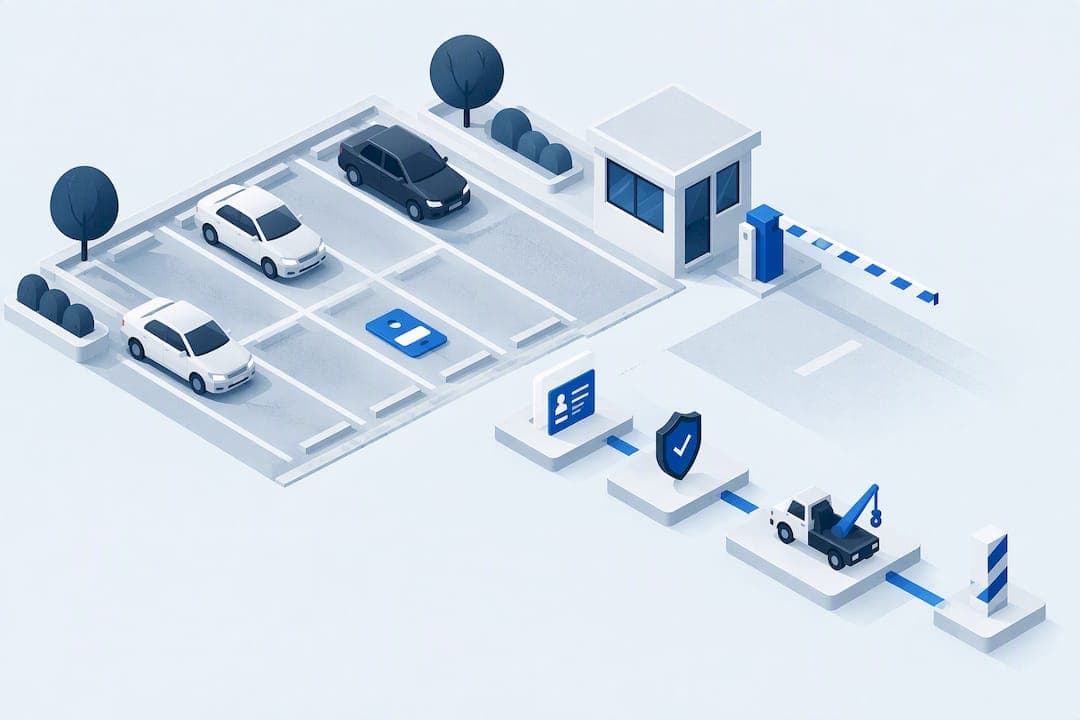
Boards that want to fix parking problems should do several things at once: confirm their enforcement authority in the CC&Rs, publish a clear guest-pass workflow, adopt a documented towing sequence that matches state law, and set up a fast intake process for accommodation requests under the Fair Housing Act. HUD/DOJ guidance and platforms like MyParkingMgr both support pieces of that plan.
TL;DR:
- CC&Rs outrank bylaws, board rules, and operating procedures; changing parking rights usually requires a formal amendment rather than a simple board vote.
- Guest policies should tie each reservation to a unit and set a default stay of 24 to 72 hours with a renewal process.
- Before towing, boards should photograph and timestamp violations, issue written notice, and confirm state requirements; California noncompliance can expose associations to towing and storage costs.
Table of Contents
- How to structure HOA parking rules and where authority comes from
- Guest parking: policies, self-service workflows, and fair use limits
- Enforcement and towing: safe, lawful steps to enforce parking rules
- Handling reasonable accommodation requests under the Fair Housing Act
- Operational tools and digital controls that reduce burden
- Why an integrated platform helps: MyParkingMgr use cases and proof points
- Board perspective: governance priorities and how to get resident buy-in
- How MyParkingMgr can help your HOA implement these recommendations
- FAQ
- Sources
How to structure HOA parking rules and where authority comes from
Parking rules only hold up when they trace back to a real source of authority. Recorded CC&Rs sit at the top, followed by bylaws, then board rules and resolutions, and finally day-to-day operating procedures. A board rule that contradicts the CC&Rs is vulnerable to challenge, so any change to parking rights themselves, not just procedures, usually calls for a formal amendment rather than a simple vote.
Precise definitions prevent most disputes before they start. Rules should spell out what counts as a guest, a resident, a permitted vehicle, an inoperable vehicle, and a commercial vehicle, since vague language is what residents challenge first.
A few drafting and process habits keep enforcement defensible:
- Define every category of vehicle and visitor explicitly, rather than relying on common sense.
- Keep a dated record of every rule change, board vote, and resident notice.
- Apply the same notice period and warning sequence to every violation, regardless of who committed it.
CAI's parking guidance echoes this: boards that skip the document hierarchy or write rules that conflict with recorded CC&Rs often find those rules unenforceable when challenged. Our guide to drafting enforceable HOA parking rules walks through sample language boards can adapt directly.
Guest parking: policies, self-service workflows, and fair use limits
Guest parking causes more complaints than almost any other HOA policy, mostly because the rules are unwritten or inconsistently applied. A workable system gives residents a simple way to register guests and gives the board a clean record when disputes come up.
- Choose a format: temporary paper or digital passes for short visits, QR-based self-service links for same-day guests, and decals or transient permits for longer stays.
- Set a default time window, commonly 24 to 72 hours, with a renewal step for longer visits.
- Log every guest reservation against the resident's unit number so violations and disputes tie back to an accountable party.
- Plan for peak periods with temporary overflow lots or short-term permits announced in advance.
- Send a short reminder notice before holidays or known high-traffic weekends so residents register guests ahead of time.
CAI's holiday parking guidance recommends checking governing documents before charging guest-parking fees and communicating temporary rules well before a holiday weekend arrives.
Enforcement and towing: safe, lawful steps to enforce parking rules
A defensible enforcement process follows the same sequence every time: identify the violation, document it with photos and timestamps, issue a formal written notice, and only then authorize a tow. Skipping steps, or applying them unevenly, is what turns a parking dispute into a liability claim.

State towing statutes often set specific prerequisites before a vehicle can legally be removed from private property.
Some towing statutes impose doubled liability when procedural steps are skipped. California Vehicle Code §22658, for example, requires posted signage, defined notice periods, and police notification before a private tow, and noncompliance can expose the association to liability for the towing and storage costs.
Before signing with a towing vendor, boards should confirm:
- Proof of current insurance covering the vendor's towing and storage operations.
- A written commitment to retain photo evidence and notify police where state law requires it.
- Clear timestamps and documentation standards that match the board's own notice records.
Reports that document permit and violation history give boards a stronger position if a towing decision is ever disputed.
Handling reasonable accommodation requests under the Fair Housing Act
Boards have a legal obligation to consider reasonable accommodation requests from residents with disabilities, and treating every resident identically can itself violate the Fair Housing Act. The HUD/DOJ joint statement requires an interactive process: the board and resident work together to find an accommodation that meets the need without creating an undue burden.
A workable intake process includes:
- Acknowledging a written or verbal request within a short, fixed window, often around three business days.
- Issuing a decision within ten to fifteen business days unless the board needs more time and says so in writing.
- Offering a temporary accommodation while the request is under review, rather than leaving a resident without a solution.
- Documenting the specific cost, space, or feasibility factors behind any denial.
Pro Tip: Never deny a request on "undue burden" grounds without a written, individualized analysis of the specific costs and alternatives considered; a blanket policy reason rarely survives a later challenge.
Common accommodations include assigning a reserved accessible space closer to a unit or granting a temporary exception to a permit rule during recovery from an injury. A 2022 HUD administrative charge shows what happens when an HOA mishandles an accessible parking assignment: enforcement action and a remedial agreement, not just a complaint letter.
Operational tools and digital controls that reduce burden
The policies above only work smoothly when someone can track them without a spreadsheet and a clipboard. A handful of feature categories do most of the heavy lifting.
- Digital permits and resident validation that check a vehicle against the current resident record in seconds.
- Guest self-service links that let residents register a visitor without calling the office.
- Violation tracking that attaches timestamped photos directly to a unit's record.
- Towing workflow integration that logs notice dates, photos, and tow authorization in one place.
- Online fine payments that remove a manual collections step.
- Audit logs that show exactly who approved what and when.
Our guide to digital permit validation covers how a 30 to 60 second check at the curb replaces manual lookups. Boards choosing between hosted SaaS and client-hosted deployment should also weigh who controls access to resident vehicle data and how long records are retained.
Why an integrated platform helps: MyParkingMgr use cases and proof points
We built MyParkingMgr around a single idea: guest access, permits, violations, payments, towing activity, and audit trails belong in one record, not five disconnected tools. Every deployment option we offer, hosted SaaS, client-hosted, or white-label, keeps that same unified structure.
In practice, that means a guest pass issued through self-service automatically shows up in the same record a board member checks during a dispute. A towing decision carries its photo evidence and timestamps forward into the audit log, and an accommodation exception gets flagged against the same vehicle and unit history used for everyday enforcement. Boards weighing a change often start by piloting a platform on a small subset of guest spaces before expanding it portfolio-wide, then request onboarding once they're ready to commit.
Board perspective: governance priorities and how to get resident buy-in
Boards that roll out new parking rules without a pilot almost always face more pushback than the policy deserves. Running a 30 to 60 day trial, collecting resident feedback, and sharing the data behind a decision turns an unpopular rule into a defensible one. Clear, written communication beats a perfect policy nobody understood in advance.
— MyParkingMgr
How MyParkingMgr can help your HOA implement these recommendations
Putting these recommendations into practice usually means replacing a patchwork of spreadsheets, paper passes, and phone calls with one system residents and board members both trust. Our HOA and gated community parking platform maps directly onto the workflow this article describes.
- Guest passes and self-service registration tied to unit records for accountability.
- Resident and vendor permit tracking with full historical vehicle data.
- Violation and towing documentation with photo evidence and audit trails.
- Reporting that gives boards the records they need to defend enforcement decisions.
We offer onboarding for boards ready to move forward. Visit our guest parking management page or request a demo through MyParkingMgr to see how a pilot would work on your property.
This article is general information, not a substitute for advice from a qualified lawyer. Consult a qualified legal professional about your own circumstances before acting on anything here.
FAQ
What should an HOA parking rule always include?
A rule should define vehicle and visitor categories precisely, cite the governing document it comes from, and state the notice period before enforcement. Vague or undefined terms are the most common reason a parking rule fails to hold up when challenged, according to CAI's parking guidance.
How quickly must a board respond to a reasonable accommodation request?
There is no single federal deadline, but a common practice is acknowledging the request within about three business days and issuing a decision within ten to fifteen business days unless more time is needed and communicated in writing. The HUD/DOJ joint statement requires an interactive process rather than a flat denial or an indefinite delay.
Can an HOA tow a car without warning?
Most state towing statutes require posted signage and a defined notice period before a private tow, and skipping those steps can expose the association to liability. California's towing statute is one example of the notice and signage requirements that commonly apply.
What counts as a reasonable accommodation for parking?
Common examples include assigning a reserved accessible space near a resident's unit or granting a temporary exception to a permit limit during a medical recovery. A denial should rest on a documented, individualized analysis of cost and feasibility rather than a general policy, based on HUD/DOJ guidance.
Does digital permit software replace the need for written parking rules?
No, software supports enforcement of rules that already exist in the CC&Rs and board resolutions; it does not create legal authority on its own. Platforms such as MyParkingMgr help boards apply existing rules consistently through permit validation, violation tracking, and audit logs.
Sources
- REASONABLE ACCOMMODATIONS UNDER THE FAIR HOUSING ACT (HUD/DOJ statement)
- Region 9 CHARGE final_9-27-22 (HUD charge/administrative record)
- California Vehicle Code §22658 (towing from private property)
- Are parking problems causing your residents to erupt in road rage? Maybe you need to review your rules. (CAI/HOA Resources)