
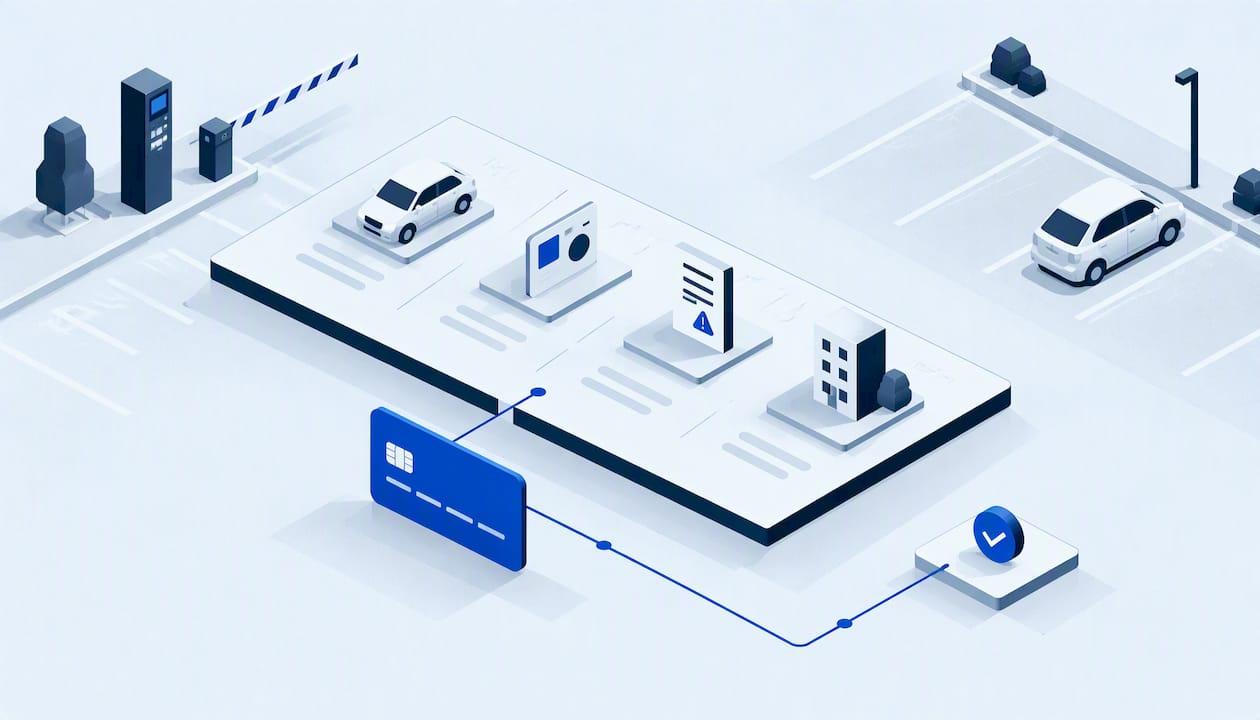
Parking payment integration means connecting your parking management system to a payment gateway, so that charges, captures and refunds post automatically to the right vehicle, permit or violation record. For a property manager, the goal is not just taking cards. It is knowing, for every dollar collected, which plate, which unit, which permit and which citation it belongs to, without a spreadsheet in the middle.
This guide is for people who run parking at apartment communities, HOAs, hotels and commercial lots, not for drivers looking for a place to pay. It covers what to integrate, how to keep card data out of your systems, and how to judge a platform before you sign.
TL;DR
- A good integration ties every payment (permit fee, guest pass, fine, tow release) to a vehicle and property record, so reconciliation and disputes take minutes instead of days.
- Keep card data off your servers: use a gateway with tokenization and, where you take cards in person, validated point-to-point encryption (P2PE). This shrinks your PCI burden.
- Evaluate platforms on the audit trail, multi-property reporting and refund handling, not on the number of payment methods alone.
- Roll out in phases: start with violations or permits, prove reconciliation, then add the rest.
Table of Contents
- What payment integration actually connects
- The payment types a property typically collects
- Why payments belong inside the parking record
- Digital payments are now the default
- Keeping card data out of your environment
- How to evaluate parking payment software
- A note on public citations versus private enforcement
- Perspective: payments are a workflow, not a widget
- How MyParkingMgr fits
- A phased rollout that works
- Mistakes to avoid
- FAQ
- Sources
What payment integration actually connects
The term gets used loosely, so it helps to be precise. Visa Acceptance's parking developer documentation describes it as a secure connection between a parking system and a payment gateway that handles authorizations, captures and refunds automatically. Its recommended practices include REST-style APIs, HTTPS/TLS encryption and tokenization, which swaps sensitive card numbers for non-sensitive identifiers.
That is the technical layer. The operational layer matters more to a property team. A payment is only useful if it lands in the right place:
- A resident pays a monthly permit fee, and the permit activates for the registered plate.
- A visitor pays for an overnight pass, and the pass is attached to the host unit.
- A vehicle is cited, the owner pays online, and the violation closes with a receipt in the history.
- A towed vehicle is released after a fee, and the tow record shows who authorized it and when.
When those links are automatic, your staff stops matching bank deposits to paper logs. When they are not, you get the familiar problems: a car that paid but still gets cited, a refund nobody can trace, a fee waived verbally and never recorded.
The payment types a property typically collects
Parking at a multifamily property or hotel is not one transaction. It is several, with different rules, timing and risk. Map them before you talk to any vendor.
| Payment type | Who pays | Typical pattern | What the integration must do |
|---|---|---|---|
| Resident permit fee | Resident | Recurring or one-time | Activate and expire the permit by plate; support autopay and failed-payment handling |
| Guest or visitor pass | Guest or host | One-time, short window | Take payment at registration; link to the host unit and property |
| Vendor or contractor pass | Vendor company | Per visit or per period | Invoice or card; tie to the company, not just one vehicle |
| Violation or fine | Vehicle owner | One-time, often after notice | Look up by plate or citation number; close the violation on payment |
| Tow or booting release fee | Vehicle owner | One-time, urgent | Record authorization and release against the tow event |
| Hotel guest parking | Guest | Folio charge or card at check-in | Post to the right stay and property, and handle checkout timing |
Not every property charges for all of these. Some communities only fine, some only sell permits. The point is to choose an integration that fits the mix you have today without forcing a second system when you add a line next year.
Why payments belong inside the parking record
Most properties start with fragmented tools: a permit spreadsheet, a separate guest registration form, a payment portal, a towing company's own log. Each works alone. Together they leave gaps, because no single place knows the full story of a vehicle.
A 2025 Parking Compliance Trends Report found that municipalities and operators rank increased payment compliance as the top benefit of integrated systems, above plain convenience. That fits what property teams tell us: payment is a way to make rules work, not just a checkout step. When a payment is tied to the vehicle's history, you can:
- Charge access and fees based on what the record shows, such as repeat violations or an expired permit.
- Stop enforcement on a paid violation automatically, avoiding double citations.
- Answer a dispute with one screen: the photo, the notice, the payment, the timestamp.
- Report by property across a portfolio without merging five exports.
The payment is the easy part. The record it attaches to is what you are really buying.
Digital payments are now the default
If you still take a meaningful share of parking money in cash or checks, you are in the minority. One industry market report estimates that digital payment penetration in U.S. parking stands at roughly 66% as of 2025, with cash under 10% of volume in most markets, and projects 89% by 2032. Treat those as market estimates from a research publisher, not a guarantee for your property type. But the direction is clear, and residents and guests expect to pay from a phone.
For property managers, the practical consequences are modest but real. Cash handling creates shrinkage and audit gaps. Checks arrive late and unmatched. Card and bank payments, tied to a record, are easier to reconcile and easier to defend.
Keeping card data out of your environment
This is the part property teams most often underestimate. Taking payments does not mean you should ever store card numbers. The aim is to make sure sensitive data never touches your own servers or your staff's devices.
Tokenization
With tokenization, the gateway stores the card and gives your system a token, a stand-in that is useless on its own. The U.S. Payments Forum's card-on-file tokenization white paper explains why this matters: when a merchant stores a card number under PCI DSS rules, everyone with access to that storage can see the number. A token removes that exposure.
If you manage multiple properties or may change processors later, ask who owns the tokens. Some token vaults are tied to one processor; independent, processor-agnostic vaults let tokens be routed across providers. That is a vendor-architecture question worth raising before you commit to a long contract.
P2PE for in-person payments
If any staff take cards on a handheld or at a kiosk, look at validated point-to-point encryption. A P2PE white paper from PayWay describes how card data is encrypted at the point of interaction and stays encrypted until it reaches the processor, which can reduce the scope of a PCI DSS assessment. Scope reduction depends on using a validated solution correctly, so confirm details with your acquirer or a qualified security assessor.
API security beyond the basics
Encryption and logins are the floor. A payment API security guide from Card Payment Network lists authentication, authorization, tokenization, input validation, credential protection and monitoring as parts of one set of safeguards. Analysts quoted in our research also stress layered defenses, with audit-trailed consent and controls that stop tokens being reused with unrelated merchants. When you evaluate a vendor, ask for how these are done, not just a statement that they are.
One caution: PCI obligations depend on how you accept payments and your merchant agreement. Ask your acquirer or payment processor which self-assessment applies to you, and involve your IT or compliance lead before launch.
How to evaluate parking payment software
Searching for the best parking payment software returns many lists, and most compare consumer apps, pay stations or processors. A property manager needs a different lens. Use these criteria.
1. Does the payment close the loop on the record?
Pay a test violation and check what happens. Does the citation close? Does the receipt appear in the vehicle history? Does enforcement see it immediately? If a person has to update anything by hand, the integration is only half built.

2. Is there a real audit trail?
You want a log of who issued, waived, refunded or edited each item, with timestamps. Waivers and refunds are where disputes and internal errors live. Role-based permissions should decide who can do them.
3. Can it report across properties?
If you run a portfolio, you need revenue by property, by payment type and by period, in one view. Ask for a demonstration with your own mix of properties, not a single-site sample.
4. How are refunds, chargebacks and failed payments handled?
Ask what happens when a recurring permit payment fails, when a resident disputes a charge with their bank, and when a fine is voided after payment. These edge cases tell you more than the happy path.
5. Which deployment models are available?
Some organizations need hosted software. Others, such as larger operators or those with strict IT policies, need client-hosted or white-label options. Confirm the model fits your governance before you start.
6. How does it work with enforcement hardware and field workflows?
Patrol staff should see current payment and permit status when they check a vehicle. If your process uses plate recognition, remember that alerts still need human review before action. We cover that in our guide to permit enforcement and ALPR alerts.
7. Who owns the data and the tokens?
Ask what you can export, in what format, and whether stored payment credentials can move if you change vendors.
A note on public citations versus private enforcement
Some readers arrive here after searching how to pay a ticket or set up a payment plan. Public municipal citations follow city rules. In San Francisco, for example, SFMTA offers payment plans for parking citations, with a $25 enrollment fee on the standard plan and a lower fee for low-income customers. Those are city programs, specific to that agency.
Private-property violations at an apartment community or hotel work differently: the property or its operator sets the policy, the fee and the process. If you manage such a property, your residents will still expect a clear way to see what they owe and pay it online. Our page on online parking fine payments shows how that fits into the violation workflow.
Perspective: payments are a workflow, not a widget
We see the same pattern when property teams come to us. They already accept payments somewhere: a portal here, a form there, a tow company collecting on its own. What they lack is one record that connects the payment to the vehicle, the permit, the violation and the property.

That is why we build payments inside the same platform that handles guest access, permits, violations and towing. A fine paid online should close the violation. A permit fee should control access. A tow release should leave a record of who approved it. When those steps share one history, your team can answer "what happened with this car?" in one place, and your audit trail holds up when a resident disputes a charge.
We also believe teams should choose how the software is deployed. Some want hosted SaaS, others need client-hosted installs or white-label, and the payment design should respect that. And we stick to what we can verify: if a capability is not confirmed for your setup, we will say so during assessment rather than promise it.
— MyParkingMgr
How MyParkingMgr fits
MyParkingMgr is parking management software for multifamily properties, hotels and lot operators. It brings guest access, resident and vendor permits, violations, payments, towing and audit trails into one platform, with portfolio reporting for multi-property teams. Deployment can be hosted SaaS, client-hosted or white-label, and onboarding is free.
If you want to see how payments would connect to your own permits and violations, request a proposal or look at the full feature set first. Portfolio operators may want the multi-property overview.
A phased rollout that works
Trying to switch every payment type at once is how projects stall. A sequence we would suggest:
- Inventory what you collect. List every fee, who pays it, how, and where the money goes today. Include fees staff waive informally.
- Pick the first workflow. Violations and fines are a common starting point because the volume is steady and the record is clear. Permits or guest passes can follow.
- Define roles. Decide who can issue, waive and refund, and set permissions to match. Keep the list short.
- Confirm security scope. Talk with your processor about tokenization, P2PE where relevant and which PCI questionnaire applies.
- Run a pilot property. Test with real payments, including a refund and a failed recurring charge. Reconcile against your bank deposits.
- Expand by property. Roll to the rest of the portfolio once reports match, then add the next payment type.
- Review monthly. Look at waived fees, refunds and payment lag by property. Patterns show up quickly.
Guest parking is often the next step after violations. Our walkthrough of visitor parking registration for multi-property managers covers the registration side.
Mistakes to avoid
- Treating the payment portal as the whole project. If it does not update the vehicle record, you have moved the manual work, not removed it.
- Letting staff store card details. Notes fields and emails are the usual culprits. Tokens or a gateway-hosted form remove the temptation.
- Skipping the refund test. Most integrations are demoed with successful payments. Test the reversal.
- Ignoring tow and vendor payments. These are small in volume but heavy in disputes.
- Buying on payment-method count. Ten ways to pay mean little if reconciliation is still manual.
FAQ
What is a payment integration in parking software?
It is a secure connection between your parking system and a payment gateway. Charges, captures and refunds are processed automatically and recorded against the right vehicle, permit or violation. Done well, it also updates enforcement status as soon as someone pays.
Which payment options should a multifamily property offer?
Offer what your residents and guests already use: major credit and debit cards, and bank payments where your processor supports them, with a mobile-friendly checkout. Recurring payment for permits is useful for residents, while guests and violators need a quick one-time option. The right mix depends on your fee types and your processor.
Do we need to be PCI compliant if we use a gateway?
Yes, PCI DSS still applies to anyone who accepts card payments, but how much depends on how you take them. Using tokenization and, for in-person payments, validated P2PE can reduce your scope. Ask your acquirer which self-assessment questionnaire you must complete.
How do I choose the best parking payment software for several properties?
Start with how well it ties payments to vehicle records, then check the audit trail, refund handling and portfolio reporting. Confirm the deployment model suits your IT policies. Ask for a demonstration using your own property mix.
Can residents set up a payment plan for a parking ticket?
For city citations, it depends on the agency: San Francisco's SFMTA, for instance, publishes its own plan terms. For private-property violations, the property owner or manager sets the policy, and the software should record any agreed arrangement in the violation history.
Sources
- Card Present Connect | Parking, Visa Acceptance developer documentation
- 2025 Parking Compliance Trends Report
- United States Parking Management Market report, Ken Research
- Card-on-File Tokenization, U.S. Payments Forum
- De-scoping PCI through orchestration and independent token vaults, BR-DGE
- Impact of PCI P2PE on PCI DSS, PayWay
- Best Practices for Payment API Security, Card Payment Network
- Payment Plan, SFMTA