
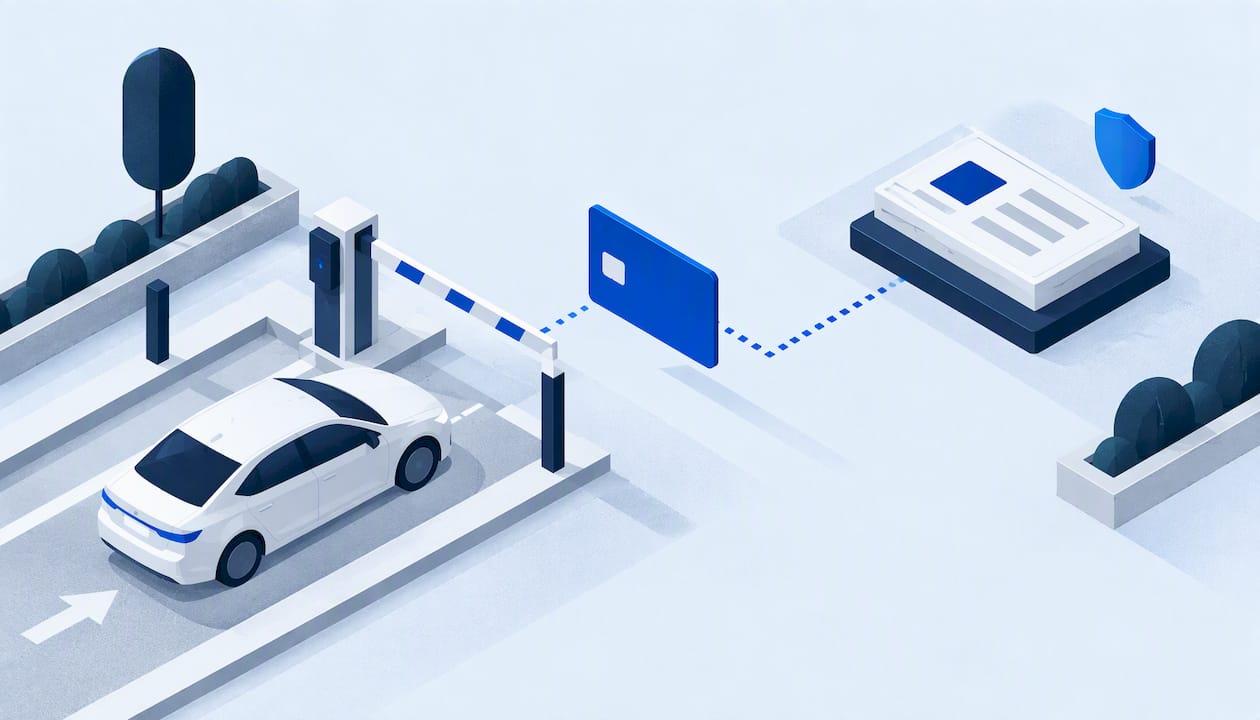
RFID parking access lets an approved vehicle open a gate without the driver stopping, swiping a card or typing a code. A tag on the vehicle is read by a reader at the lane, software checks the credential, and the gate opens or stays shut. The hardware is the easy part. What decides whether it works for a property manager is the record behind each tag: who holds it, which vehicle it belongs to, what it is allowed to do, and what happened the last time it was used.
This guide covers how the technology works, which frequency to choose, the failures that catch teams out, and how to run RFID credentials across one property or a whole portfolio.
TL;DR
- Long-range vehicle access in the US uses passive UHF tags in the 902-928 MHz band, with read ranges of roughly 10 to 30 feet. Employee badge cards usually cannot do this.
- RFID alone does not run a gate. You also need vehicle presence sensors so the gate never closes on a car.
- Plain tags can be cloned. Ask for encrypted or standards-based readers and credentials, and read the NIST guidance before you buy.
- The payoff comes from software: tying each tag to a permit, a vehicle and an audit trail, so enforcement and reporting use one record.
Table of Contents
- How an RFID parking access system works
- Why UHF is the standard for vehicles
- What goes wrong, and how to avoid it
- RFID for different property types
- Credentials, permits and payments
- Does RFID pay off?
- Our view: the record matters more than the reader
- How to plan an RFID parking access project
- Where MyParkingMgr fits
- FAQ
- Sources
How an RFID parking access system works
Every system has four parts that have to agree with each other:
- The tag. A passive tag has no battery. It sits on the windshield, a headlight or a hang tag, and answers when a reader's radio field reaches it.
- The reader and antenna. Mounted at the lane, the reader energizes the tag and receives its ID. Antenna position and angle set where the read happens.
- The controller. It takes the ID, checks it against a list of allowed credentials and decides whether to open the gate. It then logs the event.
- The gate operator and sensors. These move the barrier and confirm the lane is clear.
The controller is where most properties get stuck. If the allowed list is a spreadsheet or a separate admin screen at each site, it drifts out of date. Residents move out, vendors finish jobs, guests overstay, and tags keep working. A parking system that treats the credential as one field in a vehicle and permit record avoids this, because deactivating the permit deactivates the access.
Why UHF is the standard for vehicles
Tag frequency decides how far away a read can happen. In the US, UHF in the 902-928 MHz band is the usual choice for parking because passive tags can be read at 10 to 30 feet. That distance is what makes hands-free entry possible: the reader picks up the tag while the car is still rolling toward the arm.
Low-frequency (125 kHz) and high-frequency (13.56 MHz) cards are built for a short tap at a door. Many facility teams hope to reuse the cards they already issue to employees for the garage too. As the NIST RFID security guidelines describe, those technologies do not give the range a vehicle lane needs. The practical fix is a multi-technology reader or a Wiegand or OSDP connection, so one access control system can serve both the building door and the garage gate.
| Frequency | Typical use | Practical read distance | Fit for vehicle lanes |
|---|---|---|---|
| 125 kHz (LF) | Legacy proximity cards | Very short, a tap | No |
| 13.56 MHz (HF) | Smart cards, door access | Short, a tap | No |
| 902-928 MHz (UHF) | Windshield tags, hang tags | About 10 to 30 feet | Yes |
Radio rules you should know
Unlicensed UHF RFID in the US operates under FCC Part 15 rules, which cap transmit power and require that devices not cause harmful interference. The NIST guidelines summarize this for the 902-928 MHz band. Your installer should handle certified equipment and configuration. As the buyer, confirm the readers you are quoted are certified for US use, and ask who is responsible if a nearby radio service reports interference.
What goes wrong, and how to avoid it
Tags and metal
Passive UHF tags are sensitive to what they are stuck on. Metal surfaces can weaken the signal and shorten read range. Use tags designed for windshield mounting, or spacers when a tag has to go on metal. Test a sample of real vehicles at the real lane before ordering thousands of tags, including vehicles with tinted or metallized glass.
Gates that close on cars
RFID tells the system who is arriving. It does not tell the gate whether the car has finished passing. A Volpe Center study for a national park entrance notes that presence sensors such as loops, radar or laser curtains are part of automated entry, because they keep the barrier from closing early and keep entry and exit counts accurate. If a vendor quotes RFID readers with no mention of sensors, ask why. Our write-up on OSDP, UL 325 and gate access integration covers the safety and integration side in more detail.
Cloning and weak credentials
Passive tags have very little computing power, so many are deployed with no native encryption or authentication. NIST's guidance on securing RFID systems is the right starting point. In practice:
- Ask whether tags and readers support encryption or a standards-based secure channel such as OSDP.
- Do not treat the tag as proof of identity for high-risk areas. Pair it with a plate record, a camera or a staffed check.
- Keep a clear process for reporting lost tags and for disabling a credential the same day.
Shared and transferred tags
A tag is only as trustworthy as the rule that ties it to a vehicle. If a resident can lend a tag to a friend, you have a gate that opens for anyone. Record the plate against every permit, and review access events that do not match the vehicle on file.
RFID for different property types
Apartment and HOA communities
Residents hold one or two long-term credentials per unit, and guests and vendors come and go. The pain points are resident move-outs, tags that outlive leases, and visitors who park for days. A permit record with a start date, an end date and a unit, linked to the tag, handles the first two. For the third, see our guide to visitor parking registration for multi-property managers.
Hotels and resorts
Guest stays are short and credentials change daily. Many hotels issue a temporary credential at check-in or tie access to the reservation, and keep tags for staff, valet and vendors. Our page on hotel and resort parking management shows how we approach it.
Commercial lots and parking operators
Monthly permit holders, tenants and contractors share the same lanes. The key needs are clean permit categories, reporting by lot, and a way to connect gate events to violations and towing when someone is parked where they should not be.
Credentials, permits and payments
A tag is a credential, not a permit. Keeping those two ideas apart makes everything simpler. The permit says who may park, where, when and for how long. The tag is one way of proving it. If you later add plate recognition, a mobile pass or a QR code for guests, the permit stays the same and only the credential changes.

That is also why vendor parking passes and guest registrations deserve their own rules. A plumber on site for one afternoon does not need a permanent tag, and a resident does not need to re-register a guest at every visit.
A note on stored value
If your tags also hold prepaid balances, pause before you design it. FinCEN's prepaid access FAQ discusses when closed-loop systems fall under prepaid access definitions, with a $2,000 per day maximum value threshold mentioned for devices. Ask your own counsel whether a balance-holding transponder program affects you. For most residential and hotel properties, a simpler design is to keep balances out of the tag and keep payments in the management system.
Does RFID pay off?
There are two kinds of return: the physical one and the operational one.
On the physical side, a University of Wisconsin-Madison study of ramp permits found that switching from magnetic stripe cards to RFID hanging permits cut idling at gates. The authors estimated the elimination of 12.2 metric tons of CO2 equivalent per two-semester cycle. That was one campus with a high daily volume, so treat it as direction rather than a promise for a 120-unit community. Still, faster entry means shorter queues and fewer stuck gates.
The operational return is larger for most property teams, and it comes from data. The same report treats RFID as a workflow change, not only a hardware swap. When entry events land in a central system alongside vehicle history, you can enforce, audit and report from one place instead of reconciling the gate vendor's logs with a violation spreadsheet.
Our view: the record matters more than the reader
We build parking management software for multifamily properties, hotels and parking operators, and we see the same pattern. A property buys good gate hardware, issues tags and then discovers it cannot answer simple questions. Who owns this tag? Is this vehicle permitted? Was it warned last month? Who towed it, and was the notice correct?

Our position is that access should be tied to a vehicle's history, not to a standalone list inside a gate controller. That is why the platform keeps guest access, permits, violations, payments and towing in one record, with audit trails and role-based users, so a leasing agent, a security officer and a regional manager each see what they need. It is also why we support hosted SaaS, client-hosted and white-label deployments: some organizations have IT rules that make a single hosting model a non-starter.
We also keep a discipline around verified capabilities. Before you commit to any RFID hardware, ask what the software can actually read from it and what it can do with that data. A reader that cannot hand events to your management platform is a closed island, however good the antenna is.
— MyParkingMgr
How to plan an RFID parking access project
- Map every lane and user group. List resident, guest, vendor, staff and overflow lanes, and the rules for each.
- Decide the credential policy first. Who gets a tag, how many per unit or room, what happens at move-out, and how replacements are issued.
- Choose the frequency. UHF for vehicle lanes, with multi-technology readers or OSDP/Wiegand if the same system must cover doors.
- Specify sensors and safety. Loops or other presence detection, and gate operators that meet safety standards.
- Pilot at one lane. Test tags on real vehicles, in rain, at night and at the speeds drivers actually use.
- Connect the data. Make sure gate events, permits and violations land in one management record before rollout across the portfolio.
- Train staff and publish rules. Residents and vendors need to know how to get a tag, report a loss and register guests.
If you manage several communities, our page on multi-property parking management explains how to keep one set of rules while letting each site have its own exceptions. Teams in specific metros can also see our pages for Atlanta, Philadelphia and San Diego.
Where MyParkingMgr fits
If you are choosing or reworking RFID access, we can look at your current setup and show how permits, guests, violations, payments and towing would sit in a single record. Our features page lists the full scope, including hardware integration for enforcement activities. On-boarding is free (0 USD, one-off). You can see the platform on our home page or contact us to talk through your lanes.
FAQ
Does a car key fob use RFID?
Many do, but not for parking. Most key fobs use short-range or dedicated radio links to the car itself. A parking gate needs a credential that the gate's reader can recognize, which is normally a UHF tag issued for that purpose.
How do I get an RFID tag for my car?
You get it from the property or lot operator that runs the gate, not from a retail store. The manager registers you, links the tag to your vehicle and permit, and tells you where to mount it. Using a tag from another system usually will not work, because the reader expects a specific format.
Can I use existing employee access cards for parking?
Usually not for vehicle lanes. Typical employee cards are 125 kHz or 13.56 MHz, which read only at close range, while vehicle access calls for UHF with 10 to 30 feet of range. A multi-technology reader or an OSDP or Wiegand link can let one access system serve both.
Do RFID tags work on any windshield?
Not always. Metal and some coated glass can weaken the signal, so choose tags made for windshield mounting and test them on real vehicles before a full rollout. Spacers can help when a tag must go on a metal surface.
Sources
- Wireless reader and credential technology, Security Info Watch
- Reduction in Vehicle Idling Emissions Using RFID Parking Permits, University of Wisconsin-Madison
- NIST SP 800-98, Guidelines for Securing Radio Frequency Identification (RFID) Systems
- Gateway National Recreation Area, Sandy Hook Unit, Volpe Center study
- FinCEN, Frequently Asked Questions Regarding Prepaid Access