
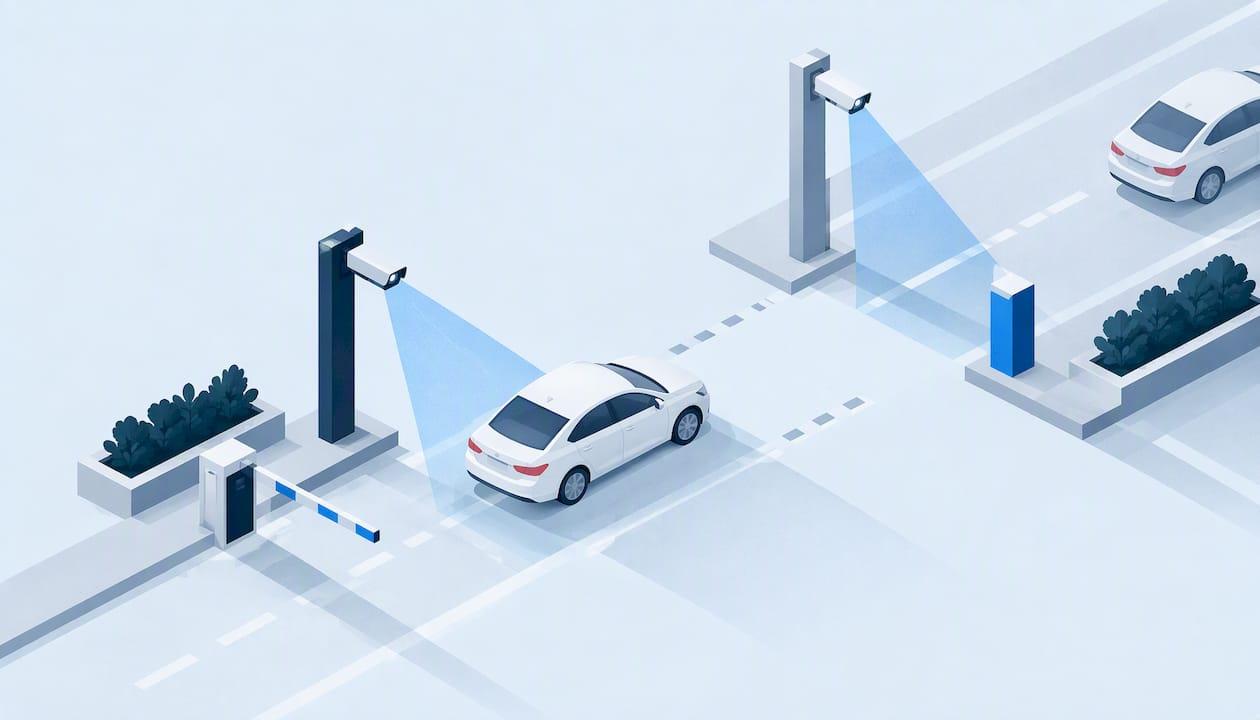
Well-installed license plate recognition (LPR) systems in real parking operations typically read plates correctly about 95% to 98% of the time. That is lower than the 99% figure on most spec sheets. Industry testing summarized by Parking Tech puts real-world results at that range across all conditions and plate types, and vendor claims of 98% to 99% often come from ideal lab conditions.
The gap matters because your property pays for it. A few percentage points of error turns into wrong tickets, missed violators and angry residents. This guide covers what the numbers mean, what pulls them down, and how to test a system on your own site.
TL;DR
- Expect roughly 95% to 98% correct reads from a fixed, well-installed camera. Treat 99% as a best-case lab number.
- "Read rate" and "accuracy rate" are different metrics. Ask vendors for both, measured on a site like yours.
- Dirt, glare, shadows, speed and camera angle each chip away at accuracy. Fixed cameras beat mobile ones.
- Every LPR alert that could lead to a ticket or tow should get a human check first.
- Run a pilot with your own plates and lighting before you sign anything.
Table of Contents
- What the published accuracy numbers really say
- Read rate versus accuracy rate
- What a 5% error rate means on a real property
- Why accuracy drops after installation
- How to test LPR accuracy before you buy
- Put a person between the read and the penalty
- Reduce misreads with better permit data
- Privacy and data retention come with LPR
- Our perspective
- Where MyParkingMgr fits
- What to budget
- FAQ
- Sources
What the published accuracy numbers really say
Search for LPR accuracy and you will see figures from 80% to 99.9%. They are not contradictory. They measure different things in different places.
| Source type | Typical claim | Context |
|---|---|---|
| Vendor marketing | 98% to 99%+ | Often lab or ideal conditions |
| Well-installed parking systems | 95% to 98% | Fixed cameras, all plate types, normal conditions |
| Controlled access point with good lighting | About 92% to 97% | Practitioner estimate |
| Law enforcement field deployments | 80% to 85% in some reports | Mobile, moving vehicles, varied conditions |
The parking-industry range comes from Parking Tech's camera technology review. A separate Parking Operator Hub implementation guide also describes 95% to 99% under good conditions, with poorer results when lighting or plate condition worsens.
The National Institute of Justice's guidance on LPR performance is blunt about vendor claims: figures like 98 or 99 percent are not realistic outside a laboratory. That document is written for police agencies, so mobile patrol results are harsher than what a fixed gate camera in a residential lot will see. Still, the warning travels well.
The lesson is simple. A number without a context is marketing. "99% accurate" should always prompt the questions Parking Tech asks of every manufacturer: under what conditions, with which plate types, at what speed and in what lighting.
Read rate versus accuracy rate
This is the distinction most buyers miss.
- Read rate is the share of vehicles for which the system produces any plate read at all.
- Accuracy rate is the share of those reads that are correct.
The two multiply. As Parking Tech explains, a system with a 98% read rate and a 97% accuracy rate delivers roughly a 95% combined correct-read rate (0.98 × 0.97 ≈ 0.95). A vendor can quote either figure alone and sound better than the whole result.
When you ask a vendor for numbers, ask for:
- Read rate and accuracy rate, stated separately.
- The combined correct-read rate on a comparable site.
- How the test counted partial reads, such as one wrong character.
- Results by condition: day, night, rain, and plates with graphics or dirt.
What a 5% error rate means on a real property
Percentages feel small until you apply them to volume. Take a hypothetical garage with 2,000 plate reads a day and a 95% correct-read rate. That is about 100 wrong or missing reads every day, or roughly 3,000 a month.
Not all of those become problems. Many land on vehicles that are already permitted, and a misread simply fails to match a record. But the two failure types behave differently:
- False positive: the system flags a vehicle that has a valid permit, because one character was wrong. This is how a resident gets a ticket they did not earn.
- False negative: the system misses an unauthorized vehicle, so no alert fires.
Parking Tech notes that at this scale, a 5% error rate creates a meaningful number of incorrect reads and calls for human-in-the-loop workflows for violation management. Your accuracy target should be set by what your team can review, not by what a brochure promises.
Why accuracy drops after installation
Most of the loss comes from the environment, not the software.
Camera angle and placement
Perspective distortion limits what a camera can read. Documentation in a San Jose city document notes that commercial systems usually restrict camera yaw to under 15 degrees and pitch to under 30 degrees for reliable recognition. A camera mounted too high or too far to the side will underperform no matter how good the algorithm is.

Lighting, weather and dirt
Parking.Management reports that dirt, mud, snow, shadows, uneven light and oncoming glare can consistently cost one to three percentage points compared with ideal test conditions. At a 97% lab result, that already puts you at 94% to 96%.

Speed and mobile versus fixed
Fixed installations tend to be more accurate than mobile ones, since the camera angle stays consistent and vehicle motion does not add slant distortion, according to the same Parking.Management guide. A gate or entry lane where cars slow down is the friendliest setting you can give a camera.
Unusual plates
Specialty plates, frames, trailer hitches and bike racks that cover characters, and out-of-state designs all cause misreads. Residential communities and hotels see more of this variety than a commuter garage, because guests arrive from everywhere.
Context beats benchmarks
Field conditions can undo lab results. A 2018 police-conducted study cited in the San Jose document reported error rates above 35% for cameras used in dynamic field environments. That is an extreme case from law enforcement, not a forecast for a gated lot, but it shows how much operating context determines results.
How to test LPR accuracy before you buy
You do not need a lab. You need a pilot and a spreadsheet.
- Pick the worst lane, not the best. Choose the entrance with the most glare, the oldest signage or the tightest angle.
- Collect ground truth. For one to two weeks, have staff log the actual plates (or review photos) for a sample of vehicles.
- Compare read by read. Count vehicles with no read, vehicles with a wrong read, and exact matches. Compute read rate, accuracy rate and combined rate.
- Sort errors by cause. Night, rain, specialty plates and blocked plates each point to a different fix.
- Check the workflow, not just the camera. How fast can an officer see the photo next to the read and correct it? A system with 94% accuracy and a fast review screen can outperform one with 97% and a clumsy one.
- Set a go/no-go threshold in advance. Decide what combined rate and what review time you will accept before you see the results.
For hotels, the same test should include how reads post to guest records. Our guide on testing LPR and folio posting before you buy walks through that.
Put a person between the read and the penalty
No accuracy figure justifies skipping review. Parking.Management's guidance says misreads are inevitable, and that successful operators use LPR to speed up officer decisions, not replace them, especially when citations get disputed.
A defensible workflow looks like this:
- The system flags a possible violation.
- An officer or manager compares the photo of the plate against the read and the permit record.
- Only a confirmed match triggers a warning, ticket or tow.
- The photo, read, reviewer and decision are stored together.
That last step is what holds up in an appeal. We cover the details in why ALPR alerts need human review and in our policy and verification guide for LPR enforcement. If you are building the wider process, five steps to defensible private parking enforcement shows how the pieces fit.
Reduce misreads with better permit data
Accuracy is not only a camera problem. A plate can be read perfectly and still produce a false alert because the permit record has a typo, an old vehicle or a missing guest registration.
Two habits help:
- Let residents and guests enter plates themselves, with validation, so errors get caught at the source. Our piece on visitor parking registration for multi-property managers describes a workable process.
- Use digital permits so records stay current without paper passes.
If you want a system that tolerates a one-character miss, ask whether it can suggest near matches for an officer to confirm. That is a design question to put to any vendor.
Privacy and data retention come with LPR
Accurate reads create a record of where vehicles were. Residents will ask what you keep and why. A municipal example, the Beavercreek, Ohio license plate reader program page, shows the kind of transparency communities expect: stated retention windows, usage logs and a public explanation that the data supports parking management and public safety rather than commercial use.
For a private property, the practical version is:
- Write down how long reads are kept and who can see them.
- Limit access by role.
- Tell residents in plain language what the cameras are for.
- Never sell or share plate data for unrelated purposes.
Check your state and local rules, and your community's governing documents, with your attorney before you deploy. Rules differ by state.
Our perspective
We build parking management software, and we see the same pattern at property after property: the camera is rarely the weakest link. The weak link is what happens after a read. Permits live in one tool, guest passes in another, violations in a spreadsheet, and nobody can pull up the vehicle's history when a resident disputes a ticket.
So we do not treat an accuracy percentage as the goal. We treat it as an input to a verified workflow. Our platform keeps guest access, permits, violations, payments and towing in one record tied to vehicle history, with audit trails showing who decided what and when. Workflows are configurable, so a property can require a review step before any ticket or tow goes out.
Our advice: ask any vendor, including us, for field-verified numbers from a site like yours, and judge the system by how well it handles the 3% to 5% it gets wrong.
— MyParkingMgr
Where MyParkingMgr fits
If you manage several properties and want LPR-driven enforcement without scattered tools, look at our parking enforcement software and parking violation management. For portfolios, the multi-property parking management page shows how reporting rolls up across sites. The platform runs as hosted SaaS, client-hosted or white-label, and on-boarding is free ($0 one-off). You can start from our main site.
What to budget
Costs vary widely by model, so get quotes for your own layout. Legacy vehicle-mounted units and modern fixed-camera subscriptions are priced very differently, and software that reuses existing security cameras is cheaper still. Whatever the model, ask what is included: hardware, software updates, maintenance and cloud storage. Then add the staff time for reviewing alerts, which is the cost most budgets leave out.
FAQ
How accurate are license plate readers in parking?
Well-installed, current systems typically reach about 95% to 98% correct reads across conditions, according to Parking Tech. Results fall with poor lighting, dirt, bad camera angles and unusual plates. Expect lower numbers on mobile units than on fixed cameras.
Can LPR reach 100% accuracy?
No. Misreads from specialty plates, obstructions and weather are unavoidable, so operators need review steps for anything that leads to a ticket or tow. Aim for a high, measured rate and a fast way to correct errors.
Why do vendors claim 99% when field results are lower?
Those figures often come from ideal conditions. The National Institute of Justice guidance says such numbers are not realistic outside a lab. Ask for read rate and accuracy rate separately, from a comparable live site.
How long should a property keep plate reads?
There is no single rule for private properties. A 30-day window is a common example in public programs, such as the Beavercreek program. Set a written policy and confirm it with your attorney under your state's law.
Sources
- LPR Camera Technology in 2024: What Has Actually Changed, Parking Tech
- Implementing LPR Technology for Parking Enforcement, Parking Operator Hub
- License Plate Recognition for Parking, Parking.Management
- License Plate Recognition Systems: Function, Performance, and Considerations, NIJ
- City of San Jose document on ALPR accuracy concerns
- License Plate Reader Program, City of Beavercreek, Ohio