
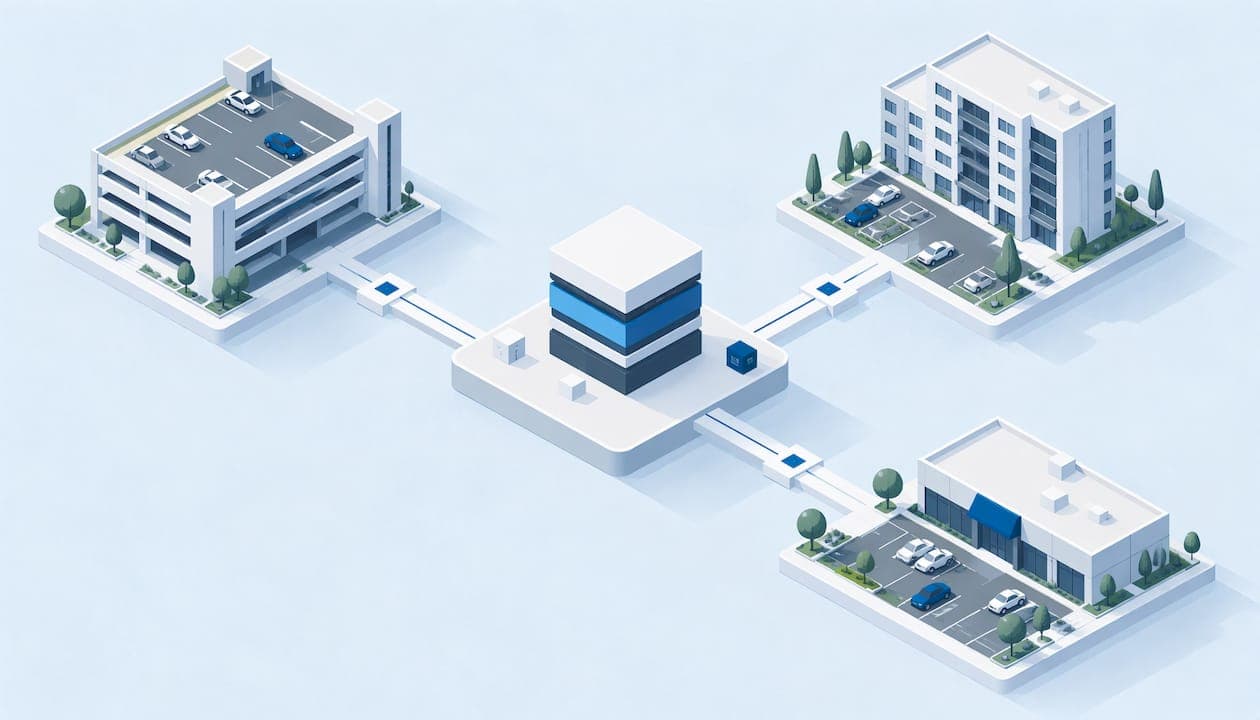
Multi-property parking management means running permits, guest access, violations, payments and towing for every site in your portfolio from one system and one vehicle record, while each property keeps its own rules. Done well, a manager can answer "who is parked where, under what permit, and what happened last time" without opening five tools or calling five site teams.
This guide covers what the work involves, what a centralized setup should include, the controls to check before you consolidate, and how to roll it out without disrupting residents or guests.
TL;DR
- Centralized parking means one record of vehicles, permits, guests, violations and payments across all properties, with rules set per property.
- The biggest gain is consistency: a permit added or removed once should update every site it applies to, so nothing stays active by mistake.
- Look for a unified database, configurable permits, enforcement tools, payments, tow workflow, role-based access and audit logs.
- Savings only hold if resident and guest experience does not suffer, so roll out in stages and track a few clear measures.
- Check privacy and data retention rules before you adopt plate recognition or store vehicle data.
Table of Contents
- What multi-property parking management involves
- Where fragmented parking operations break down
- What a centralized parking system should cover
- Resident permits and hotel guest parking, with rules per property
- Enforcement, violations and towing
- Integrations, controls and audit trails to check
- Privacy and legal points to settle early
- How to roll out centralized parking operations
- What results to expect
- Our perspective
- See it across your portfolio
- FAQ
- Sources
What multi-property parking management involves
At one property, parking is a small chore: a permit list, a guest log, a tow company's phone number. Across ten, thirty or a hundred properties, the same chores multiply and drift apart. Each site ends up with its own spreadsheet, its own guest rules and its own way of recording a violation.
Multi-property parking management brings those chores under one roof. In practice it covers:
- Resident and vendor permits: issuing, renewing, limiting and revoking them by property, building or lot.
- Guest and visitor access: registration, time limits and frequency caps.
- Violations: warnings, citations, appeals and repeat-offender history.
- Payments: permit fees, guest fees and fines, tied to the vehicle and the account.
- Towing: authorization, documentation and follow-up.
- Reporting: a view per site and a view across the whole portfolio.
The problem it solves is not parking itself. It is the cost of inconsistency: staff who cannot see another site's history, residents who get different answers at different properties, and managers who cannot compare sites because the data lives in different formats.
A portfolio-level dashboard is the visible payoff. Industry reporting describes dashboards that summarize revenue, utilization and equipment alerts across facilities, so a regional manager can spot a problem site without waiting for a monthly report.
Where fragmented parking operations break down
Most portfolios do not choose a fragmented setup. They inherit it through acquisitions, different management companies and years of one-off fixes. The cracks show in predictable places:
- Stale permits. A resident moves out of one building, but the permit stays active because no one told the right person.
- Unequal enforcement. One site tows quickly, another never does, and the residents who talk to each other notice.
- No shared history. A vehicle cited at one property shows up at another with a clean record.
- Payment gaps. Fees and fines are tracked in one place, permits in another, and the two never reconcile.
- Weak audit trail. When a resident disputes a tow, nobody can show who changed what and when.
- Slow onboarding. Every new property means rebuilding forms, rules and reports from scratch.
The National Apartment Association describes centralization as shared services doing work that used to be done at each property. Parking is a natural candidate: the work is repetitive, rule-driven and record-heavy. It is also customer-facing, which is why the rollout needs care (more on that below).
What a centralized parking system should cover
Before you compare tools, define the scope. A public-sector scope of work for a citywide parking system is a useful checklist because it was written by people who had to specify every function. It calls for a unified database of citations, appeals, permits, vehicles and users, configurable permits and eligibility, mobile and plate-recognition enforcement, customer self-service, integrations with payment systems, optional boot and tow workflow, role-based access, audit logs and reporting.
Translated for a multi-property operator, the checklist looks like this:
| Function | What to look for | Why it matters across sites |
|---|---|---|
| Vehicle and user records | One database for vehicles, residents, guests, vendors and staff | History follows the vehicle from property to property |
| Permits | Per-property types, limits and eligibility rules | Each site keeps its own policy without a separate tool |
| Guest access | Registration, duration and frequency limits | Hotels and apartments can differ without custom work |
| Violations | Warnings, citations, appeals, repeat tracking | Consistent treatment and defensible records |
| Payments | Fees and fines tied to the vehicle record | Finance sees one ledger, not five |
| Towing | Documented authorization and status | Fewer disputes, clearer evidence |
| Roles and permissions | Role-based access by site or portfolio | Site staff see their lot, executives see everything |
| Audit and reporting | Logged changes, portfolio and per-site reports | Accountability and comparison |
If you want to see how this maps to a specific platform, our multi-property parking management page walks through the portfolio view, and the features overview lists the full set of modules.
Resident permits and hotel guest parking, with rules per property
The hardest design question is how to be consistent without being rigid. A downtown hotel, a garden-style apartment community and a mixed-use lot have different needs. The answer is a shared structure with local settings: the same permit and guest workflow everywhere, with limits, durations, fees and eligibility configured per property.
Permits that update everywhere at once
Portfolio-wide permit programs need centralized credential management so that adding or removing a permit holder updates access control at all authorized facilities at the same time. That prevents the common failure of a permit that was deactivated in one place and left live in another. Our resident parking permits module is built around that single-record idea.
Guest parking without front-desk bottlenecks
For apartments, guest rules usually revolve around how many nights a month a visitor can park and how many guests a unit can register. For hotels, the question is tying a guest vehicle to a stay and a space. In both cases self-registration reduces calls to the office, and recorded limits make enforcement fair. See how this works in our guest parking management module.
Define the rules at the start
Whatever the tool, write the recurring rules down before residents arrive. Guest limits, roommate access and move-in procedures are best set out at the start of the lease, because that minimizes administrative disputes later. Then configure those rules once per property rather than relying on staff memory.
Enforcement, violations and towing
Enforcement is where consistency matters most and where mistakes cost the most. A good workflow separates detection from decision: a patrol, a camera or a resident report flags a vehicle, the system checks it against permits and guest registrations, and a person confirms before a citation or tow.
That human step is not optional in our view. Plate-recognition alerts can be wrong, and a wrong tow is expensive. We cover the reasoning in why ALPR alerts need human review.
What the violation workflow should record, per incident:
- the vehicle, location and time, with photos or notes
- the rule that applied and the permit status at that moment
- the action taken: warning, citation, tow request
- who took each action, and any appeal outcome
With that, repeat violations are visible across the portfolio, and a disputed tow can be answered with a record rather than a recollection. Our parking violation management module follows this pattern.
Parking complaints rarely arrive alone. They tend to sit alongside other neighbor issues, so it helps to pair your permit rules with a clear noise complaint response process, so that residents know where each kind of concern goes.
Integrations, controls and audit trails to check
Consolidation moves a lot of responsibility into one system, so test its controls before you commit. Two questions deserve a firm answer from any vendor:
- Does it integrate through an API with your accounting system? Payments and fines should reach your ledger without re-keying.
- Are configuration changes logged by user, timestamp and affected facilities? Guidance on multi-facility platforms points to exactly this kind of change logging as a requirement.
Also ask about:
- Role-based access. Site staff, regional managers, auditors and vendors should each see only what they need.
- Hardware. If you use cameras, handhelds or gates for enforcement, confirm how they connect.
- Deployment. Some portfolios want a hosted service, others need the software on their own infrastructure, and some operators want to offer parking under their own brand.
- Data export. You should be able to get your records out in a usable format.
Privacy and legal points to settle early
Parking systems hold vehicle, plate and sometimes payment data, so retention and access policies matter. Rules differ by state and city, and your counsel should confirm what applies to your properties and your contracts with residents.
One public example shows what careful handling can look like. San José's residential permit program deletes plate photos not connected to a violation, warning or process after 36 hours. Its plate records hold no personal information, and vehicle registration data stays in a separate, secure state database. That is a municipal program, not a rule for private property, but it is a useful model for the questions to ask: how long are images kept, what personal data sits next to them, and who can see it?
For private operators, the practical steps are the same everywhere: publish clear parking rules and signage, keep retention short, limit who can view records, and keep an audit log of access.
How to roll out centralized parking operations
A staged rollout protects residents and gives your team time to adjust.
- Inventory current practice. For each property, list permit types, guest rules, enforcement habits, tow vendors and where records live.
- Set portfolio standards. Decide what must be identical (record fields, violation categories, appeal process) and what can differ (limits, fees, hours).
- Clean the data. Remove stale permits and duplicate vehicles before migrating, so the new system starts accurate.
- Pilot with two or three properties. Pick one simple site and one complicated one.
- Train by role. Leasing staff, front-desk teams, security and regional managers each need a different walk-through.
- Communicate with residents and guests. Explain what changes, when, and how to register a guest or renew a permit.
- Expand and review. Add sites in waves and review reports monthly at first.
For a longer residential walk-through, see our six steps for multifamily parking management.
What results to expect
Be realistic. The National Apartment Association notes that net operating income benefits arrive only if centralization does not hurt the customer experience, leasing or revenue. Faster back-office work is not a gain if residents get frustrated and leave.
One published case shows the upside of tightening parking operations: a 2026 case study reports an annual NOI increase of $123,931 after the owner renegotiated its parking contract and deployed new technology. Results like that depend on the property, the starting point and the contract, so treat it as an example of what is possible, not a forecast.

Track a short list of measures from day one. Public guidance suggests looking at parking complaints, unauthorized-vehicle rates, guest-limit violations, paid-space utilization, patrol time, appeals, repeat violations and staff hours spent administering the program. Capture a baseline before the switch so you can see the change.
Our perspective
Most parking problems we see in portfolios are record problems. A permit that never got revoked, a tow nobody can document, a guest rule applied differently in two buildings. Those are symptoms of parking data living in separate places.
That is why we built MyParkingMgr around a single record for guest access, permits, violations, payments and towing, with charges tied to historical vehicle records. When everything attaches to the vehicle, a manager can follow an incident from the first alert to the final payment.
We also think operators should not have to bend their policies to fit software. Workflows are configurable to how each client actually operates, and the platform can run as hosted SaaS, client-hosted or white-label. Audit capabilities and financial oversight are part of the core, not an add-on.
Our advice is to start with one honest question: can you see every property's parking history in one place today? If not, that is where to begin.
MyParkingMgr
See it across your portfolio
MyParkingMgr is parking management software for multifamily properties, hotels and parking lot operators who need guest access, permits, violations, payments and towing under one interface. On-boarding is free ($0, one-time), so you can map your properties and rules before you commit to anything else.
If you manage apartments across several markets, start with our multifamily portfolio parking software page, or contact us to talk through your sites. Operators who want to offer parking under their own brand can look at the white-label parking platform. You can also start from our main site.
FAQ
What is multi-property parking management?
It is running parking for several sites from one system: permits, guests, violations, payments and towing share one vehicle record, and each property keeps its own rules. Managers get a per-site view and a portfolio view.
How is centralized parking different from using one tool per property?
Separate tools mean separate records, so a permit change or a violation at one site is invisible at the others. A centralized system updates once and applies everywhere it should, and it gives you one audit trail instead of several.
Can each property still set its own parking rules?
Yes. The workflow is shared, while limits, fees, guest durations and eligibility are configured per property. A hotel and an apartment community can run on the same platform with different policies.
What should I measure after consolidating?
Track complaints, unauthorized-vehicle rates, guest-limit violations, repeat violations, appeals and staff hours spent on parking. Record a baseline before launch so the comparison is fair.
Do I need to host the software myself?
Not necessarily. Our platform can be delivered as hosted SaaS, installed on the client's own infrastructure, or white-labeled. The right choice depends on your IT policies and how you want to present the service.
Sources
- Multi-Facility Parking Management: Platform Requirements
- Centralization is Harder for Third-Party Managers: Some Are Doing It Anyway (NAA)
- Citywide Parking Enforcement and Management System, Scope of Work (City of Redmond)
- Technology Behind the Virtual Residential Permit Parking Program (City of San José)
- Transforming Parking Operations at 935M by ARIUM (RMR)
- Apartment Parking Management for Multifamily in 2026
- Protect Permits With Liaison Led Noise Complaint Response