
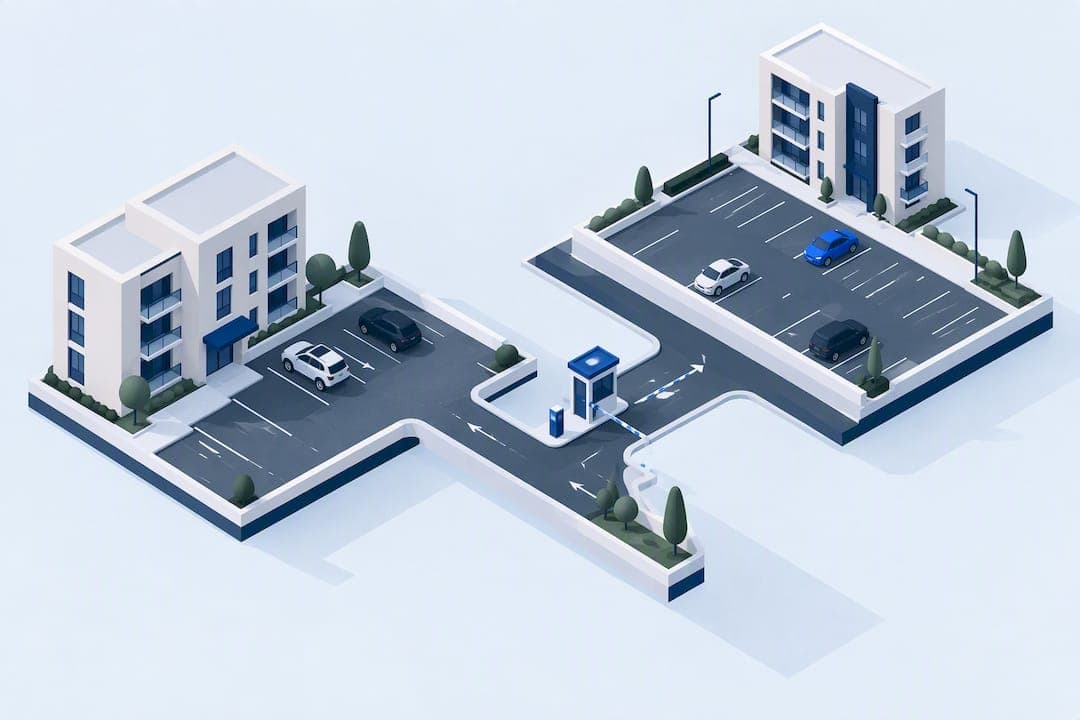
The most reliable approach to multifamily parking management combines a unified digital permit system, consistent enforcement workflows, and access control technology under one clear policy. Done well, this cuts resident complaints, saves staff hours otherwise lost to manual tracking, and makes every citation or tow defensible. Platforms that integrate permits, guest access, violations, and towing all into one record show what this looks like in practice.
TL;DR:
- Define resident and guest rules, plus warning to tow criteria, before choosing technology; pilot one building and track complaints, resolution, and staff hours.
- Count accessible spaces by facility, not across the site; restriping can trigger corrections, and van accessible spaces need wider aisles and vertical clearance.
- A housing provider may need to assign a resident a closer space when documentation links the request to a disability.
- Keep permits, guest registrations, violations, and towing in linked vehicle records, with timestamps and photos, so staff can resolve disputes using evidence rather than memory.
- Choose hardware for a specific problem: license plate cameras suit high guest turnover or unauthorized parking disputes, while gates prioritize perimeter control.
Table of Contents
- Why Modern Parking Management Matters for Multifamily Properties
- Core Components of an Effective Multifamily Parking Program
- Operational Best Practices for Day-to-Day Parking Management
- Compliance Essentials: ADA and Accessibility Requirements for Parking
- Choosing Technology and Integrations for Your Property
- A Practical Rollout Checklist: Step-by-Step for Implementation
- How an Integrated Platform Supports the Program
- Author Perspective: Where to Start When Priorities Compete
- How MyParkingMgr Helps: Turning This Guide Into a Working System
- FAQ
- Sources
Why Modern Parking Management Matters for Multifamily Properties
Parking is not a background amenity. It is something residents interact with every single day, and friction there bleeds into how they feel about the whole property. A blocked assigned space or a towed guest vehicle generates a support ticket, a phone call, and often a frustrated renewal conversation.
Automating workhorse amenities like parking improves resident experience while cutting the operational load on staff, according to industry commentary from the National Apartment Association. When permit issuance, renewals, and guest registration move off spreadsheets and paper logs, teams stop re-entering the same data three times and start resolving disputes with records instead of guesswork.
There is also a cost angle. Rightsizing parking supply and using shared-parking models can reduce both construction and ongoing operating costs, particularly in denser or transit-oriented developments, according to Harvard's Joint Center for Housing Studies. Properties that manage parking actively, rather than letting it run on informal rules, are better positioned to capture that value.
Unmanaged parking tends to generate the same handful of problems on a loop:
- Residents parking in spaces that are not theirs, with no record to resolve the dispute.
- Guest vehicles overstaying because no one tracked when they arrived.
- Staff manually checking plates against paper lists during move-outs and lease turnovers.
- Towing disputes that escalate because there is no timestamped documentation.
One operational truth stands out: automating the routine parts of parking frees staff time for the exceptions that actually need a human, which is where satisfaction and retention get decided, per NAA's analysis of workhorse amenities.
Core Components of an Effective Multifamily Parking Program
A working parking program rests on a handful of interlocking systems rather than one tool. Each piece needs to talk to the others, or you end up back with fragmented spreadsheets.
Resident permits need a full lifecycle, not just an issuance date. That means registration at move-in, a clear renewal cadence, and a reliable offboarding step when a lease ends or a vehicle changes, so stale permits do not sit active for months. Digital permits reduce the wrong-ticket problem that paper hangtags create when residents swap cars, as outlined in guidance on digital parking permits.
Guest parking needs its own model. Some properties cap guest stays at a fixed window, others require a reservation through a resident portal, and some charge for extended visitor parking as a small revenue line. Whichever model you choose, it has to tie directly into enforcement, or staff will have no way to tell a registered guest from an unregistered one. A step-by-step visitor registration process gives residents a simple way to register guests before enforcement even has to get involved.
Enforcement is where policy becomes real. That means:
- Mobile citation tools that staff can use from a phone or tablet while walking the lot.
- A violation log that timestamps every citation and photo for later reference.
- A documented towing process, with clear criteria for when a vehicle moves from warning to tow.
- Records retained long enough to resolve a dispute weeks later.
Access control rounds out the system. License plate recognition (LPR) cameras, barcode stickers, and gate controllers each have trade-offs. Barcode systems are a cost-effective retrofit that can reduce unauthorized parking without requiring collection at move-out, and residents resist them less when they are framed as a security feature rather than a branding exercise, according to an NAA case example on barcode parking systems. LPR adds automated plate matching but costs more upfront. Clear signage and visible space marking tie the whole system together by setting resident expectations before enforcement ever has to act.
Operational Best Practices for Day-to-Day Parking Management
Getting the systems in place is only half the job. The daily habits around them determine whether residents experience the program as fair or as arbitrary.
Start with policy design. Assigned parking works best where supply is tight and residents value certainty. Shared or unassigned parking fits properties with more flexible supply or high guest turnover. A hybrid model, assigned for residents with a shared pool for guests, is common in mixed-density communities.
A practical move-in and enforcement sequence looks like this:
- Collect vehicle information (plate, make, model, color) during lease signing, not after.
- Issue the permit (digital or physical) before the resident's first day on-site.
- Set a renewal reminder tied to lease renewal dates so permits never go stale.
- Log every violation with a photo, timestamp, and location before issuing a citation.
- Escalate from warning to citation to tow only after a documented pattern, not a single incident.
- Archive records so disputes can be resolved by evidence rather than memory.
Communication closes the gaps that policy alone cannot. Lease language, lobby signage, and resident portal notices should all use the same wording for the same rule, so no one gets conflicting instructions from different channels.
Peak periods, move-in weekends, holiday events, or maintenance days that pull extra vehicles onto the lot, need temporary rules and extra staff presence rather than a rigid default policy. Combining tech with human oversight during these windows produces better outcomes than relying on either alone, per NAA guidance on security-enhanced technology.
Pro Tip: Let automation handle routine permit renewals and guest check-ins, but schedule a monthly human audit of flagged violations to catch edge cases software will miss.
Compliance Essentials: ADA and Accessibility Requirements for Parking
Accessible parking is not optional, and the rules get more specific than most property teams expect. The required number of accessible spaces is calculated per parking facility, not aggregated across an entire site, and restriping projects often trigger an obligation to fix existing gaps, according to the ADA's restriping guidance.
| Facility size (total spaces) | Minimum accessible spaces required |
|---|---|
| — | 1 |
| 26 to 50 | 2 |
| — | 3 |
| — | 4 |
| 101 to 150 | 5 |
| — | 6 |
Van-accessible spaces require wider access aisles and a specified minimum vertical clearance, with distinct signage separating them from standard accessible spaces, per the ADA restriping brief. Accessible routes need to connect to the building's accessible entrances, and where a facility has multiple entrances, accessible spaces should be dispersed so the closest option to each entrance is covered.
A few practical rules to keep in mind:
- Calculate the accessible space count separately for each parking facility on the property, not for the site as a whole.
- Treat any restriping project as a trigger to review existing accessible space counts and dimensions.
- Keep van-accessible signage and clearance distinct from standard accessible spaces.
- Disperse accessible spaces near each accessible entrance rather than clustering them in one area.
Reasonable accommodation requests add another layer. Under the Fair Housing Act, a housing provider may need to assign a resident a specific space closer to their unit when there is a documented connection between the request and a disability, according to joint HUD and DOJ guidance. A detailed ADA parking audit checklist can help teams walk through these calculations lot by lot.
Choosing Technology and Integrations for Your Property
The right technology stack depends more on portfolio size and control needs than on chasing the newest feature. Three deployment models cover most situations: hosted SaaS, which gets a property running fastest with the least internal IT overhead; client-hosted, which gives an organization more control over data and infrastructure; and white-label, which lets larger operators keep their own branding in front of residents while running on a shared backend.

Hardware investment should follow actual pain points rather than trend. LPR cameras pay off fastest at properties with high guest turnover or a history of unauthorized parking disputes. Gate controllers make sense where perimeter control matters more than plate-level detail. EV-capable infrastructure is worth planning for now even at properties without heavy EV demand yet, since retrofitting later costs more than wiring during a renovation.
Integration priorities worth weighing:
- Property management systems, so resident and lease data does not need manual re-entry into a separate parking tool.
- Payment processors, for paid guest parking or EV charging fees.
- Towing vendor systems, so citations and tow requests sync without a phone call.
- Audit logging, so every permit change and enforcement action has a timestamped record.
- Multi-property reporting, for organizations managing more than one site under shared ownership or management.
Security and data handling matter here too. Vehicle records, plate data, and resident information all need role-based access so only authorized staff can view or edit them, and audit trails should make it clear who changed what and when.
A Practical Rollout Checklist: Step-by-Step for Implementation
Rolling out a new parking program works best as a sequence, not a single launch event.
- Inventory current conditions: total spaces, existing permits, signage condition, and any accessibility gaps against the facility-by-facility ADA count.
- Get policy sign-off from leasing, legal, and ownership before announcing anything to residents.
- Select a pilot building or zone rather than converting the whole portfolio at once.
- Set vendor selection criteria around deployment flexibility, integration support, and reporting depth.
- Define pilot KPIs: complaint volume, time to resolve disputes, and staff hours spent on manual parking tasks.
- Train staff on the enforcement cadence and documentation standards before go-live.
- Communicate changes to residents through lease addenda, signage, and portal notices on a consistent timeline.
- Launch the pilot and track KPIs weekly for the first month.
- Review results at 30, 60, and 90 days, adjusting policy or technology based on what the data shows.
- Expand to additional properties only after the pilot demonstrates measurable improvement.
Pilot programs validate policy and technology choices before a portfolio-wide commitment, which NAA research on workhorse amenities points to as the most reliable path to a successful rollout. A capacity planning guide can help teams right-size supply before locking in a final policy.
How an Integrated Platform Supports the Program
Translating all of this into daily operations is easier when permits, guest access, violations, and towing live in one record instead of four disconnected tools. Some parking management platforms are built around that principle: every vehicle's history, permits, citations, and towing activity stay tied to one record, so enforcement decisions have a documented trail behind them rather than a staff member's memory.
- Unified vehicle records and audit trails reduce duplicate data entry and make every citation or tow defensible after the fact.
- Deployment flexibility across hosted SaaS, client-hosted, and white-label options lets portfolios choose solutions that match their control and branding needs.
- Guest access, permits, violations, and towing management sit under one workflow instead of separate point solutions, with multi-property reporting built in for operators running more than one site.
Property teams evaluating a platform should ask how it handles the exact workflows outlined above: permit renewal timing, guest registration windows, and the warning-to-tow escalation path, since those details separate a usable system from a generic one.
Author Perspective: Where to Start When Priorities Compete
My honest read after mapping these workflows: most properties buy technology before they finish writing policy, and that order causes most of the friction. Get the rules straight first, assigned versus shared, guest windows, escalation steps, then pick the tools that enforce them.
Pilot in one building before rolling out portfolio-wide. Measure resident complaint volume and staff hours saved, not just citation counts. And keep a person on-site during move-in weekends and events, no matter how good the automation is, because exceptions are where residents judge fairness.
— MyParkingMgr
How MyParkingMgr Helps: Turning This Guide Into a Working System
We built MyParkingMgr around the exact workflows this guide covers: unified permit and vehicle records, guest access control, violation tracking, and towing management, all under one record instead of scattered spreadsheets and point tools. Multi-property reporting and flexible deployment (hosted, client-hosted, or white-label) let us fit the platform to your portfolio rather than the other way around.
Onboarding is free, and we can walk through your current setup to show where the gaps are. Request a proposal or explore our multifamily portfolio solution to see how it maps to your properties.
FAQ
What is the best way to manage parking at an apartment community?
The most effective approach combines a digital permit system with consistent enforcement and access control technology under one clear policy. This reduces resident complaints and cuts the staff time spent manually tracking permits and guest vehicles, as NAA research on amenity automation suggests.
How many accessible parking spaces does a property need?
The count is calculated per parking facility, not across an entire site, using a sliding scale based on total spaces in that facility. A facility with 26 to 50 spaces needs 2 accessible spaces, while one with 101 to 150 needs 5, according to ADA restriping guidance.
Does restriping a parking lot trigger ADA compliance requirements?
Restriping is often considered a low-cost, "readily achievable" action, which means it can trigger an obligation to correct existing accessibility gaps, including van-accessible space dimensions and signage. Property teams should review their facility's accessible space count whenever restriping is planned, per ADA guidance.
Can a resident request a reserved parking space for a disability?
Yes, under the Fair Housing Act, a housing provider may need to grant a reasonable accommodation, such as assigning a space closer to the resident's unit, when there is a documented connection between the request and a disability. This is handled case by case rather than through a blanket policy, according to HUD and DOJ guidance.
What features should a parking management platform include for multifamily properties?
Look for unified permit, guest access, violation, and towing records, along with audit trails, flexible deployment options, and multi-property reporting if you manage more than one site. An ideal parking management platform covers permits, guest access, violations, towing, and portfolio-level reporting under one system, possibly including onboarding.
Sources
- ADA compliance brief: restriping parking spaces
- Parking requirements and construction cost impacts (Harvard JCHS blog)
- Making workhorse amenities work smarter (NAA)