
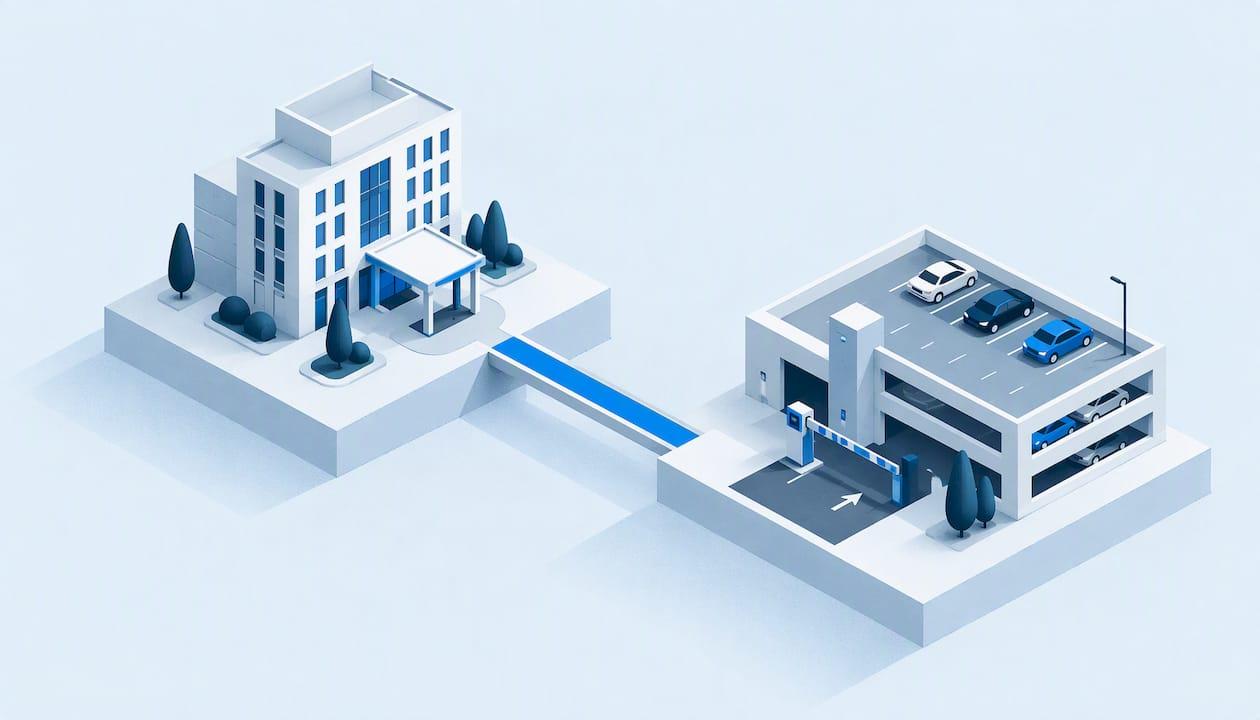
A PMS parking integration links the system that holds your guest, resident or permit records with the tools that control and enforce parking, so one record drives access, charges and citations. In hotels, PMS means the property management system. In residential and municipal parking, it often means a permit management system. Both uses lead to the same goal: stop re-keying plates and permits into separate tools, and keep one trail of who parked where, on what authority, and what they paid.
This guide explains what the term means in each setting, what data moves between systems, how fast it moves, what a setup requires and what drives the price.
TL;DR
- "PMS" means a hotel property management system, a permit management system or a parking management system, depending on who is talking. Confirm which one before you scope anything.
- Integrations run on APIs. The PMS passes reservation or permit data to the parking side, and the parking side returns status, payments and violations.
- The core data is plates, vehicles, permits, zones, payments and citations. Timing varies: one U.S. city specification caps average latency at 90 seconds per 100 transactions.
- Cost depends on scope: number of integrations, custom development, hardware, payment processing and portfolio size. No standard price exists.
- Set payment security and audit logs up at the start, not after go-live.
Table of Contents
- What PMS means in a parking integration
- What an integration connects
- How the data moves
- Which workflows an integration can support
- What gets synced, and how quickly
- What you need to set up an integration
- Security, privacy and audit trails
- What a PMS parking integration costs
- Questions to ask any vendor
- Our perspective
- See it on your own properties
- FAQ
- Sources
What PMS means in a parking integration
The search term is ambiguous, so start there. Three meanings show up in U.S. parking work.
Property management system (hotels). The hotel's core platform for reservations, folios and guest data. Parking connects to it so a registered guest can be recognized and a parking charge can be posted to the room.
Permit management system (properties and cities). The City of Berkeley's 2025 procurement document uses PMS this way. It requires a permit system to handle online permits, payments, license-plate-linked credentials, guest permits, renewals, zones, waitlists, pricing and audit trails. That list is a useful checklist for any residential or mixed-use property too.
Parking management system (operations). The regional ITS architecture describes it as electronic monitoring and management of parking facilities, covering vehicle detection, occupancy, driver information, rates, fee collection and interfaces with financial systems.
If you manage a multifamily community, the "PMS" you integrate with may be your resident management software. If you run a hotel, it is the hotel PMS. If you run a lot, it may be nothing more than your own permit database. The method below applies to all three.
What an integration connects
The parking side of a property is rarely one tool. It is usually a mix of gate or access equipment, license plate recognition (LPR), a citation process, payment collection and a towing contact. An integration ties these to the record in your PMS.
The Berkeley specification gives a realistic picture of the surface area. It calls for open APIs and real-time integration with parking-access and revenue-control equipment, citation management, LPR, mobile or text-to-pay services, pay stations and local databases. You will not need every one of those. Most properties need three or four.
Common pairings
| PMS record | Parking side | What it enables |
|---|---|---|
| Hotel reservation or check-in | Guest permit or validation | Registered guests parked without a front-desk visit |
| Lease or resident record | Resident permit and vehicle list | Permits that start and end with the lease |
| Vendor or contractor record | Temporary permit | Time-limited access with an expiry |
| Plate on file | LPR or mobile enforcement | Officers see permit status on the spot |
| Charge or fee | Payment record | Parking fees tied to the same history |
The common thread is that the plate and the person stay linked. When a violation is written, the history behind that vehicle is already attached.
How the data moves
Most modern integrations use APIs. According to the Parking Professional, REST APIs use HTTPS and return JSON, and a hotel PMS can send validation codes to the parking revenue-control system when a guest checks in. Real-time exchange is typically handled by webhooks, where one system notifies the other the moment something changes. Older or simpler integrations may instead poll on a schedule, asking "anything new?" every few minutes.
This matters for your expectations:
- Webhook or event-driven: a new reservation or a canceled permit shows up on the other side within seconds to a minute or two.
- Scheduled sync or file transfer: updates arrive on a cycle, such as every 15 minutes or nightly. That is fine for billing, poor for gate access.
Hotel standards
On the hospitality side, the hotel technology association's workgroups include HTNG Express, a JSON-based message standard meant to make vendor integrations with property management systems quicker and simpler. If your PMS vendor supports a standard like this, ask the parking vendor whether it connects the same way. Integrations built on a standard are generally easier to maintain than one-off custom work.
Which workflows an integration can support
The Berkeley document lists the range of workflows that a U.S. permit and parking system can cover: permit applications, approvals, renewals, cancellations, guest permits, waitlists, plate-based credentials, LPR validation, gate connections, citations, pay stations, text-to-pay and, in some operations, dynamic pricing. Here is how that plays out for the property types we serve.
Hotels and resorts
A registered guest drives in, the plate is read or entered, and the system checks for an active stay. The charge then goes to the reservation. Valet and self-park often need different handling: for valet, many operators link the PMS after the car is parked or at checkout, so the curbside stays fast. See how we approach hotel and resort parking for the operational view.

Multifamily and HOA communities
Here the integration is about eligibility and lifecycle. A resident gets a permit tied to a lease, visitors get time-limited guest permits, and move-outs end access automatically. Overnight stays are the common pain point, and our write-up on overnight guest parking covers the operating rules property teams need.
Mixed-use and commercial lots
Tenants, retail visitors and public parkers share space. Integration lets each group follow its own rules while reporting rolls up into one view. Our pages on mixed-use development parking and commercial parking lot management go deeper.
Enforcement and towing
The payoff of a clean integration shows up when someone is in the wrong space. An officer checks a plate and sees permit, guest and payment status instantly, writes the citation, and the record links to any towing action. That is the idea behind parking violation management and mobile parking enforcement.
What gets synced, and how quickly
Commonly synchronized fields:
- Parker and vehicle records, including license plates
- Permits and their status, zones and applications
- Payments and charges
- Citations and enforcement events
- Occupancy or availability and rates, where the property uses them
Timing is set by the integration design, not by a universal rule. For a concrete benchmark, the Berkeley specification requires exchanges among parking systems to average no more than 90 seconds for every 100 consecutive transactions, with data viewable by end users after delivery. That is a public-sector requirement, but it gives a fair yardstick when you write your own.
A useful way to decide: match the speed to the consequence.
| Data | Needs near real time? | Why |
|---|---|---|
| Guest check-in and permit activation | Yes | A guest at the gate cannot wait for a nightly update |
| Permit cancellation or move-out | Yes | Access should end when the right ends |
| Citation status | Yes | Officers need current permit and payment status |
| Charge posting and reporting | Not necessarily | Batch timing is usually fine |
What you need to set up an integration
Before you talk to any vendor, collect these items.
- PMS API access. Confirm your PMS vendor offers an API, who approves access and whether there is a fee. Some vendors charge for each connection.
- A data map. List each field on both sides: plate, unit or room, name, dates, permit type, zone, charge code. Decide which system is the source of truth for each field.
- A test environment. You want a staging copy of both systems so you can test check-ins, cancellations and edge cases before real guests or residents are affected.
- Payment handling decisions. Where do charges post, and who touches card data? More on this below.
- Documentation. The Parking Professional says a REST API with comprehensive documentation is the baseline expectation, and operators should avoid proprietary protocols that require custom development for every integration. That advice holds for any vendor you evaluate, including us.
Plan the rollout in stages: scope the work, configure it, test it, pilot it on one property, then extend to the rest of the portfolio. A pilot on a single property catches the odd cases, such as a guest who changes rooms mid-stay or a resident with two plates, before they multiply.
Security, privacy and audit trails
Parking integrations touch payments and personal data, so decide the ground rules early.
Payment card data. The PCI Data Security Standard is a global standard for any entity that stores, processes or transmits cardholder data, and it prohibits storing sensitive authentication data after authorization. Compliance means knowing where cardholder data lives, fixing vulnerabilities and removing data you do not need. The practical move for most property teams is to keep raw card numbers out of the parking and PMS databases entirely, using a payment processor that returns tokens instead. Ask your payment provider and your acquiring bank how your scope is defined, and have a qualified security assessor confirm it if you handle cards directly. Note that the PCI Council has issued newer versions of the standard since the 3.2.1 guide cited here, so check the Council's current documents for your assessment.
Connection security. Require HTTPS, validate certificates and authenticate webhooks, so only your systems can post events to each other.
Audit logs. Every permit change, charge and citation should record who did it and when. Berkeley's specification asks for audit trails as a core requirement, and for good reason: when a resident disputes a ticket or a guest disputes a charge, the log settles it. If your integration cannot show the history behind a vehicle, you will end up reconstructing it from emails.
Access control. Give front-desk staff, enforcement officers and regional managers different permissions. Role-based access limits who can waive a citation or change a plate.
For how payment records connect to parking records in practice, see our guide to parking payment integration.

What a PMS parking integration costs
There is no standard price, and public documents do not publish one. The Berkeley specification does not state a dollar figure for integration, so cost depends on the scope you require. These are the drivers to expect on any quote:
- Number and type of integrations (PMS, payments, LPR, access control)
- API work, and any custom development if the PMS has a limited API
- LPR and access hardware, where used
- Payment processing fees
- Hosting model
- Data migration from current records
- Implementation, training and ongoing support
- Security and compliance work
- Transaction volume and number of properties
Hardware is usually the largest swing. A software-only integration for permits and guest passes costs far less than one that adds cameras and gates, so separate those two lines when you compare bids. Also ask whether pricing is per property, per transaction or per user, because portfolio scale changes the math.
Questions to ask any vendor
- Which PMS or resident systems do you connect to today, and how (API, file transfer, middleware)?
- Is the connection event-driven or scheduled, and what is the typical delay?
- Who is the source of truth for plates and permit status?
- What happens if the PMS is offline? Does parking keep working and then catch up?
- How are payments handled, and does card data ever enter your database?
- Can I see the audit log for one vehicle from permit to citation to tow?
- Can you run hosted, client-hosted or white-label if our IT policy requires it?
- What does onboarding cost, and who does the work?
Vague answers to questions 2, 4 and 6 are the usual warning signs.
Our perspective
Most parking problems we see at multi-property operators are not caused by missing features. They come from fragmented records: permits in one tool, guest passes in another, citations on paper or in a spreadsheet, and payments somewhere else. Each system is fine alone. The trouble starts when someone asks what happened to one vehicle and nobody can answer in one place.
That is why we built MyParkingMgr around a unified record for guest access, permits, violations, payments and towing. When every action ties to the vehicle's history, integration stops being a side project and becomes the way the platform works. Audit capabilities, customizable workflows and portfolio-wide reporting sit on top of that record.
We also think deployment should fit your policies, not the other way around. That is why the platform is available as hosted SaaS, client-hosted or white-label. And we are careful about what we promise: we scope integrations against what can be verified for your environment, and we say so when something needs a closer look during assessment.
MyParkingMgr
See it on your own properties
If you manage hotels, multifamily communities or lots and want one record behind guest access, permits, violations, payments and towing, start with a walk-through of how our platform features fit your workflow. Onboarding is free ($0, one-off), and we begin with an assessment of your PMS and parking setup so the scope is clear before anything is built.
Ready to talk through your integration needs? Contact our team or review the guest parking management module first.
FAQ
What does PMS integration stand for in parking?
It means connecting a property management system, or a permit management system, to your parking tools so data flows between them. In hotels, the PMS is the reservation and folio platform. In residential and municipal settings, it often refers to the permit system. Always confirm which one a vendor means.
How long does it take to sync data between a PMS and parking software?
It depends on the design. Event-driven connections using webhooks can update within seconds, while scheduled syncs run on a cycle. One U.S. city specification sets an average of no more than 90 seconds per 100 consecutive transactions as its requirement. Use that as a reference point when you write your own.
How much does a parking management system cost?
No standard price applies. Costs depend on the number of integrations, custom development, hardware such as LPR cameras and gates, payment processing, hosting, data migration, support and the number of properties. Ask for a quote on your scope, and separate software from hardware so bids compare fairly.
Is a PMS parking integration safe for payments?
It can be, when set up with care. Keep raw card data out of your parking and PMS databases through tokenization, use HTTPS and authenticated webhooks, and keep audit logs. Confirm your PCI DSS scope with your payment provider and acquiring bank.
Do I need a PMS integration for valet parking?
Not always at the curb. Many operators link the PMS after the car is parked or at checkout, using the integration mainly for billing and reporting so the arrival stays fast.
Sources
- City of Berkeley, Parking Management and Permit Management System RFP (2025)
- ITS Architecture 2021 Update, Parking Operator
- Parking Professional, Parking API Integration Guide
- AHLA, HTNG Workgroups
- PCI Security Standards Council, PCI DSS v3.2.1 Quick Reference Guide