
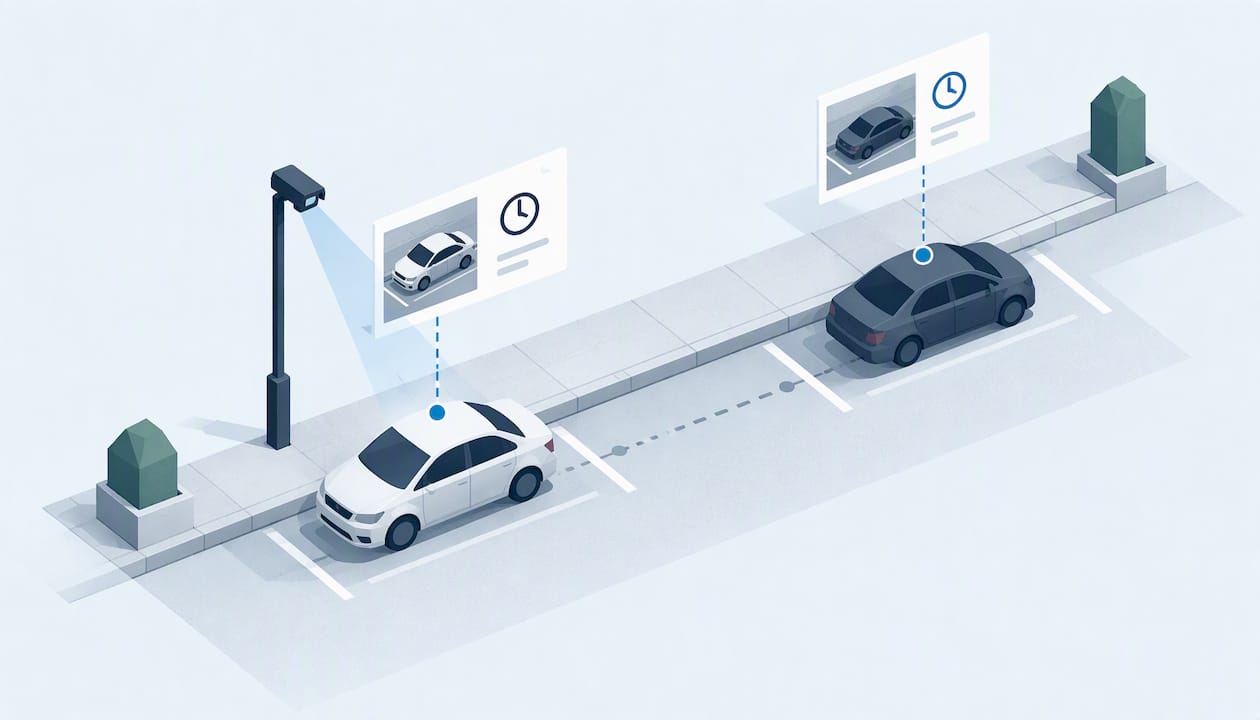
Time-limited parking is enforced by proving how long a vehicle has stayed in one place. Officers or cameras record the plate, location and time, come back after the posted limit, and cite any vehicle that has not moved. The details vary by city: how far you must move, whether Sundays count, what the fine is. If you manage a property or a lot, the same logic applies to your own rules, and it only holds up if your records are as solid as a city's.
This guide covers both sides. First, how public enforcement actually works, with examples from US cities. Then what property managers can borrow from it.
TL;DR
- Enforcement rests on a time record: tire chalk, a license plate reader (LPR) "electronic chalk", or a handheld entry with plate, place and time, followed by a second check.
- Moving a few feet rarely resets the clock. Cities set their own distances, from 150 feet in Monterey to two blocks in Eugene.
- Hours, Sundays, holidays, grace periods and fines are local. The sign on the block and the city code decide, not a general rule of thumb.
- Private lots and communities need the same discipline: a clear rule, a timestamped record and a consistent second check before anyone is ticketed or towed.
Table of Contents
- What a time limit requires of a driver
- How officers prove a vehicle overstayed
- Does moving the car restart the clock?
- Sundays, holidays and hours outside the sign
- Grace periods, fines and towing
- How to find the rule for a specific block
- What this means for private lots and communities
- Our perspective: the record matters more than the patrol
- Putting time-limit enforcement into software
- FAQ
- Sources
What a time limit requires of a driver
A posted limit means the vehicle may stay for that period and no longer. Monterey, California, says limits are shown by signs or curb markings, and that when the period ends the driver must move the vehicle at least 150 feet.
The sign is the starting point, but not always the whole rule. Cincinnati's police procedure says posted restrictions govern where they exist. Where nothing is posted, a vehicle still may not stay parked more than 14 hours. So a block with no sign is not automatically a block with no limit.
Residents often have an exception. Savannah's revenue ordinance provides residential permits that allow unlimited parking in qualifying time-limit spaces inside the permit holder's color-coded zone, with stated conditions and exclusions. A permit helps only inside its own zone and only where the ordinance says so.
How officers prove a vehicle overstayed
A ticket for overstaying needs two facts: when the car was first seen and that it was still there after the limit. Cities collect those facts in a few ways.
Tire chalking
The oldest method is still the most common. Rockville, Maryland's police general order calls tire chalking the most common method of monitoring how long a vehicle sits in a time-zone area. The officer marks a tire, returns after the limit and checks whether the mark is still in the same place.

Chalk is a legal marker, not graffiti. Monterey states that removing a chalk mark from a tire is illegal.
Two-pass logging
Saint Paul describes a more record-based version. On the first pass, officers record the plate, location, time and position and mark the vehicle. On the second pass, a vehicle still in the same spot beyond the posted limit is cited. The mark is a convenience. The written record is what supports the citation if a driver disputes it.
License plate readers
Cameras now do the first pass in many cities. Kirkland, Washington uses electronic chalking: an LPR camera captures the plate with a date and timestamp, the officer returns when the limit expires, an alarm flags a vehicle still present, and a citation may then issue. Monterey also uses a chalk-less camera system alongside chalking.
San Jose's program is explicit about scope. The city says its parking compliance cameras photograph, document and file parking violations for rules such as timed parking and residential permit parking, and it limits what the data may be used for. That kind of written limit on camera data is worth copying in any setting.
Multi-day rules
Some rules run for days rather than hours. Stamford, Connecticut has a 120-hour same-space rule. Officers chalk the vehicle and return five days later. A vehicle still in the same position is tagged for towing, with at least 24 hours before removal. Tuolumne County, California's code treats a vehicle left on a public street more than 72 consecutive hours after notice as a violation unless it is moved at least 50 yards, and the vehicle may be removed at the owner's expense.
Does moving the car restart the clock?
Usually only if you move far enough, and "far enough" is set locally. The examples below come from city and county pages.
| Place | What the rule says |
|---|---|
| Monterey, CA | Move at least 150 feet after the posted period |
| Eugene, OR | Move at least two blocks; no return to the same block until after midnight |
| Tuolumne County, CA | Move at least 50 yards to avoid the 72-hour violation |
| Stamford, CT | Vehicle in the same position after five days is tagged for towing |
Two practical points follow. Shuffling a car to the next space on the same block usually does not count, and a return to the same block may be barred for hours. If you are parking near a limit, read the whole sign and the city's page, not just the number of hours.
Sundays, holidays and hours outside the sign
A time limit generally applies only during the hours posted or set by code. Lincoln, Nebraska enforces its meters 8 a.m. to 6 p.m., Monday through Saturday, and does not enforce on Sundays or listed holidays.
But enforcement days change. Bend, Oregon's code update, effective January 1, 2026, says Sunday and city-recognized-holiday parking rules continue not to be enforced, while special-event restrictions remain enforceable. A holiday can free you from a two-hour limit and still leave you in a temporary no-parking zone for a parade or festival.
A city can also extend its hours. Richmond, Virginia has announced enforcement of time-restricted parking on Saturdays, with a short grace period at the start. When a city changes its days, the warning period is usually brief, so check for a notice before assuming last year's habits still apply.
Grace periods, fines and towing
Do not count on a grace period. Most cities treat the posted limit as the limit. Where grace exists, it is specific. Cincinnati's procedure gives qualifying disabled motorists up to two hours beyond the legal meter period, but bars that extension during posted rush-hour restrictions.
Fines range widely. Lincoln's expired-meter fine is $15, increasing by $30 if unpaid within seven days. Monterey says vehicles beyond its 72-hour street maximum may be warned, cited and/or towed, and that neither a disabled placard nor a residential permit exempts them.
If you plan to dispute a ticket, the process matters more than the argument. Photograph the signs, the curb and your tire valve position, and note the time. Then follow the appeal instructions printed on the citation, because deadlines are short and local.
How to find the rule for a specific block
Cities do not use one format, so there is no single national lookup. Three routes work in most places:
- Read every sign on the block. Look for the hours, the days and the exceptions, such as permit zones. Curb markings can carry a time limit too.
- Check the city's parking or public works page. Monterey, Eugene, Lincoln and Stamford each publish rules, fees and enforcement details for their own streets.
- Use open data where it exists. San Francisco publishes parking regulations by blockface, including time limits and residential permits, so you can check a specific street.
When the sign and the web page disagree, trust the sign you are standing next to, then call the parking office. Rules change, and pages lag.
What this means for private lots and communities
City enforcement is a useful model because it has already solved the evidence problem. Every defensible citation answers the same questions: what was the rule, when was the vehicle first seen, was it still there later, and who checked?
Property managers face the same questions with weaker tools. Guest spaces, retail pads, hotel lots and apartment communities often have a limit, such as 24 hours for guests or four hours for visitors, but enforcement relies on a patrol notebook, a spreadsheet and memory. Disputes follow, and the manager has no record to resolve them.
Three practices carry over directly from the city examples above:
- Post the rule where drivers see it, and keep the wording identical to your policy. A limit that exists only in a lease addendum is hard to enforce against a visitor.
- Log the first sighting, not just the violation. Saint Paul's two-pass approach records plate, place, time and position at the start. A timestamped first entry is what turns "I think it was there all day" into evidence.
- Review automated alerts before acting. A camera flags a possible overstay; a person confirms it. Our piece on why ALPR alerts need human review explains where automated matches go wrong, and our guide to LPR enforcement policy and verification covers how to set that up.
If your rules are enforced by more than one person or across more than one site, consistency becomes the real problem. Two staff members applying a rule differently produces exactly the complaints that make residents distrust it. Our five steps for making private parking enforcement defensible walk through signage, evidence and escalation.
Our perspective: the record matters more than the patrol
When we talk with property teams about time limits, the question is rarely whether they can spot an overstay. It is whether they can show, weeks later, exactly what happened. A patrol that sees a car and writes a note has seen a violation. A system that holds the plate, the time, the permit status, the prior history and the outcome has built a case.

That is why we built MyParkingMgr around one unified record for guest access, permits, violations, payments and towing, rather than separate tools that each know a fraction of the story. When a visitor disputes a notice, the manager can look at the vehicle's history in one place instead of three. When a portfolio has several properties with different limits, each can keep its own workflow while the operator still sees the whole picture.
Our advice is plain. Write the rule so a driver can understand it in one read. Treat every first sighting as a record you may need later. Use automation to find candidates, and people to decide. Fairness and evidence are the same goal.
— MyParkingMgr
Putting time-limit enforcement into software
If you manage guest, visitor or short-stay parking across one property or many, a single system for sightings, permits, violations and payments removes most of the dispute work. You can see how parking enforcement software handles this, or look at how guest parking management keeps visitor stays within your limits. Deployment can be hosted SaaS, client-hosted or white-label, and on-boarding is free (0 USD, one-off). To see it against your own rules, request a demonstration.
FAQ
How long can I legally park in a time-limited space?
Only as long as the sign, curb marking or city code allows. Where nothing is posted, some cities still cap stays: Cincinnati's procedure says a vehicle may not remain parked more than 14 hours outside posted restrictions. Check the city's parking page for the street you are on.
Can I get a time-limit ticket on a Sunday or holiday?
Often not, but it depends on the city. Lincoln does not enforce meters on Sundays or listed holidays, and Bend continues not to enforce ordinary Sunday and holiday rules. Special-event restrictions can still apply, so read the signs for temporary notices.
Does moving my car a few feet reset the time limit?
Usually not. Cities set a minimum distance: 150 feet in Monterey, two blocks in Eugene, 50 yards under Tuolumne County's 72-hour rule. Eugene also bars returning to the same block until after midnight.
How do private property managers enforce a parking time limit?
They need the same evidence a city uses: a posted rule, a timestamped first sighting, a second check after the limit, and a record of the outcome. Many managers use LPR cameras or mobile enforcement to capture the first sighting, with a person confirming before a notice or tow. Our mobile parking enforcement page shows how that workflow runs.
Sources
- City of Monterey, CA: street and metered parking
- City of Monterey, CA: rules and regulations
- Cincinnati Police Department procedure manual
- Savannah 2019 Revenue Ordinance
- Saint Paul: Enforcement of Parking Regulations
- City of Kirkland: Parking Enforcement
- Rockville City Police: General Order on Parking Enforcement
- Stamford, CT: Parking
- Eugene, OR: Parking Tickets
- Tuolumne County Code, Chapter 10.24
- City of Lincoln, NE: Meter Operations
- City of Bend: Parking Code
- City of San José: ALPR Parking Compliance Cameras
- DataSF: Map of Parking Regulations