
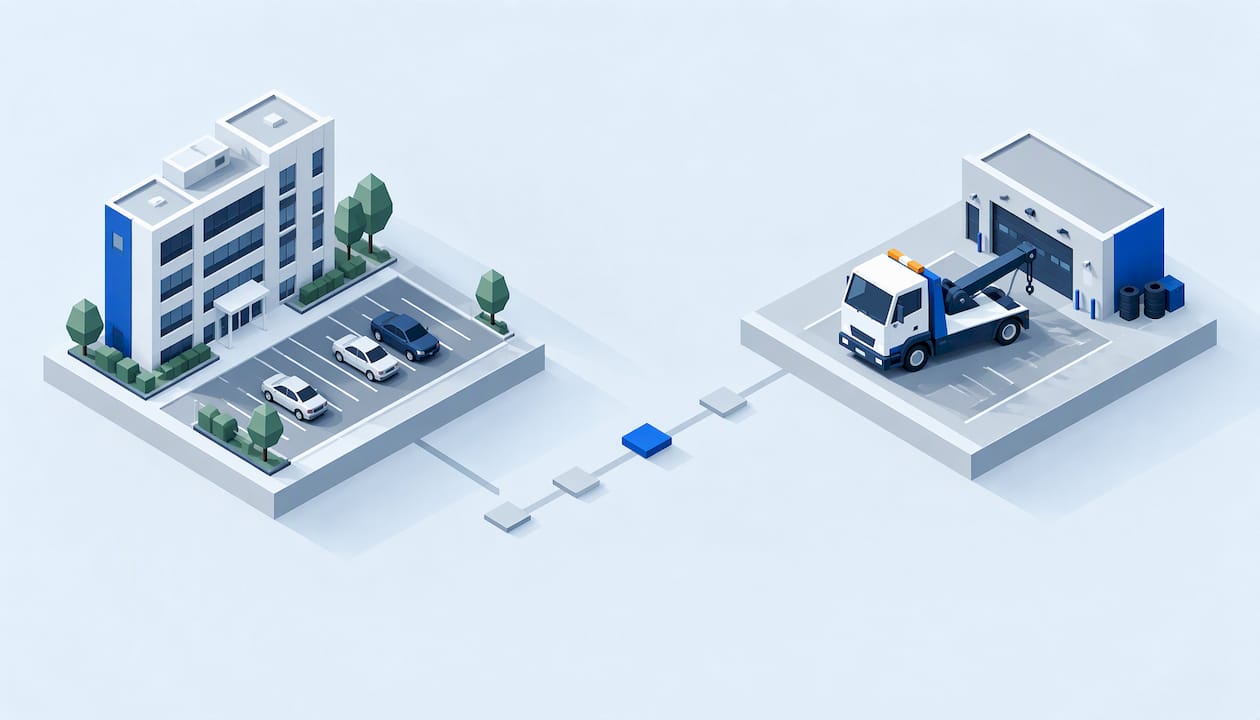
The right towing partner for a property is one that answers fast around the clock, charges what its filed fee schedule says, carries proper insurance, and documents every tow so you can defend it. Pick on those four things, write them into the agreement, and review the relationship against real data. Choosing on price or a quick phone call alone is how managers end up with complaints, disputes and legal exposure.
This guide is for property managers, HOA directors, hotel operators and multi-property teams who authorize tows on private lots. It draws on how cities and counties select their own tow providers, because those public procedures are a ready-made checklist you can borrow.
TL;DR
- Judge a tow company on experience, financial responsibility, equipment condition, storage security and 24/7 release, not on the lowest quote.
- Put response time, dispatch coverage, insurance, itemized invoicing and a filed fee schedule into a written agreement.
- Know your state and city signage rules before the first tow. They differ, and a tow without compliant signs can be unlawful.
- Tie every tow to a permit, guest or violation record so you can answer a complaint in minutes.
- Review the towing log monthly and tie renewal decisions to the data.
Table of Contents
- What to evaluate in a towing provider
- What the towing agreement should specify
- Fees, insurance and liability
- Rules to check before you authorize a tow
- Connecting tow requests to permits, guests and violations
- Preventing wrongful tows and handling complaints
- Monitoring your towing partner over time
- Our perspective on towing partners
- Put your towing workflow in one place
- FAQ
- Sources
What to evaluate in a towing provider
Cities that pick official tow providers spell out their criteria, and the list translates well to private property. Newport Beach, California, requires its council to weigh an applicant's towing-business experience and financial responsibility when choosing its police tow providers. The same ordinance looks at the quality of service to the public, including storage access and adequacy, whether an attendant is present or release is on call 24 hours, the availability of extra equipment, the reasonableness of fees, and the physical condition of equipment.
Turn that into a screening list for your own properties:
- Track record. How long has the company operated in your market? Ask for references from other property managers, not only from police rotations.
- Financial footing. A company that cannot absorb a damage claim becomes your problem. Ask for proof of insurance and business registration.
- Equipment. Look at the trucks. Wheel lifts, flatbeds and dollies suit different vehicles, and you want the right tool for a lowered sedan and for an oversized truck.
- Storage. Hyde Park, New York, requires tow storage that is secured, available 24/7, inside town limits and under the applicant's exclusive control. Those are sensible expectations for any partner you use. A resident whose car is gone at 11 p.m. needs to be able to retrieve it.
- Legal fit. The facilities, people and equipment must meet your municipal and state requirements. Ask which jurisdictions the company is licensed to operate in.
- Multi-site coverage. If you run a portfolio, ask whether one company can serve every property or whether you need a primary and a backup partner by market.
Run a competitive process
Glendale, California, requires an open, competitive process in which the police chief prepares a request for proposals with performance standards and evaluation procedures. You can do a light version of this. Send the same written questions to three or four companies, score the answers against the same criteria, and keep the scoresheet. If a tow is ever challenged, a documented selection process shows you chose a partner with care.
What the towing agreement should specify
A handshake arrangement is the most common weakness. A written agreement settles what happens when something goes wrong. Public agreements are a good model for what to include.
| Term | What to write down | Public example |
|---|---|---|
| Dispatch coverage | 24 hours a day, 7 days a week, with named phone numbers | Hyde Park requires 24/7/365 capability to answer dispatcher calls |
| Response time | A set maximum, with a defined way to handle exceptions | Forney, Texas, requires response within 20 minutes on a consistent basis |
| Subcontracting | Prohibited unless you approve it in writing | Hyde Park prohibits assigning tows to another agency |
| Insurance | Coverage for each truck and place of business, with proof on file | Hyde Park requires proof of insurance for each tow truck and place of business |
| Fee schedule | A complete, current schedule filed with you | Hyde Park requires a complete, current fee schedule with the application |
| Invoices | Itemized, matching the filed schedule | Hyde Park requires itemized invoices in line with the submitted schedule |
| Site cleanup | Debris removed after a tow or incident where relevant | Forney requires removal of wreckage, glass and vehicle parts from public places |
Your private-lot needs differ from a police rotation, so adjust. A residential community may care most about evening and weekend response and about the tow driver's conduct with residents. A hotel may need a partner who can move a vehicle discreetly before check-in. Whatever you choose, write the response time as a number, not as "prompt."
Escalation and communication
Name one contact at the tow company and one at your office, plus a backup for each. Specify how the driver confirms a tow with you before hooking up, how the company notifies you when a vehicle is released or claimed, and how fast it answers a complaint. Hyde Park's dispatcher moves to the next participant when a call goes unanswered, which shows how seriously public programs treat missed calls. You can set the same expectation: if a call goes unanswered for a set period, you may call your backup partner without penalty.

Fees, insurance and liability
Fee disputes cause most tow complaints. Settle them in the contract, not at the impound gate.
Filed rates. Seaside, California, requires tow permit holders to file a schedule of rates for each service and bars any charge outside it, with limited exceptions. Ask your partner for the same: a rate card that lists the hook-up fee, per-mile charge, daily storage, after-hours fee and any other line, with a clause that nothing else may be billed.
Reasonable charges. Rules on what a tow company may charge vary by state. California, for example, requires that towing and storage charges after an accident or stolen-vehicle recovery be reasonable, and it lists categories of presumptively unreasonable charges, including certain administrative, security, dolly and pull-out fees. That statute covers specific circumstances, so check what your own state says about private-property tows and ask your attorney which rules apply to you.
Insurance. Newport Beach requires its tow providers to carry adequate liability insurance at their own cost, with policies approved before designation. In your agreement, ask for certificates of insurance before the first tow, name your company as an additional insured if your counsel advises it, and require notice if coverage lapses. Require a damage-claim process with a response deadline.
Credentials. Hyde Park asks for proof of valid vehicle registration and inspection, DOT number display on each truck, and proof of authority to do business in the state. Collect equivalent documents from any partner and refresh them every year.
Repair-shop referrals. Hyde Park also requires compliance with restrictions on recommending particular auto repair or body shops. It is reasonable to ask your partner not to steer vehicle owners to any shop.
Rules to check before you authorize a tow
Even a perfect partner cannot make an improper tow lawful. The authority to tow comes from your state and city rules and from your signs, and the requirements differ widely:
- Florida. Statute 715.07 generally requires compliant tow-away notices posted before towing, placed prominently at driveway access points and maintained for at least 24 hours beforehand. The sign must carry the words "tow-away zone" and the tow company's name and current phone number, and local governments may require sign permitting and inspection.
- Orange, California. The city code sets minimum sign requirements: at least 18 by 24 inches, specific wording, the police department phone number and the legal citation, posted at each entrance and exit and no more than 150 feet apart.
- Hollywood, Florida. The municipal code requires specific sign wording and the days and hours of towing in set circumstances, and fee and company information where a written contract exists between owner and tow company.
- Hayward, California. Removal from private property requires police clearance or Traffic Bureau pre-authorization after signage inspection, and a vehicle owner who arrives before clearance must be released without charge.
The lesson is not to memorize any one city's rule. It is to confirm the rules for each property's city and state, and to build them into a checklist that your team and your tow partner both follow. Our guide on towing signage, authorization and records walks through what to document, and the piece on making private parking enforcement defensible covers the broader process. Have local counsel review your signs and your tow authorization steps.
Connecting tow requests to permits, guests and violations
A tow should never be a standalone phone call. Before anyone dispatches a truck, the person authorizing it should be able to answer four questions from one place:
- Does the vehicle have a valid resident, vendor or guest permit?
- Is there a registered guest visit for this plate right now?
- What violations and warnings are already on the record for this vehicle?
- Were the required signs in place at the time?
When those answers live in separate spreadsheets, email threads and a notebook in the patrol vehicle, mistakes follow. A guest who registered an hour ago gets towed, or a repeat violator cannot be shown to have had two earlier notices. Whatever system you use, the principle is the same: the tow request, the plate, the permit status and the violation history belong in a single record, time-stamped, with photos.
Also decide who is allowed to authorize a tow. Role-based rules help: patrol staff can document and recommend, a manager approves, and the tow company only accepts requests from named approvers. That stops a stray call from a resident or an unauthorized employee from starting a tow. A good violation letter with consistent fields supports the same trail when the step before a tow is a written notice.
Preventing wrongful tows and handling complaints
A wrongful tow costs far more than the fee: refunds, a damaged relationship with a resident, and possible legal claims. These habits reduce the risk. They are practical recommendations, so adapt them to your state's rules.
- Verify before dispatch. Check permit and guest status in real time. If you cannot verify, do not tow.
- Capture evidence at the scene. Photograph the vehicle, the plate, the space and the nearest sign before the truck arrives. Record time, location and the authorizing person.
- Give the owner a path. Post the tow company's name and phone number on signs where your rules require it, and make sure your office phone and the tow company's release hours are clear to residents.
- Respond to complaints quickly. Acknowledge a complaint the same day, pull the record, and share what you found. If the tow was wrong, fix it and cover the cost.
- Keep itemized invoices. Compare each invoice to the filed fee schedule. Dispute any extra charge with the partner, not the resident.
- Train the team. Everyone who can authorize a tow should know the signage rules for the property and the escalation steps for disputes.
Treat each complaint as data about your process. If three complaints trace back to the same lot, the cause is probably a sign or a permit gap, not bad luck.
Monitoring your towing partner over time
Signing the agreement is the start. A California Civil Grand Jury report on towing and impound practices in Los Angeles County cities recommends performance-based contract management: collect performance data, define service objectives, and link results to renewal decisions. The report notes that reporting should go beyond complaints and response times, and that specific fields such as vehicle descriptors, tow and release dates, and case numbers help agencies confirm that improper towing or storage is not happening.
A private-property version looks like this:
- Monthly log review. Pull every tow for the month by property, time, space type and authorizing person. Look for repeat complaints, tows at odd hours, and missing documentation.
- Response-time audit. Compare dispatch and arrival times with the number in your agreement.
- Invoice match. Check a sample of invoices against the filed fee schedule.
- Sign inspection. Walk each property regularly. Faded, damaged or missing signs weaken your authority to tow, so repair them first.
- Annual review. Refresh insurance and credentials, review the data with the partner, and decide whether to renew, renegotiate or add a backup company.
Share the findings with the partner. Good companies welcome clear feedback, and a documented history gives you leverage if you need to end the relationship.
Our perspective on towing partners
Most towing problems we see are not towing problems. They are record problems. A good partner shows up fast and charges fairly, but your protection when a resident disputes a tow is the quality of your own records: the permit status, the guest registration, the violation history, the sign evidence and who approved the tow.
That is why we built MyParkingMgr as one unified record for guest access, permits, violations, payments and towing, so a tow request is tied to the vehicle's history and not to a phone call. Our platform is designed to support audit trails, custom workflows and role-based approvals, so each property can decide who may authorize a tow and what must be on file first.
For operators with several properties, we think the answer is portfolio-level oversight: the same standards, the same documentation and the same review of your tow partners across every site. Our towing management tools are designed for exactly that.
MyParkingMgr
Put your towing workflow in one place
If you manage more than one property, MyParkingMgr's towing management is designed to connect each tow request to permits, guest records and violations, with audit trails and approval roles you configure. It can run as hosted SaaS, client-hosted or white-label, and on-boarding is free ($0 one-off).
You can see how it fits your portfolio by requesting a demonstration, or look at the wider parking management platform first.
FAQ
How many towing companies should a property use?
Many operators name a primary partner and at least one backup. The backup covers missed calls, overnight gaps and properties in other markets. Put both under the same written standards for response, fees and insurance.
Should I choose the cheapest towing quote?
Compare quotes, but weigh them against service. Public programs score experience, financial responsibility, storage access, equipment condition and fee reasonableness, not price alone. A low hook-up fee means little if response is slow or invoices contain extra charges.
What should a towing sign on private property include?
It depends on your state and city. Florida's statute, for example, calls for the words "tow-away zone" and the tow company's name and phone number, while Orange, California sets size and spacing rules. Check your local code and have counsel review your signs.
How often should I review my towing partner?
Review the towing log monthly and run a fuller review each year, when insurance and credentials are refreshed. Use the data to decide on renewal, renegotiation or adding a second partner.
What records should I keep for each tow?
Keep the plate, vehicle description, photos, time and location, the sign evidence, permit or guest status, the authorizing person, the tow company's invoice and the release date. These let you answer a complaint or dispute quickly.
Sources
- Newport Beach Municipal Code, Chapter 5.15, official police tow providers
- Hyde Park, NY, Tow Rotation Policies and Procedures
- Glendale City Code, Chapter 10.55, official police tow services
- Forney, TX, Wrecker/Towing Service Agreement
- Seaside City Code, Chapter 5.70, contract-patrol towing operations
- California Vehicle Code section 22524.5
- Florida Statutes, section 715.07 (2025)
- Orange City Code, Chapter 10.75, removal of vehicles from private property
- Hollywood, FL, Code section 111.02, towing
- Hayward, CA, facts concerning removal of vehicles from private property
- California Civil Grand Jury, Towing and Impound Management Practices