
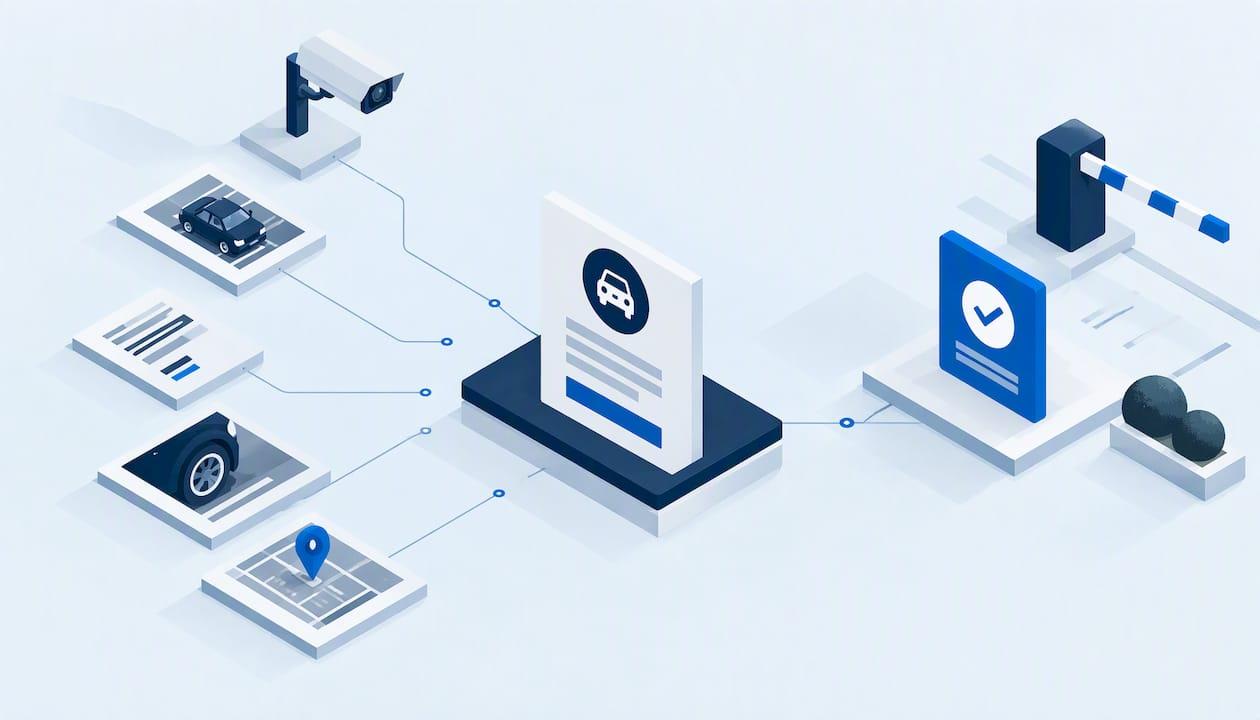
A parking incident report is the internal record your staff create when something happens on your lot: a collision, a slip and fall, a break-in, a gate failure, a confrontation, a disputed tow. It works when frontline staff can log it in minutes, a supervisor verifies it, and management can later pull it up by date, location and vehicle. This guide covers what to capture, who does what, when police are involved, and how to keep the records useful once the incident is closed.
It is written for property managers, HOA directors, hotel managers and lot operators who run parking across one site or many.
TL;DR
- Define a short list of reportable events, or staff will drown the system in minor complaints and stop using it.
- Capture the same core fields every time, and file within 24 hours, whether or not police respond.
- Police often do not respond to non-injury private-lot collisions, so your own report may be the only record. Many cities offer online self-reporting.
- Keep reports factual. Leave fault, liability and cost guesses to insurers and attorneys.
- Review reports monthly. Repeated incidents in one spot are a pattern, and a documented pattern creates a duty to act.
Table of Contents
- Why your own incident record matters
- Decide what counts as an incident
- The fields every report needs
- Write it factually
- Who does what: a simple escalation workflow
- When police are involved, and when they are not
- Violations, tows and disputes: link them to the incident
- Turn reports into patterns
- Our perspective: one record, not five tools
- What to look for in software for incident workflows
- See it on your own properties
- A starter checklist
- FAQ
- Sources
Why your own incident record matters
Most people searching this topic land on pages about what a driver should do after a parking lot crash. That is the driver's side. Your side is different: you need a record that exists whether or not anyone calls the police, that your staff fill in the same way every time, and that you can produce months later.
Three reasons make this worth the effort.
Police may never write it down. Departments set their own thresholds. Louisville Metro Police, for example, limits the collisions it investigates and reports on, and non-injury collisions in private lots generally fall outside that unless a criminal act is involved. If an officer never attends, your report is the first and sometimes the only account of what happened.
Insurers and courts ask about history. Risk guidance from Travelers describes foreseeability: if you have a documented history of incidents in an area and make no reasonable improvement, such as lighting, cameras or changed patrols, your exposure can rise. The same records can also show that an incident was isolated. Either way, you need them.
Reports are a management tool. Parking Operator Hub frames incident logging as performance management as well as safety: consistent logs reveal equipment faults and staff non-compliance, so you can schedule maintenance and patrols from data instead of reacting to the latest complaint.
Decide what counts as an incident
The most common way a reporting system fails is by being too broad. When every tenant gripe, noise comment and ticket dispute becomes an incident, staff get fatigued and the reports that matter get buried. Facility Parking Guide points to this reporting fatigue and recommends a clear, actionable list of reportable events.
A workable starting list for most residential, hospitality and commercial lots:
| Category | Examples | Typical urgency |
|---|---|---|
| Property damage | Vehicle struck in a lot, damaged gate arm, broken barrier | Same shift |
| Injury or medical | Slip and fall, medical emergency, assault | Immediate escalation |
| Security | Break-in, theft, vandalism, trespass, suspicious activity | Immediate or same shift |
| Equipment failure | Gate, intercom, lighting, camera or payment device down | Same shift |
| Enforcement dispute | Contested violation, disputed or complaint-triggering tow, confrontation with staff | Within 24 hours |
Routine items belong elsewhere. A resident asking about a guest pass is a service request. A vehicle without a permit is a violation record. Keep those in their own queues so the incident log stays small enough to read.
The fields every report needs
Facility Parking Guide lists the core fields an internal system should capture regardless of police involvement: a unique incident number, a precise location, conditions at the time, and contact details for everyone involved and any witnesses. We would turn that into a form like this.
- Incident number. Generated automatically, never typed by hand, so reports cannot be duplicated or lost.
- Date, time and reporter. Who filed it, and when it actually happened versus when it was logged.
- Precise location. Property, level or zone, and bay or nearest landmark. "The back lot" is not a location.
- Category and severity. Pick from your fixed list, not free text.
- People involved. Names, phone numbers, role (resident, guest, vendor, employee), and witnesses.
- Vehicles involved. Plate, state, make, model, color, and permit or guest-pass status if any.
- Conditions. Lighting, weather, surface, any signage in view.
- Factual description. What was seen or heard, in order.
- Evidence. Photos, video clip references, and any citation or tow record connected to the event.
- Police and emergency response. Whether called, agency, report or case number, and officer name if given.
- Follow-up. Owner, due date, outcome.
The same guide recommends submitting documentation to facility management within 24 hours of the occurrence. Treat that as a ceiling, not a target. Details fade fast, and so does footage.
Write it factually
Experienced operators keep incident reports free of opinion. Staff are witnesses, not investigators, and fault and liability are legal determinations. According to Facility Parking Guide, opinions or estimated repair costs written into an internal report can become discoverable, prejudicial evidence if a claim reaches litigation.
In practice, train staff on the difference:
- Write: "White sedan, plate on file, contacted the left gate arm while exiting. Arm detached from housing. Driver stated she was not injured."
- Avoid: "Driver was careless and should pay for the gate. Probably a $900 repair."
The first can be verified. The second invites a dispute. Record what people say as statements, in quotes where possible, attributed to them.
Who does what: a simple escalation workflow
A report is only as reliable as the process around it. Parking Operator Hub recommends training staff on an escalation matrix before incidents occur, with frontline staff logging in real time without investigation duties, and shift supervisors verifying completeness and accuracy before management review. That division keeps the log current without making the person on the ground responsible for conclusions.
Here is a five-step version that scales from a single garage to a portfolio.

Step 1: Stabilize and call for help
Injuries, fire, threats and active crimes go to 911 first. Paperwork waits. Your escalation matrix should say who is notified, in what order, for each category, and the list should be posted at the facility.
Step 2: Log it as it happens
The frontline employee opens a report and fills in the fields above from the scene: photos, plates, witness contacts. Mobile entry beats a paper pad that gets typed up later, because typing up later is where details go missing.
Step 3: Preserve evidence
At sites without on-site staff overnight, remote monitoring needs predefined protocols. Parking Professional notes that digital evidence can be overwritten if footage is not secured promptly. Make saving the clip a named step with a named owner, and write down the camera and time range saved.
Step 4: Supervisor verification
The shift supervisor checks that required fields are filled, that nothing speculative slipped in, and that any police case number is recorded. Incomplete reports go back to the author the same day.
Step 5: Management review and closure
A property or operations manager assigns follow-up: repair a gate, change lighting, notify the insurer, contact a resident. The report closes only when the action and outcome are logged.
When police are involved, and when they are not
This is the part drivers search most, and it affects how you set expectations with residents and guests.
There is no single national rule. Some departments will respond to non-injury collisions on private property only in limited circumstances, such as a crime or a hit and run. For lower-level crashes, many cities direct people to file themselves. Joliet, Illinois lets people report private property crashes online when the case meets its criteria, and Providence, Rhode Island offers self-reporting for non-emergency accidents on private property, including in parking garages. Fayetteville, Arkansas publishes a private property accident report form for citizens reporting an accident after the fact, which is not investigated by an officer.
What to do with that variety:
- Know your local department's policy and put a one-line version in your staff procedure: when to call, when to direct people to online reporting.
- Always log the event yourself, even when you tell the driver to file with police. Your report covers the property side: the gate, the lighting, the signage, the footage.
- Record the outcome. Note the report number if one exists, or note that police declined to attend.
- Do not give legal advice. Staff can say how to file with the local department. They should not say who is at fault.
When the incident involves a tow, state rules apply on top. California is one example of strict private-property towing rules, and the City of San Diego explains towing rights and how to report towing violations, including signage requirements. Your own state will differ, so check it before you write towing steps into your procedure. We cover the records side in our guide to towing signage, authorization and records.
Violations, tows and disputes: link them to the incident
Many of the incidents that cause the most friction are enforcement events. A resident says they were towed from a space they were entitled to. A guest says the pass never registered. A vendor blocks a fire lane and an argument follows.
These are easiest to resolve when the incident report points to the underlying records: the permit or guest registration, the violation with its photos and timestamp, the tow authorization, and the payment history. If those live in four different tools, someone has to assemble them by hand while the complaint ages.
The habit that helps most is to record every enforcement step as it happens, so a dispute becomes a lookup. Our article on making private parking enforcement defensible walks through that, and the one on reports that defend your permit policy shows which records to keep ready.
Turn reports into patterns
The log has a second life after each incident closes. Facility Parking Guide recommends that management review reports monthly to spot patterns that justify security or patrol improvements. A monthly review does not need to be elaborate. Sort by location, category and time of day, and ask four questions:
- Is one zone producing repeated damage or theft reports?
- Does the same gate, camera or intercom keep appearing in equipment reports?
- Do incidents cluster on certain shifts, suggesting a staffing or training gap?
- Are the same vehicles or people appearing across multiple events?
If a pattern appears, decide on an action and record the decision, even when the decision is to do nothing for now, with the reason. That record is what you will want if someone later asks what you knew and what you did. It ties back to the foreseeability point above.
For portfolios, run the same review across properties. A problem that looks like bad luck at one site often shows up at three. Our piece on a parking data pilot covers using operational data to make decisions.
Our perspective: one record, not five tools
We build parking management software for multifamily properties, hotels and lot operators, and the same failure shows up everywhere we look. Incidents are not hard to document. They are hard to connect. The incident note sits in an email thread, the violation sits in a spreadsheet, the permit sits in another system, the tow is a phone call, and the payment lives somewhere else. When a dispute arrives, someone spends an afternoon reconstructing a timeline.

Our view is that incident reporting should sit on the same record as everything else you do with a vehicle: guest access, permits, violations, payments and towing, with an audit trail showing who changed what and when. That is why we designed the platform around a unified record tied to vehicle history, with workflows you can configure to your own categories and escalation rules, role-based access so frontline staff log and supervisors verify, and reporting that spans a whole portfolio.
We also think software should fit your operation, not the other way around. Some operators want hosted SaaS, some need a client-hosted installation, and some want white-label. We support all three.
— MyParkingMgr
What to look for in software for incident workflows
If you are moving from paper or a patchwork of tools, judge options against your actual workflow rather than a feature checklist.
- Fixed categories with required fields, so reports are comparable and complete.
- Links between records. An incident should connect to the vehicle, permit, violation, tow and payment history without copy-paste.
- Roles and approvals. Staff log, supervisors verify, managers close.
- An audit trail showing edits and who made them.
- Photo and evidence attachments from a phone.
- Portfolio reporting, filtered by property, zone, category and date.
- Deployment that matches your IT and contract requirements.
Spreadsheets and general forms can work for one small lot. They get hard to manage once you have several properties, multiple shifts and enforcement activity feeding the same disputes.
See it on your own properties
Our platform covers violation management, guest parking and multi-property oversight in one interface, and you can see the full list on the features page. On-boarding is free ($0 one-off). If you want to walk through your own incident categories and escalation steps, request a proposal and we will map them to the platform with you.
A starter checklist
Before you change any tools, you can improve things this week:
- Write your reportable-event list on one page, five to eight categories.
- Fix the required fields and make them identical at every property.
- Name who logs, who verifies and who closes, per shift.
- Post an emergency contact list, in order, at each facility.
- Add a line on police policy for your city and your state's towing rules.
- Set a 24-hour filing deadline and a monthly review date on the calendar.
- Train staff with two sample reports, one factual and one speculative, and have them rewrite the second.
- Agree who preserves camera footage, and how long it is kept.
Visitor and guest records matter here too, since many disputes begin with a vehicle nobody can account for. Our five-step guide to visitor parking registration helps close that gap, and HOA boards may find the guide to enforceable guest pass and towing rules useful when drafting policy.
FAQ
Do we need to file a report if police already did?
Yes. A police report covers what the officer observed and decided. Your internal report covers your property: location, conditions, equipment, footage and follow-up. Record the police case number in your report so the two can be matched later.
How quickly should staff file an incident report?
Log the basics at the scene or as soon as the situation is safe, and complete the full report within 24 hours, the window Facility Parking Guide recommends. Security and injury incidents should reach a manager immediately, not at the 24-hour mark.
What should we not put in an incident report?
Leave out opinions on fault, legal conclusions and estimated repair costs. Stick to what was observed, what was said and what was done. Your insurer or attorney can advise on liability.
What if police decline to come to a minor private-lot collision?
That is common for non-injury crashes. Log the incident, collect plates and contact details from both drivers, take photos, and point them to your local department's self-reporting process if one exists. Note in your report that police did not attend.
Sources
- Parking Incident Reporting: Building a System That Works, Facility Parking Guide
- Parking Operations Incident Reporting: What to Log and Why, Parking Operator Hub
- Parking Night Operations Guide, Parking Professional
- Premises Security and Liability, Travelers
- SOP 7.1 Report Requirements, Louisville Metro PD
- Self-Reporting Car Accidents (Private Property), Providence Police Department
- Private Property Accident Report, Fayetteville Police Department
- Know Your Towing Rights, City of San Diego