
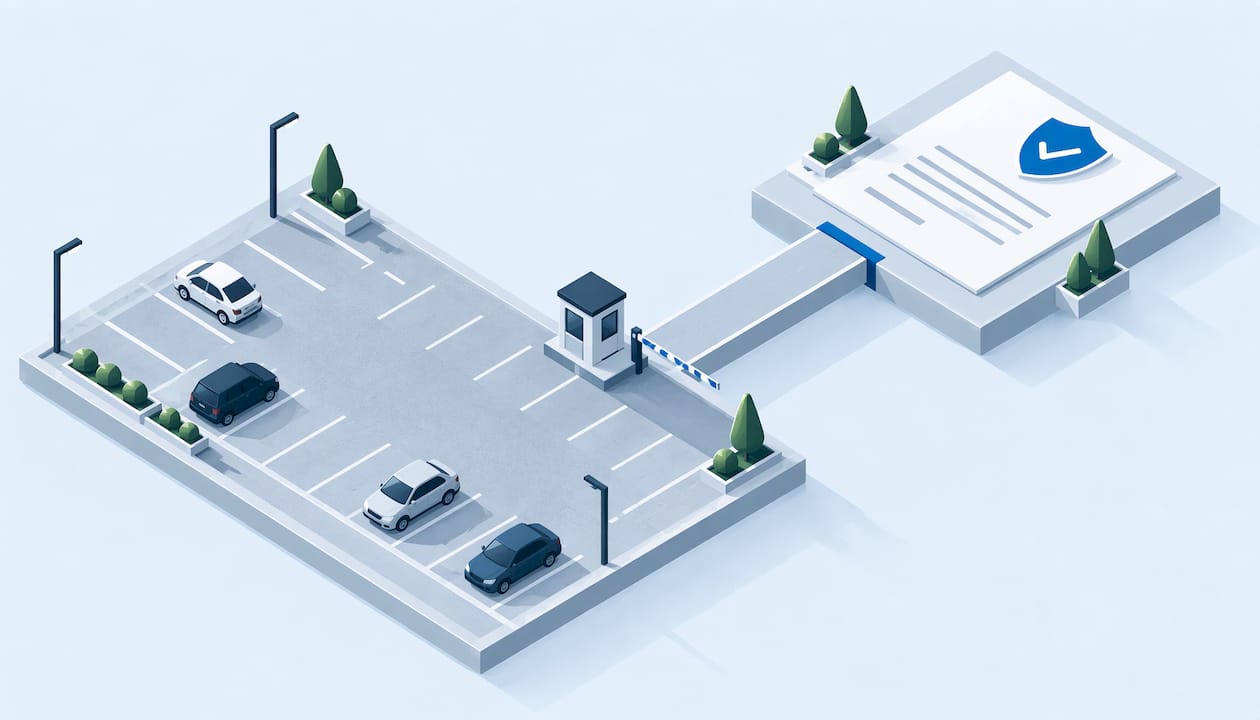
A parking liability waiver can limit your exposure for ordinary negligence claims, but only if it is clear, conspicuous, presented before the driver commits, and backed by a record you can produce later. Courts look at the wording, the notice and who held the keys, not at the fact that a form exists. The most reliable way to make a waiver hold up is to tie it to a verifiable record of each vehicle, permit, guest pass and incident, which is how we build parking operations at MyParkingMgr.
TL;DR
- A parking waiver is a contract term in which the driver agrees not to hold you responsible for certain losses, usually theft or vehicle damage. It generally covers ordinary carelessness, not gross negligence or intentional acts.
- Enforceability turns on clear wording, real notice, and custody. Self-parking with the keys retained is easier to defend than valet or attended storage.
- Some states restrict waivers by statute. New York, for example, voids garage waivers for the operator's own negligence.
- A waiver is only as strong as your records: timestamped acceptance, vehicle data, photos and incident logs.
- Have local counsel and your insurer review any waiver before you roll it out across a portfolio.
Table of Contents
- What a parking liability waiver does
- When a waiver holds up and when it does not
- State law changes the answer
- What a waiver usually cannot cover
- How to draft and present a waiver
- Why the record matters more than the form
- Where MyParkingMgr fits
- Our perspective
- FAQ
- Sources
What a parking liability waiver does
A parking liability waiver, also called an exculpatory clause, is a contract term in which a customer agrees not to hold the lot or garage responsible for certain losses, usually theft or damage to the vehicle. Waivers in practice often bundle three things:
- Release: the driver gives up claims against you.
- Assumption of risk: the driver acknowledges the risks of parking, such as collisions, theft, vandalism, third-party criminal acts, weather, hazardous surfaces and equipment malfunction.
- Indemnity: the driver agrees to cover your losses or legal costs. This differs from a waiver, which releases you from liability, while indemnity shifts the cost of a claim.
One real-world operator form also requires the customer to report vehicle damage within 24 hours or lose the release for that damage. That kind of reporting condition is useful because it forces a timely, documented complaint.
When a waiver holds up and when it does not
A waiver is enforceable generally only if it is clear, unambiguous, not contrary to public policy, and the signer was not induced by fraud or forced to sign. Courts generally will not enforce waivers for gross negligence, reckless behavior, intentional harm or criminal action.
Three factors drive most outcomes:
- Visibility and notice. Did the driver actually see the terms before committing?
- Bargaining power. Was the driver free to decline?
- Severity of misconduct. Even a clear waiver generally cannot shield a company from reckless or grossly negligent behavior.
Notice is where most waivers fail
A waiver on a sign the customer did not see or would not normally pass does not work. Courts have also held that mere retention of a parking receipt is not notice. In California, delivery of a claim check did not by itself create a contract containing the printed exclusions; whether the customer consented to be bound is a question of fact.
Practical consequence: the waiver must reach the driver before payment or arrival, and you need proof that it did. A printed notice on the back of a ticket is the weakest form.
Custody changes the analysis
When a driver hands over keys, as with valet or supervised storage, courts often treat the arrangement as a bailment, which carries a higher duty of care that a waiver may not fully absolve. Self-parking with keys retained looks more like a license and is easier to limit. Some courts void a waiver where the customer hands over the car and keys, while a preprinted machine ticket with the customer keeping the keys is more likely to be enforceable.

For hotels running valet, how a valet key works matters to the custody question, because what the attendant can access affects what duty you owe.
State law changes the answer
There is no single national rule. A few examples:
| Jurisdiction | What the sources show |
|---|---|
| New York | A garage or lot with capacity for four or more vehicles may not exempt itself from liability for the negligence of its employees. Property-loss liability can be limited only by a storage agreement with a specific per-vehicle limit of no less than $25,000. |
| Ohio | Broad parking waivers have been held void as against public policy. |
| Alabama, California, Louisiana | Courts have held that a preprinted ticket with an express waiver can give sufficient notice in some circumstances. |
| Texas | A pre-injury negligence release must state the intent to avoid liability for negligence in specific terms and be conspicuous, for example with a capitalized heading or larger type. Courts of appeals are split on releases of gross negligence. |
If you run properties in more than one state, you probably cannot use one form everywhere. Treat each state as its own template, reviewed by local counsel.
Third parties and event waivers
A waiver signed for one party does not automatically cover another. In Ryan v. Sea Colony, the Delaware Supreme Court held that a participant's event waiver did not automatically bar a claim against a separate parking-lot owner, because the relationship between organizer and lot owner was not established. If vendors, event organizers or tenants use your lots, name who is covered.
What a waiver usually cannot cover
- Gross negligence and intentional acts. Drafting that tries to waive them invites a court to throw out more than it needs to.
- Your employees' negligence in some states. Waivers generally do not apply to damage caused by negligent actions of garage employees.
- Statutory duties. Where a statute forbids the waiver, it fails.
- Minors' rights. A pre-injury waiver signed by a parent for a child can be unenforceable under a Michigan Supreme Court decision.
- Third-party property. Garage liability policies exclude damage to property of others in your care, so garagekeepers coverage is a separate question for your insurer.
How to draft and present a waiver
Following the drafting practices operators commonly recommend:
- Name the specific risks (theft, scratches, weather damage) rather than using sweeping language.
- Do not waive gross negligence or intentional acts.
- Use a conspicuous heading such as "Release of Liability".
- Include a dated signature block with a line confirming the driver read and understood it.
- Present it before payment or drop-off, not on a receipt afterward.
Source for the list: operator drafting guidance. After acceptance, give the driver a copy and a receipt. If you take custody, photograph the exterior, note existing damage and log the key handover.
Valet guidance also suggests a claim check with disclaimer language consistent with state law, reviewed by legal counsel or the insurer, and asking guests to remove valuables.
Why the record matters more than the form
When a claim arrives, the question is rarely "do you have a waiver?" It is "can you show this driver saw it, accepted it, and what condition the car was in?" That is a records problem. Paper forms, scattered spreadsheets and separate tools for permits, guests and towing leave gaps that opposing counsel can use.
On a multi-property portfolio, the gaps multiply. Different sites carry different wording, different acceptance methods and different incident files. A defensible approach has five parts:
- One approved waiver template per state, with version history.
- Acceptance captured digitally at registration, with a timestamp.
- Vehicle and permit records linked to each acceptance.
- Incident, violation and towing history in the same record. Our guide on making private parking enforcement defensible walks through it.
- Reports you can pull by property when a claim or dispute lands.
If your waivers sit alongside signage and parking terms, the same logic applies to the agreements themselves. See our overview of shared parking agreements and the parking compliance management basics.
Where MyParkingMgr fits
MyParkingMgr is parking management software for multi-property environments. It brings guest access, resident and vendor permits, violations, payments and towing into one record tied to vehicle history, with audit trails, customizable workflows and role-based users. It can run as hosted SaaS, client-hosted or white-label. Our free on-boarding costs $0 one-off.
For waivers, that means acceptance and the surrounding record can live in the same place as the permit and the incident file. You can see how QR visitor parking registration and the resident parking portal handle registration, or look at multi-property parking management for portfolio oversight. To talk through your sites, contact us.
For towing exposure, our guide to building a defensible towing record covers the documentation side.
Our perspective
A waiver is a sentence in a contract. What protects you in a dispute is the file behind it: who accepted, when, on which version, for which vehicle, and what happened afterward.
We built MyParkingMgr around a unified record because fragmented tools are where defensibility breaks down. When permits, guest passes, violations, payments and towing all point to the same vehicle history, you can answer a claim with facts instead of reconstruction.
Customizable workflows matter here too. Each property, and each state, has its own rules, so your acceptance steps should follow your operation, not a rigid template. Audit trails and portfolio reporting let you see which sites are consistent and which are not, before a claim shows you.
MyParkingMgr
FAQ
Does a parking liability waiver hold up in court?
Often it does for ordinary negligence, when the wording is clear and the driver had real notice. It usually will not protect against gross negligence, intentional misconduct or situations where a statute bans the waiver. State law and custody of the keys both shape the result.
Can a property manager write its own waiver?
Yes, but it should be reviewed first. Operators planning blanket releases, long-term storage contracts or valet programs should involve legal counsel before using one. Use specific risk language and a conspicuous heading, and keep one reviewed version per state.
Does a waiver replace insurance?
No. A waiver limits certain claims, while insurance responds when a claim succeeds anyway. Garage liability policies exclude customers' property in your care, so ask your insurer about garagekeepers coverage for valet or attended operations.
Is a sign enough to create a waiver?
Usually not on its own. A sign the driver did not see or would not normally pass does not work. Present the terms before arrival or payment and keep proof the driver accepted them.
This article is general information, not legal advice. For your properties, consult a licensed attorney in your state.
Sources
- Parking Liability Waivers for Operators: When Custody Matters
- Combined Waiver and Release of Liability, Assumption of Risk
- Liability Waiver & Parking Agreement
- Signed a Liability Waiver? You Might Still Have the Right to Sue
- Is Valet Responsible for Damages?
- Parking Lot Waivers
- Liability of Parking Lot Operators for Car Thefts
- Cal. State Auto. Bureau v. Barrett Garages, Inc.
- New York General Obligations Law § 5-325
- Texas, The Waiver Society Project
- Ryan v. Sea Colony, Delaware Supreme Court
- Is the Business Liable for Falls in the Parking Lot?
- Garage Liability Section III
- Valet Parking Operations
- Valet Key Meaning