
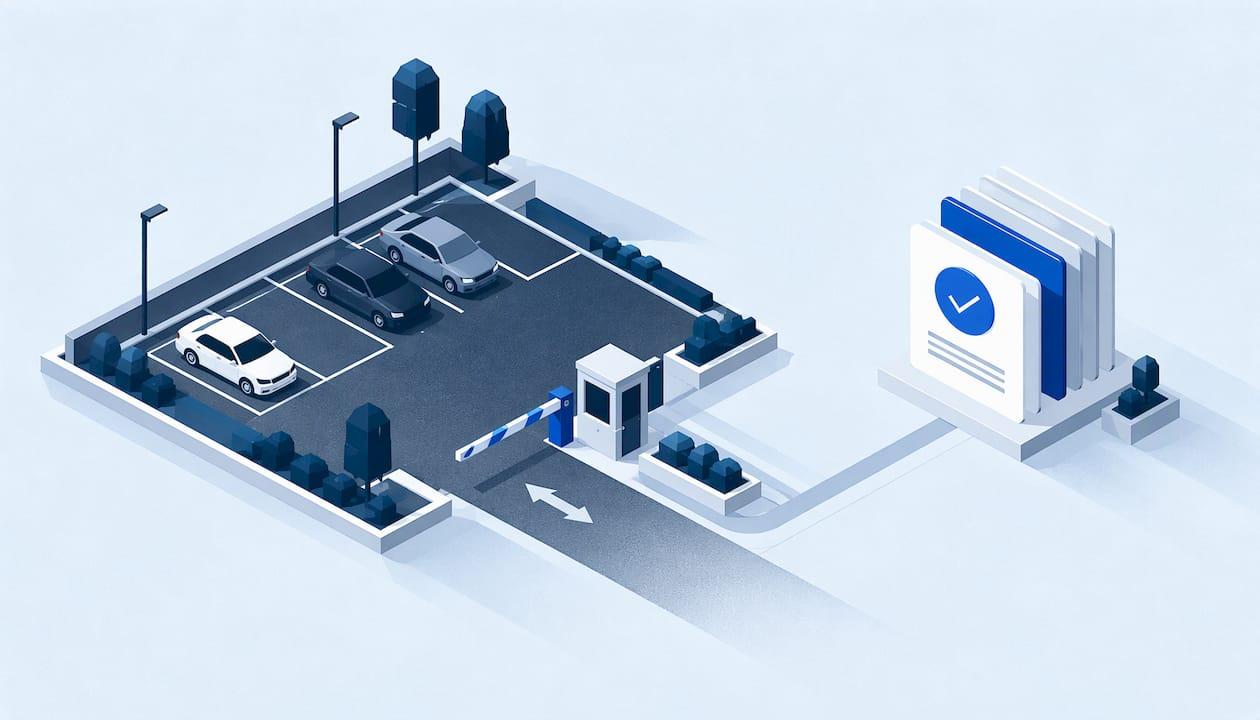
Parking compliance management is the work of writing parking rules, giving every vehicle a documented right to be on your property, and recording each violation, notice and tow so you can defend it later. It works best when permits, guests, violations, payments and towing sit in one record tied to the vehicle's history, instead of in spreadsheets, email and a tow company's paperwork. That is the approach we build MyParkingMgr around, and the rest of this guide shows how to set it up.
TL;DR
- Compliance has four parts: a written policy, an inventory of spaces, a permit and guest system, and a documented path from violation to appeal to tow.
- Most disputes come from undocumented rules and incomplete records, not from the violation itself.
- Accessible parking is checked lot by lot, never as a portfolio-wide pool.
- Across multiple properties, one unified record beats separate tools because every decision can be traced to a vehicle, a rule and a date.
- Start with a free on-boarding: MyParkingMgr offers it at 0 USD.
Table of Contents
- What parking compliance management includes
- Step 1: Write a policy people can follow
- Step 2: Build a parking inventory and register
- Step 3: Manage permits and guests as one system
- Step 4: Document every violation
- Step 5: Make towing defensible
- Step 6: Check accessible parking lot by lot
- Who enforces what
- Technology that supports compliance
- Why one system across properties
- Put it into practice
- Our perspective
- FAQ
- Sources
What parking compliance management includes
The City of Nashville sorts parking management strategies into three types: infrastructure, policy and technology. For a private property, the same split works as a practical frame:
- Infrastructure: signs, striping, gates, accessible spaces, lighting.
- Policy: who may park where, for how long, and what happens when they do not comply.
- Technology: the records and tools that enforce the policy and prove what happened.
Most compliance failures are policy and technology failures. The lot is marked, but the rule is vague, the permit list is out of date, or the tow was never documented. Fixing those two layers is where a property manager gets the most return.
Step 1: Write a policy people can follow
A workable policy is short and specific. Maryland Services Property Management recommends covering resident permits, guest parking, overnight parking, prohibited parking and towing, then communicating it in common areas, online portals, resident meetings and mailings. Enforcement escalates from permits to courtesy notices, with towing as a last resort.
For HOAs, FS Residential's parking guide (March 31, 2025) adds that a policy should state the community's authority to regulate parking and enforce fines, list what is and is not allowed, let the board grant exceptions, and set out towing procedures with required notifications and cost responsibilities.
What the policy should answer in plain words:
- Who needs a permit, and how do they get one?
- How long can a guest stay, and how is a guest registered?
- What counts as a violation, and what is the first response?
- When is a vehicle towed, and what notice comes first?
- How does a resident appeal?
If you manage an HOA, our guide on HOA parking management covers enforceable guest pass and towing rules in more depth.
Step 2: Build a parking inventory and register
You cannot enforce spaces you have not defined. Tenancy.cloud (April 18, 2026) says the first step is a full inventory: assigned spaces, tandem stalls, carports, garages, street-adjacent spaces, accessible spaces, motorcycle parking, loading zones and guest spaces. Then build a register showing each space's exact location, who may use it, whether it is assigned or first-come, and whether it is tied to a unit or lease addendum.
The same source finds that many urban multi-unit properties do best with a hybrid: assigned spaces for residents who pay for certainty, permits for overflow or unassigned parking, and designated guest areas, all under one master policy.
The policy should also say what happens when a resident changes vehicles, buys a second car or shares a vehicle with a partner, and how and when management may reassign a space. Those are the situations that turn into complaints.
Capacity matters too. If you have more permits than spaces, enforcement becomes a fight. Our piece on parking capacity planning shows how to size permits against real demand.
Step 3: Manage permits and guests as one system
Every vehicle on the property should be in one of a few categories: resident, vendor, guest or unauthorized. A violation is simply a vehicle with no valid category at that moment. That only works if the data behind each category is current.
Paper hang tags and shared spreadsheets break down at this point. Permits expire, residents move out, and guests overstay without anyone noticing. A digital record tied to the license plate removes much of the guesswork. The Oregon Parking Management Jump Start Guide (October 2024) notes that cloud-based systems let cities track which permits a vehicle holds, tied to the plate, and that license plate recognition eased enforcement of violations.
In MyParkingMgr, guest access, resident and vendor permits, violations, payments and towing sit in one platform, with charges for user access tied to historical vehicle records. Hotels and multifamily properties use the same records to see who is parked and why. Our guest parking management page and permit management guide show how that works day to day. For the reporting side, see the four reports that defend your permit policy.
To cut wrong tickets, see digital parking permits.

Step 4: Document every violation
A violation you cannot prove is a liability. A sound record includes the plate, the violation, the location, the date and time, the officer or staff member, and photographs, according to Parking Professional (April 28, 2026). For appeals, reviewers should have the citation record, notes, photos and the appellant's submission, and you should log the decision date, outcome, reviewer and rationale, then notify the appellant. Boot and tow events should be tracked through to release confirmation.
Where it goes wrong:
- Notes live in a staff member's phone and never reach the file.
- Photos have no timestamp or location.
- The appeal outcome is communicated verbally and never logged.
- A repeat offender is not recognized because each notice sits in a different place.
A platform that keeps every notice against the vehicle's history solves the last problem automatically. We also publish parking violation notice templates so your first notice is consistent. For the full enforcement workflow, read parking policy enforcement and digital parking enforcement.
Step 5: Make towing defensible
Towing is where compliance becomes legal exposure. State law governs private property tows, and the rules differ. California, for example, addresses entrance signage, notice-based towing, written authorization and required vehicle and authorization details in Vehicle Code section 22658. Check your own state's statute and local ordinances before you set a towing procedure, and have your attorney review it.
Whatever the state, the record you want is the same: the posted rule, the notice given, the evidence of the violation, the authorization to tow and the release. Our towing management module keeps these in one place, and the guide to building a defensible towing record walks through the checklist. For a five-step view, see making private parking enforcement defensible.
Step 6: Check accessible parking lot by lot
Accessibility is a compliance item you cannot treat as an average. ADA.gov states that the required number of accessible spaces is calculated separately for each parking lot or facility. Spaces must be on the shortest accessible route, have marked access aisles, and at least one of every six accessible spaces must be van accessible.

For a multi-property operator, that means every lot gets its own count and its own audit. Blocked access aisles and spaces used without a placard are enforcement items too, and they belong in the same violation record. Our ADA parking requirements and audit checklist covers slope and layout checks.
Who enforces what
Responsibility depends on who owns the land. On public streets, authorities enforce. The Oregon guide describes three models: police, deputized civilian officers, or a contracted private company. Cities such as Grandview Heights, Ohio, have delegated duties like citations, payment collection and permit management to a private operator.
On private property, you are the authority, and your policy and records carry the weight. Physical security such as cameras and gates supports enforcement, and specialists such as car park security and access control installers supply the hardware layer. The management layer, the policy, permits, notices and towing record, is what the platform handles, including hardware integration for enforcement activities.
Technology that supports compliance
The North Central Texas Council of Governments Parking Technology Guide (September 2025) groups parking technology into input technology that collects data, information technology that informs drivers, and management and enforcement technology that ensures compliance and manages access and timing. Compliance software sits in the third group, but it relies on the first.
License plate recognition is a common input. The AAMVA best practices guide (August 2025) notes that parking enforcement authorities rely on LPR to enforce regulations. Camera reads only help if they feed a record that links plate, permit and history.
Why one system across properties
Once you manage more than one site, fragmentation costs add up. Each property has its own permit list, its own notice format and its own tow vendor. Nobody can answer a simple question like how many repeat violators the portfolio has. A single platform with role-based users and portfolio reporting lets site staff work their own property while you see everything. Read more about multi-property parking management or the platform page.
Put it into practice
MyParkingMgr is parking management software for multifamily properties, hotels and parking lot operators. It covers guest access, permits, violations, payments, towing, audit trails and custom workflows, and it can run as hosted SaaS, client-hosted or white-label. On-boarding is free (0 USD). See the full feature list or start at myparkingmgr.com.
Our perspective
Compliance fails at the seams between tools. A permit lives in one system, a violation in another, and the tow in a vendor's email. When a resident disputes a charge, nobody can show the whole story.
We built MyParkingMgr around a single record tied to the vehicle's history, so access, charges, notices and towing all trace back to the same place. Workflows are customizable because a hotel and an HOA do not enforce the same way, and audit capabilities are there so every action can be reviewed.
Deployment is flexible for the same reason: hosted, client-hosted or white-label, depending on how your organization works.
MyParkingMgr
FAQ
What is parking compliance management?
It is the process of setting parking rules, controlling who may park, and documenting violations, notices, appeals and tows. The goal is consistent enforcement you can defend if a resident, guest or court questions it.
How do I create parking rules for residents and guests?
Draft a short policy covering permits, guest limits, overnight parking, prohibited areas and towing. Post it in common areas and online, and apply it the same way to everyone. Have your attorney review the towing section against your state's law.
Who is responsible for parking enforcement on private property?
The owner or manager is, either directly or through a contracted operator. Public authorities handle public streets. On your property, your written policy and records determine whether enforcement holds up.
How many accessible spaces do I need?
The count is calculated per lot or facility under ADA rules, and at least one in six accessible spaces must be van accessible. Check each lot against the ADA.gov guidance and your local code.
Sources
- Best Practices: Parking Management, City of Nashville
- How Property Managers Craft Parking and Towing Policies
- HOA parking rules: A complete guide, FS Residential
- Fair Parking Systems for Multi-Unit Buildings
- Oregon Parking Management Jump Start Guide
- Parking Citation Management Software, Parking Professional
- California Vehicle Code 22658
- Accessible Parking Spaces, ADA.gov
- NCTCOG Parking Technology Guide
- AAMVA License Plate Reader Program Best Practices Guide