
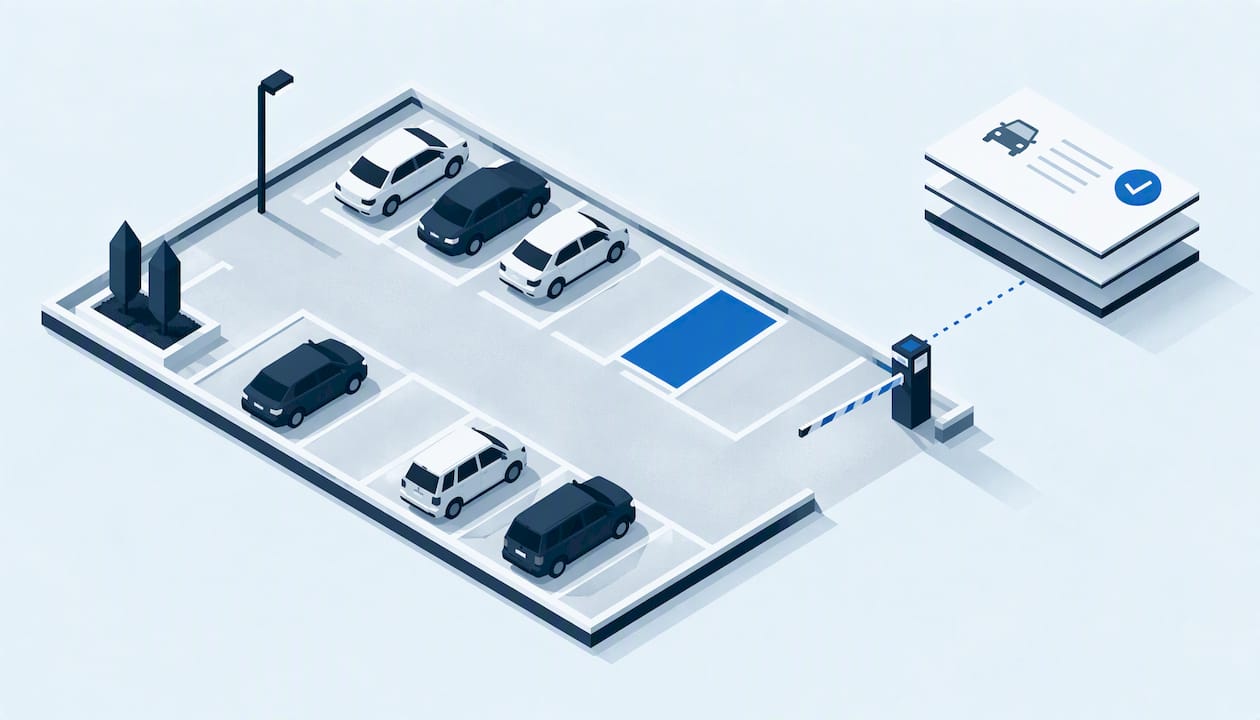
Parking policy enforcement works when four things line up: rules that are specific, records that prove who parked where, a response ladder everyone follows the same way, and notice that satisfies your state's towing rules. Miss one and every citation becomes an argument. This guide walks through each piece for managers of apartment communities, HOAs, hotels and lots, and shows how to cut repeat violations without turning the office into a complaint desk.
TL;DR
- Write the policy so a stranger could apply it: what is allowed, who decides, what each violation costs, and who may order a tow.
- Keep one record per vehicle, permit and violation. Photos, timestamps, notices and correspondence are your defense in a dispute.
- Use a staged response (warning, citation, tow) and reserve immediate towing for safety problems like fire lanes and blocked access.
- Check your state's private-property towing rules before you post signs or call a tow operator. They differ sharply.
- Most violations drop when rules are clear, communicated often and enforced the same way for everyone.
Table of Contents
- Start with a policy that can actually be enforced
- Keep records that settle disputes
- Tell people the rules, then tell them again
- Use a response ladder, not a single punishment
- Towing: the step where policies get sued
- How to reduce parking violations
- Where technology helps and where it does not
- Our perspective: one record beats five tools
- See how it fits your properties
- FAQ
- Sources
Start with a policy that can actually be enforced
A policy that says "park considerately" cannot be enforced, because every ticket turns into a debate about what the word means. Community-law guidance makes the same point: vague restrictions invite interpretation and weaken enforcement, so rules should be short and exact.
According to FirstService Residential's HOA parking guide, a solid policy covers:
- The community's authority to regulate parking, which comes from your governing documents or lease.
- What is and is not allowed: guest parking, accessible spaces, fire lanes, hydrants, loading zones and vehicle types such as RVs, trailers and commercial vans.
- Exceptions and waivers, and who can grant them.
- Towing procedures and the notifications that come before a tow.
- Who pays for what when a vehicle is cited or removed.
Add the operational details most policies skip. Define how long a guest may stay, how many permits a unit gets, what counts as an inoperable vehicle, and how a resident registers a new car. Then add the consequence for each violation in dollars or steps, plus the appeals process with timelines and a named decision-maker. If you want a deeper walk-through of the HOA side, our guides on HOA parking rules and enforceable rules for guest passes and towing cover it in detail.
Confirm you control the pavement
Before you enforce anything, confirm who controls the surface. FirstService advises that an association generally cannot impose its private rules on public roads it does not control. Check deeds, plats and municipal agreements, and have counsel confirm the answer for streets inside your community.
Build in accessible parking and reasonable accommodation
Residential properties have a fair-housing duty here. HUD has stated that the Fair Housing Act prohibits disability discrimination and that a reasonable accommodation can include providing an accessible parking space. In a 2018 HUD agreement with Utah housing providers, the owner and manager agreed to revise their parking policy to tell residents with disabilities that they may request a designated space as a reasonable accommodation, and to train staff on fair-housing obligations.
Put that sentence in your own policy, name the person who handles requests, and train every enforcement staffer to route those requests instead of citing first. If a resident with a disability disputes a citation, bring in your fair-housing counsel before you respond.
Keep records that settle disputes
Every enforcement dispute comes down to proof. Who owns this vehicle? Was it registered? Did the resident get notice? Was the sign there? If the answers live in a spreadsheet, a glovebox binder and someone's email, you will lose time and sometimes the argument.
At minimum, track:
- Vehicles: plate, state, make, model, color and the unit or tenant the vehicle belongs to.
- Permits: type (resident, guest, vendor, temporary), number, dates and assigned space where applicable.
- Violations: date, time, location, rule broken, photos, the officer or patroller and the outcome.
- Communications: warnings, notices, appeals, payment and every attempt to reach the owner before a tow.
Official guidance supports this level of detail. Nevada's Real Estate Division training material says sanction and fine records should state the sanction length or original fine amount and be kept in an organized, convenient filing or data system. A federal example shows what a permit record looks like in practice: the Department of Defense's notice for the Pentagon parking program lists name, plate number, state and permit number among the records used to run it.
Update records whenever something changes: a new lease, a sold unit, a replaced car, a rented stall. Verify the full list at least once a year so stale plates do not produce false violations. For a portfolio, the harder problem is consistency. Ten properties with ten spreadsheets means ten versions of the truth, and a repeat offender who moves between buildings starts fresh each time. We cover the reporting side in four reports that defend your permit policy.
Tell people the rules, then tell them again
Residents cannot follow rules they never saw. Communicate through several channels at once: email reminders, signs in common areas, the community website, board or resident meetings, newsletters, and a welcome packet for every new resident. Altitude Community Law also recommends signs that clearly identify reserved, resident and guest parking.
For tenants in Texas multiunit complexes, this is also a legal matter. Under Texas Property Code §92.0131, landlords must provide the applicable parking or towing rules before the lease is signed, give written notice before mid-lease changes, and make a change effective no earlier than the 14th day after notice, except for a construction or utility emergency.
Two habits make communication stick:
- Put the rule where the behavior happens. A sign at the guest lot that states the time limit and the consequence works better than a clause on page nine of a lease.
- Announce exceptions as loudly as rules. FirstService notes that documented emergency or disaster exceptions should be communicated to residents. Silent exceptions look like favoritism later.
Use a response ladder, not a single punishment
The most common enforcement mistake is jumping straight to a tow for something a reminder would have fixed. The second most common is ticketing the same offense differently depending on who the resident is. A written ladder solves both.
| Situation | Typical first response | Escalation | Notes |
|---|---|---|---|
| Guest overstay, no pass | Courtesy notice | Citation, then permit restriction | Check the pass record first |
| Wrong space or unregistered vehicle | Warning with registration deadline | Citation, then tow review | Verify the plate record before citing |
| Expired permit | Reminder and grace window | Citation | Send renewal notices ahead of expiry |
| Fire lane, hydrant, blocked access | Immediate tow where your state and contract allow | Citation and tow record | Safety first, document everything |
| Inoperable or stored vehicle | Written notice with deadline | Citation, then tow | Follow your state's notice rules |
| Repeat offender | Citation at the higher tier | Permit suspension, tow | Needs history across properties |
A staged response of warning, citation, then towing for repeated or egregious violations is standard, with fire-lane and access-blocking violations treated as candidates for immediate towing authority, according to Facility Parking Guide. Your governing documents and state law decide how much of this you may actually do, so have counsel review the ladder before you publish it.
Two more rules keep the ladder honest. First, define who may authorize a tow. Limit that to named staff, so a patrol contractor cannot trigger a tow on its own initiative. Second, do not let discretion drift: if you waive a fine, log why. Applying the policy uniformly and without favoritism is the core of defensible enforcement, and it is also the best answer when a resident says "you never ticket my neighbor."
Towing: the step where policies get sued
Towing is the most expensive and most litigated part of enforcement. Before you tow from private property, confirm the notice, signage, contract and authorization rules in your state and city. They vary widely. Examples from published regulations:
- Georgia: compliant signs must be placed within 50 feet of designated entrances and posted at least 24 hours before towing, under Georgia's towing sign rule.
- New Jersey: the private-property towing regulation generally requires a written towing contract, entrance signs stating authorized purposes and times, towing warnings, charges and storage information, and property-owner authorization. It lists exceptions, including certain small residential properties, blocked driveways and law-enforcement-directed safety tows.
- Colorado: Colorado's notice rule generally requires notice of parking restrictions and tow-at-owner's-expense consequences when a vehicle enters and parks, with conspicuous signs at each entrance and at reasonable intervals. Towing carriers must retain evidence of notice for three years.
The lesson from Colorado applies everywhere: someone must be able to prove the notice existed. Photograph signs with dates, keep the sign specifications and installation dates on file, and keep the authorization record for each tow.
Where possible, try to reach the owner before the tow and log each attempt. Trade coverage of towing practice advises publishing a step-by-step procedure, keeping records of contacts and signage, and limiting who can request a tow. Our guide to towing signage, authorization and records goes through what to keep for each tow, and your own attorney should confirm what your state requires.
How to reduce parking violations
If you want fewer violations rather than more citations, treat enforcement as the last layer, not the first. Oregon's state Parking Management Jump Start Guide frames parking management as a progression: signage and wayfinding, then time limits, permit programs, metering, enforcement and technology. The order matters. A property with confusing signs and no permit system will write endless tickets and still have the same problems.
What tends to work in practice:
- Fix the signs and the map. Many violations are honest mistakes. Clear signs on reserved, guest and no-parking areas remove the excuse.
- Make registration easy. If adding a plate takes a week and three emails, people park unregistered. Let residents add vehicles and guests online.
- Give guests a simple path. Guest overstays are usually a pass problem. A fast digital guest pass beats a paper hang tag. See how we approach guest parking management.
- Review the data monthly. Look at where, when and who. Ten violations in one lot at one hour usually mean a design problem, not ten bad residents.
- Keep consequences predictable. People change behavior when the outcome is certain and the same for everyone.
- Make paying and appealing easy. A resident who can pay a fine online or file an appeal with a clear deadline is less likely to escalate. Our notes on ticket appeals explain the document trail.
FirstService's summary of the basics is a good checklist: clear, well-defined rules, regular communication and uniform enforcement, with notice of temporary adjustments when emergencies or natural disasters change what is practical.
Where technology helps and where it does not
Spreadsheets and paper tickets work for one small lot. They break down when you have multiple properties, vendors, guest flows and a board asking for numbers. Metro Nashville's parking best-practices document notes that technology can support operations, enforcement, data collection and public information, and that digital enforcement can monitor compliance and issue citations, while collected data can populate databases, track demand and reveal trends.
License plate recognition is the clearest example. Berkeley's policy describes reads as computer-readable data including plate images, GPS coordinates, digitized plate numbers and timestamps, which can be cross-checked against permit information. That is the same logic a private property uses: match the plate to a permit record, and flag what does not match. Time-limit enforcement can use repeated scans instead of chalk marks, but staff should still review alerts and verify each violation before a citation goes out, as Facility Parking Guide cautions.

Technology does not replace policy. If your rules are vague, software will only help you enforce vague rules faster. Fix the policy first, then pick tools that carry it out: a single record for vehicles, permits, violations, payments and tows. It also helps to avoid wrong tickets; see how digital permits cut errors.
Our perspective: one record beats five tools
Most enforcement failures we see are not failures of will. They are failures of memory. The permit lives in one system, the violation in a notebook, the payment in the accounting package and the tow in an email thread. When a resident disputes a ticket, nobody can show the whole story quickly.
That is why we built MyParkingMgr around a unified record: guest access, permits, violations, payments and towing tied to the same vehicle history. A manager can see what happened, who did it and what was sent. We also think workflows should fit the property rather than the other way around, which is why the platform supports custom workflows, role-based access, audit trails and portfolio-level reporting, and why it can be deployed as hosted SaaS, client-hosted or white-label. Our advice stays the same whatever tool you use: write the rule, record the facts, apply the ladder evenly, and be able to show your work.
— MyParkingMgr
See how it fits your properties
If you manage apartments, HOAs, hotels or lots and want one place to run permits, violations, payments and towing, look at our parking enforcement software or read about parking violation management. On-boarding is free ($0 one-off), and you can see the full list on the features page. HOA and gated community boards can start with our community parking solution.
To start, take your current policy and ask whether each rule has a defined consequence, a responsible person and a record trail. Where it does not, you have found your first fix.
FAQ
What should a parking enforcement policy include?
It should state your authority to regulate parking, what is allowed and prohibited, exceptions, the consequence for each violation, who may authorize towing, required notices and the appeals process. Add accessible-parking and reasonable-accommodation language if you manage housing. Have an attorney review it against your state's towing rules and your governing documents.
How do I reduce parking violations at my property?
Start with clear signs and rules, then make registration and guest passes quick to complete. Enforce the same way for everyone and review violation data monthly to spot problem areas. Most repeat violations trace to confusion, not defiance.
When can I tow a vehicle from private property?
That depends on your state, city and governing documents. Georgia, New Jersey and Colorado, for example, each set different rules on signage, contracts and notice, so confirm the requirements with local counsel before you tow. In all cases, keep photos of signs, notice records and the tow authorization.
Is a warning required before a citation or tow?
Not always, but a staged response is the safer practice for ordinary violations, with immediate action reserved for safety problems like fire lanes and blocked access. Some states and leases require specific notice, so check yours. Document every attempt to reach the owner.
Sources
- HOA parking rules: A complete guide, FirstService Residential
- Drafting and Enforcing Parking Restrictions, Altitude Community Law
- HUD: charges against California high-rise condominium, October 3, 2022
- HUD: agreement with Utah housing providers, September 5, 2018
- Nevada Real Estate Division: Fines, Sanctions, & Towing in CICs
- DoD notice DWHS D04, Pentagon parking program records
- Tex. Prop. Code Section 92.0131
- Ga. Comp. R. & Regs. R. 570-38-7-.14, towing signs
- N.J. Admin. Code § 13:45A-31.6, towing from private property
- 4 CCR 723-6-6513, Colorado notice rule
- To Tow… or Not To Tow? Seven Tips
- Oregon Parking Management Jump Start Guide
- Metro Nashville: Best Practices, Parking Management
- Berkeley ALPR policy, supplemental agenda material
- Parking Enforcement Best Practices for Facility Managers