
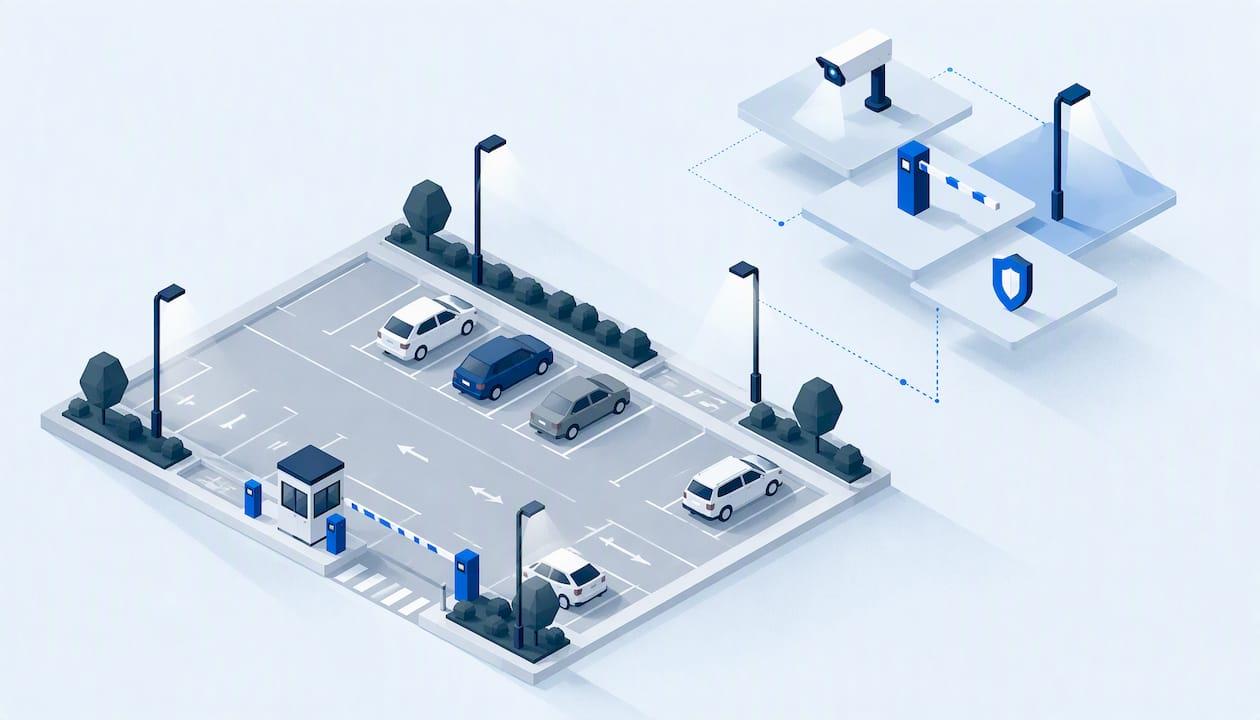
A parking lot security plan is a written, site-specific document that says what risks your lot faces, which layers of protection you use against them, who does what when something happens, and how you prove it. The strongest plans layer lighting, sightlines, access control, cameras, patrols and response procedures, then get audited and updated on a schedule. This guide walks through each part, with costs, mistakes to avoid and a 90-day rollout.
TL;DR
- Start with a documented risk audit of each lot. It sets your baseline of reasonable care and tells you where to spend first.
- Layer your defenses. Lighting, landscaping and signage are passive layers; access control, patrols and monitored communications are active ones. No single layer, cameras included, carries the plan.
- Only promise what you deliver. Signs that advertise monitoring you do not perform can raise your exposure instead of lowering it.
- Keep records: who entered, which vehicles, what violations, which incidents and how you responded. A plan you cannot document is hard to defend.
- Review the plan at least once a year and after every serious incident.
Table of Contents
- Why parking areas need their own security plan
- Step 1: Run a documented risk audit
- Step 2: Build security in depth
- Lighting and sightlines come first
- Access control: know who is on the lot
- Cameras: useful, but not a plan
- Patrols, communications and response
- Enforcement and records make the plan defensible
- Our perspective: a plan lives in its records
- A 90-day rollout
- How MyParkingMgr supports the plan
- FAQ
- Sources
Why parking areas need their own security plan
Parking is where most visitors, residents and employees begin and end their time on your property, and it is often the least supervised part of it. The National Institute of Justice notes that parking facilities are more likely settings for violent and property crime than all other real estate except residences. Low occupancy, isolation and long stretches without anyone watching create opportunity, and most parking crime is opportunity crime: a car break-in, a theft, an assault on someone walking alone.
The Parking Today safety-by-design article published by the National Parking Association points out that people assaulted in parking structures are most often women walking alone to their vehicles. That is why direct, well-lit, clearly marked pedestrian routes matter as much as anything you do for the vehicles.
There is a legal side too. A property owner can be held liable when inadequate security contributes to a crime against a guest. A journal article on parking-area liability describes crime-abatement through design and prior planning as the owner's practical answer. Rules differ by state, so have your counsel and insurer review the plan. What every property can do is show that it identified foreseeable risks and acted on them.
Step 1: Run a documented risk audit
Every good plan starts with a walk of the site, ideally at night as well as in daylight. Record what you see, date it, and keep it. According to the NIJ, CPTED principles are easiest to apply at the design stage, but existing facilities can be brought up to standard through risk audits and active measures such as electronic access control and intercoms linked to video.
Your audit should cover:
- Incident history. Police calls, resident complaints, tow records, damage claims and violation logs for the past two or three years. Patterns by time and location tell you more than general checklists.
- Lighting. Dark shadows between cars, burned-out fixtures, and dim stairwells or elevator lobbies.
- Sightlines. Overgrown shrubs, signs, dumpsters or columns that hide a person from view.
- Entry and exit points. Every gate, pedestrian path, stairwell door and fence gap.
- Existing equipment. Which cameras actually record, how long footage is kept, whether gates close and whether emergency phones or call buttons work.
- Who uses the lot. Residents, guests, vendors, employees, hotel visitors, delivery drivers. Each group needs a different level of access.
Repeat the audit on a schedule. The same Parking Today article stresses that security is not set and forget: risk profiles change, and so must the plan.
Step 2: Build security in depth
CISA's guidance on facility security plans describes security in depth: several layers that together slow down or discourage unauthorized access, rather than one measure you hope will do everything. The guidance is written for chemical facilities, but the logic transfers directly to a parking lot.
A useful way to organize it:
| Layer | Examples | What it does |
|---|---|---|
| Passive (design) | Lighting, trimmed landscaping, clear pedestrian routes, signage, fencing | Makes offenders feel seen and makes legitimate users feel comfortable |
| Active (access) | Gates, permits, visitor registration, intercoms, bollards | Decides who may enter and creates a record of who did |
| Active (people) | Patrols, staff presence, attendants | Responds, deters and notices what technology misses |
| Detection | Cameras, license plate recognition, alarms | Records events and supports investigation and response |
| Response | Written procedures, emergency communications, police liaison | Turns detection into action |
| Governance | Audits, incident logs, plan updates | Proves the other layers work |
The next sections take these layers in order.
Lighting and sightlines come first
The NIJ's CPTED guide for parking facilities states that lighting is the single most important CPTED security feature. The International Foundation for Protection Officers advises assessing the type and placement of fixtures so that there are no dark shadows between cars where someone could hide, and lighting in elevators and stairwells deserves the same attention.

For a numeric baseline, ASIS reports that the Illuminating Engineering Society recommends a minimum horizontal illuminance of 0.2 footcandles and a minimum vertical illuminance of 1 footcandle for regular parking lots. Treat that as a floor, check local code, and ask a lighting professional to measure your lot, since uniformity matters as much as brightness.
Sightlines are cheap to fix and easy to neglect. CISA's guidance on natural surveillance supports keeping low landscaping under 3 feet and tree canopies above 8 feet so that people walking to their cars can be seen by others. Add a maintenance task to your vendor contract: trim shrubs on a set schedule and log it.
Access control: know who is on the lot
Most parking incidents involve someone who should not be there, or a legitimate user doing something they should not. Access control addresses both.
- Residents and employees: issue permits tied to a specific person, vehicle and space or zone, and keep the list current when people move out or leave.
- Guests: require registration so you can tell a visitor's car from an unknown one. Our guide on visitor parking registration for multi-property managers lays out the steps.
- Vendors and contractors: short-term passes with an end date, rather than shared codes that never expire. See how vendor parking passes can be handled.
- Physical barriers: gates, bollards and fencing where the audit shows uncontrolled entry points. Intercoms at gates should connect to video so the person answering sees who is calling.
Numbered, mapped spaces also help. If you cannot tell which unit or tenant a space belongs to, you cannot tell who is parked in it. We cover this in digital parking space numbering.
Cameras: useful, but not a plan
Cameras record and support investigations. They do not stop anyone physically. The best plans treat them as one detection layer and put design and access control ahead of them.
What to cover: entrances and exits, pedestrian paths, stairwells and elevator lobbies, and any area your incident history flags. Then decide who watches the feeds and how long you keep footage.
What cameras cost
Budget figures vary by site, so get written quotes. One security integrator's 2026 guide puts installation of a camera system at roughly $5,000 to $15,000 for a small lot of 20 to 50 spaces, and well above $80,000 for large multi-level garages. The same source puts monthly monitoring between roughly $400 and $3,500, depending on intensity, and individual camera hardware between $200 and $1,500. Cabling, poles and the number of cameras drive most of the spread. Treat these as ballpark numbers from a vendor, not a quote.
Signage: say only what is true
Nashville police's crime prevention guidance for businesses stresses that the owner or manager is responsible for making the lot as safe as possible. One practical consequence: do not post "video surveillance" signs unless cameras are working and someone reviews them. A sign that promises more than you deliver can create a false sense of security for users and weaken your position if something goes wrong. Signs such as "Permit Required" or "Access Controlled" describe what you actually do and still guide behavior.
Patrols, communications and response
People notice what cameras miss. Patrols, whether staff or contracted officers, should follow a route and schedule based on your incident data, and log each round.
Communication is where many plans break down. Per IFPO's parking security guidance, security systems that are isolated from one another often fail during incidents; officers and parking staff need reliable communications that connect with access control and video so that an alarm arrives with visual context.
Write a short response procedure for each of these situations:
- Emergency in progress: call 911 first, then notify on-site staff and management.
- Vehicle break-in or theft reported: secure the scene, collect camera footage, file the report, notify the owner.
- Unauthorized or abandoned vehicle: verify against permit records, follow your posted enforcement policy, and document each step.
- Harassment or a person who feels unsafe: have someone escort them to their vehicle and log the request.
- Equipment failure: a broken light, gate or camera gets a ticket, a deadline and a temporary fix such as an extra patrol.
The NIJ notes that security in parking facilities has tended to be reactive rather than proactive. Written procedures, rehearsed with staff, are how you move to the proactive side.
Enforcement and records make the plan defensible
A plan is only as strong as its follow-through. Unauthorized vehicles, expired permits and repeated violations are early warning signs, and consistent enforcement is part of how you control who is on the lot.
Consistency also protects you. If one resident is towed and another with the same violation is not, you have a fairness and legal problem. Our article on making private parking enforcement defensible covers signage, documentation and process, and the piece on reports that defend your permit policy shows what to keep on file.
Keep, at minimum:
- Dated audit reports and the actions taken afterward
- Permit, guest and vendor records tied to vehicles
- Violation and towing history
- Incident reports and response times
- Maintenance logs for lights, gates, cameras and landscaping
- Patrol logs
This is the paper trail the NIJ-style audit approach relies on. As one summary of the research puts it, regular documented audits are how practitioners establish a baseline of reasonable care. Ask your attorney how that applies in your state.
Our perspective: a plan lives in its records
We work with property managers, hotels and parking operators, and the same pattern shows up again and again. The security equipment is rarely the weak point. The weak point is that permits sit in one spreadsheet, guest passes in another, violations in a notebook and towing in an email thread. When an incident happens, nobody can say quickly which vehicle belonged where, who authorized it, or what was done the last three times.
That is why we built MyParkingMgr around a single record for guest access, permits, violations, payments and towing, tied to vehicle history, with audit trails and workflows that match how each property actually operates. A security plan on paper tells your team what to do. A unified record tells you whether it is being done, across one lot or an entire portfolio.
Our advice is to start with what you can verify. Do not promise 24/7 monitoring you do not have. Do not add a camera before you fix the light. Do not write a procedure nobody can follow at 2 a.m. A modest plan that is true and documented beats an ambitious one that is not.
— MyParkingMgr
A 90-day rollout
Days 1 to 30: assess. Walk every lot at night, pull incident and violation history, inventory equipment, and note what is broken. Fix what is cheap immediately: bulbs, shrubs, signs that overpromise.
Days 31 to 60: decide and document. Rank the findings by risk and cost. Set access rules for residents, guests and vendors. Write the response procedures and assign owners. Get quotes for lighting, gates or cameras where the audit calls for them. If you are managing capacity at the same time, our guide to parking capacity planning helps.
Days 61 to 90: implement and train. Roll out registration and permit controls, start patrol logs, train staff on the response steps, and schedule the first review. Put the annual audit and a post-incident review on the calendar.

How MyParkingMgr supports the plan
If your plan depends on knowing who is parked where and acting consistently, the software layer matters. MyParkingMgr covers guest parking management, permits, parking violation management and towing in one platform. You can view it across properties through multi-property parking management, and it can be deployed as hosted SaaS, client-hosted or white-label. Details for commercial lots and multifamily portfolios are on their own pages.
On-boarding is free (0 USD, one-off). To see how it would fit your sites, schedule a parking platform assessment.
FAQ
What should a parking lot security plan include?
A risk audit, lighting and sightline standards, access control for each user group, camera coverage, patrol schedules, written response procedures, enforcement rules and a review schedule. It should also name who is responsible for each item. Keep the records that show each task was done.
How do you make a parking lot safer?
Fix lighting and visibility first, since they cost less than most equipment and the NIJ calls lighting the single most important CPTED feature. Then control who enters, mark safe pedestrian routes, add patrols where incidents cluster and train staff to respond. Cameras come after those basics.
How much do parking lot security cameras cost?
One integrator's 2026 estimate is $5,000 to $15,000 for a small lot, with large garages far higher and monitoring adding monthly fees. Your price depends on camera count, cabling, poles and whether footage is monitored. Request several written quotes.
What is parking lot security for?
It deters opportunity crime, protects residents, guests and employees, and reduces the risk of liability and reputational damage after a publicized incident. It also keeps the lot available to the people who are entitled to use it.
Sources
- Crime Prevention Through Environmental Design in Parking Facilities, National Institute of Justice
- Parking Safety by Design, Parking Today / National Parking Association
- Asphalt Jungle: Providing Parking-area Security through Design and Common Sense
- CISA ChemLock facility security plan guidance
- National Institute of Justice CPTED package
- Parking Garage/Parking Lot Security, IFPO
- Lighting Standards for Parking Facilities, ASIS Security Management
- Parking Lot Security Camera Cost: What to Budget in 2026
- Crime Prevention Measures for Business, Nashville Police