
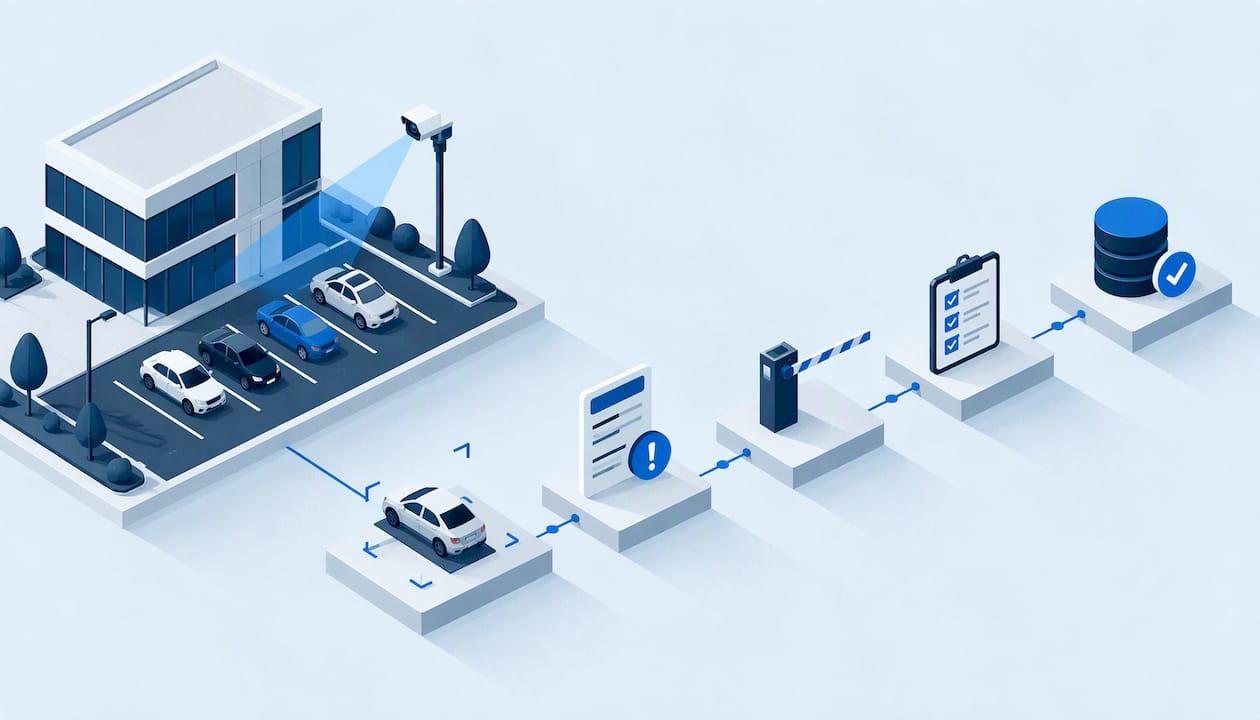
Digital parking enforcement means checking, documenting and acting on parking violations through software and connected devices instead of paper logs, chalk and memory. For a property manager, the point is not the gadget. It is that every permit, guest pass, warning, citation, payment and tow lives in one record that anyone with the right role can look up. This guide explains how the workflow runs, what it can and cannot do, which rules to watch in the United States, and how to choose a setup that holds up when a resident disputes a ticket.
TL;DR
- Digital enforcement ties each violation to a vehicle record, a permit status and a photo, so a notice can be defended later.
- It works best as a tool that supports staff. Plate-recognition alerts should be reviewed by a person before a ticket goes out.
- The real gain for multi-property operators is one system for permits, guests, violations, payments and towing, not five disconnected tools.
- Before you buy, check privacy rules, access to vehicle data, your notice and appeal process, and how towing is documented.
- Start with the workflow you already run and digitize it, rather than adopting a rigid process from a vendor.
Table of Contents
- What digital parking enforcement actually is
- How a digital enforcement workflow runs, step by step
- Coordinating permits, guests, violations, payments and towing
- What to expect: benefits and limits
- Privacy, notice, appeals and towing in the United States
- Choosing and rolling out a digital enforcement workflow
- Our perspective
- Getting started with MyParkingMgr
- FAQ
- Sources
What digital parking enforcement actually is
Manual enforcement is a person walking a lot with a clipboard, checking stickers or hangtags against a list, and writing notices by hand. A trade publication on enforcement technology puts the pace of that work at 30 to 50 vehicles per hour. It is slow, and the evidence it produces is thin: a handwritten note, maybe a phone photo saved somewhere.
Digital enforcement changes three things:
- How vehicles are checked. Officers or staff use a handheld device or mobile app, or a license plate recognition (LPR) camera, to compare plates against a live list of valid permits and guest registrations.
- How evidence is captured. The plate, location, time, photos and the rule that was broken are stored together at the moment of the check.
- How the case moves on. The notice, payment, appeal and, if needed, tow request all attach to the same record instead of being rebuilt from emails and spreadsheets.
None of this changes your parking rules. It changes whether you can prove, in thirty seconds, that a rule was applied the same way to every vehicle.
How a digital enforcement workflow runs, step by step
The details differ by property, but a defensible workflow tends to follow the same order.

1. Establish who is allowed to park
Everything starts with a current list of parking rights: resident permits, vendor permits, guest registrations, reserved spaces. If that list is wrong, every downstream ticket is wrong. Digital parking schemes in Europe describe this as a repository of vehicle parking rights used as the reference for enforcement, and the same logic applies to an apartment community or hotel. Our notes on digital parking permits show why a permit that updates in under a minute prevents most wrong tickets.
2. Check vehicles
Staff walk or drive the property with a mobile device, or fixed or vehicle-mounted LPR reads plates automatically. Either way, each plate is matched against the list from step one. A mobile enforcement workflow lets the person in the lot see the answer on the spot.
3. Review before anything is issued
Automated reads make mistakes: a misread character, a plate from another state, a guest who registered a minute ago. The Calgary Parking Authority, a Canadian public body, says its LPR system supports officers rather than replacing them, and that every flagged potential violation is reviewed by a trained officer before a ticket is issued. Private properties should hold themselves to the same standard. We go deeper on this in why ALPR alerts need human review and in our guide to policy and verification for LPR enforcement.

4. Document and notify
The reviewer confirms the violation, attaches photos, selects the rule that applies and issues a warning or notice. Because the vehicle record is already open, repeat offenses are visible immediately, and the escalation path (warning, citation, boot or tow where allowed) follows your written policy.
5. Collect payment and handle appeals
The notice should give the driver or resident a way to pay and a way to contest. Public agencies show what a mature version looks like: Pasadena's citation system, described in a city procurement document, supports uploading appeal documents, managing payment plans and searching by citation, plate or case number. A property does not need that scale, but it needs the same traits: one place to pay, one place to appeal, one searchable history. See how online parking fine payments fit into the same record.
6. Tow only with a paper trail
Towing is where disputes become expensive. The record behind a tow request should show the permit status, the prior notices, the photos and the time each step happened. If you cannot produce that file quickly, the tow is a liability.
Coordinating permits, guests, violations, payments and towing
Most enforcement problems at multi-property operators are not enforcement problems. They are data problems. Permits sit in one spreadsheet, guest passes in a gate app, violations in a notebook, payments in accounting software, and tow logs in a vendor's email. When a resident calls about a ticket, someone has to chase four sources.
A unified platform reverses that. Research on European parking programs describes the idea as a data hub for parking management, with dashboards that aggregate information from different sources. For a property portfolio, the practical version looks like this:
| Question a manager gets | Fragmented setup | One connected record |
|---|---|---|
| Was this vehicle permitted? | Check the permit sheet, then the guest app | One lookup by plate |
| Has this driver been warned before? | Search old notes or emails | Full history on the vehicle |
| Was the fine paid? | Ask accounting | Payment status on the same case |
| Why was the car towed? | Reconstruct from the tow vendor | Photos, notices and timestamps attached |
| How is the portfolio doing? | Combine exports by hand | Reporting across properties |
This is the approach behind our multi-property parking management and guest parking management tools, and behind violation management, where each violation is tied to historical vehicle records. One detail that quietly causes billing losses is inconsistent space numbering, which we cover in digital parking space numbering.
What to expect: benefits and limits
Benefits that show up in practice
More coverage with the same staff. The clearest US example is Aspen, Colorado. According to a 2020 U.S. Department of Transportation entry, LPR let the city check residential parking spaces two to three times a day instead of twice a week, with fewer staff. A city is not an apartment community, but the principle carries over: automation extends how often you can check without extending payroll.
Evidence you can stand behind. A photo, a timestamp and a permit lookup beat a handwritten note when a resident disputes a notice. Our five-step guide to making private parking enforcement defensible walks through the habits that matter.
Consistency. When every check is run against the same list and the same rules, residents stop suspecting that tickets depend on who is working that night. That alone cuts a lot of complaint volume.
Better planning data. Once enforcement is digital, you can see where and when violations cluster, which feeds decisions on permit counts and pricing. Our pieces on parking capacity planning and a 3 to 6 month data analytics pilot show how to use it.
Limits to plan around
- Bad data in, bad tickets out. Software cannot fix an outdated permit list.
- Automated reads need review. Treat an LPR alert as a lead, not a verdict.
- Rules can slow adoption. Industry research notes that enforcement technology is mature, but regulatory issues such as in-person check requirements and limits on vehicle registration data can complicate introducing it. That research is European, so US managers should confirm what applies in their own state.
- People still matter. Staff need training on when to warn, when to cite and when to escalate.
Privacy, notice, appeals and towing in the United States
Parking enforcement on private property is governed mostly by state and local law, plus your lease, HOA covenants or hotel terms. There is no single national rulebook, so treat the following as questions to settle with a local attorney rather than answers.
- Plate and location data. LPR creates a record of where vehicles were and when. Public agencies handle this carefully: Seattle's policy for parking enforcement technology, including ALPR, provides for background checks on employees and controlled access to the information. Private operators can borrow the habits: limit who can see the data, set a retention period, and write it down.
- Notice. Residents should be told the rules before they are enforced: signage, lease language, permit terms. Many states have specific signage requirements for towing from private lots, so check yours.
- Appeals. Even where no law requires one, a simple appeal path reduces disputes. Capture the appeal and its outcome on the same case record.
- Towing. Rules on who can authorize a tow, required signage, fees and notification differ by state and city. Keep photos and timestamps for every tow request.
- Payments. If you collect fines, you need clear accounting. A city RFP in Grandview Heights, Ohio, for example, asks its parking operator to collect and account for revenues and provide weekly and monthly reports. A portfolio manager should expect the same reporting from their own system.
Choosing and rolling out a digital enforcement workflow
When you evaluate software, the research points to the same checklist: applicable legislation, data privacy, access to vehicle registration data, and whether parking rights sit in a digital repository that supports enforcement. Turn that into questions for any vendor:
- Is there one record per vehicle? Permits, guest passes, violations, payments and tows should all attach to it.
- Can workflows match your policy? If you warn once before citing, the software should do the same, not force a generic sequence.
- Is there human review before a notice? Especially if LPR is involved.
- Who can see what? Look for role-based access, so a night patrol sees different data than an accountant.
- Can it report across properties? Portfolio oversight is where fragmented tools fail.
- How is it deployed? Some operators want hosted SaaS, others need client-hosted or white-label options for security or branding reasons.
- Does it work with enforcement hardware? If you use handhelds, cameras or other devices, confirm integration.
- Is there an audit trail? You should be able to see who changed what and when.
A sensible rollout order
Start with one property. Clean the permit and guest data first, then switch on mobile checks with human review, then add payments and towing records, then expand to the rest of the portfolio. Run the old and new processes side by side for a few weeks, and compare complaint volume and resolution time before you scale. Send residents and tenants a clear message before the first notice goes out under the new system.
Our perspective
We build parking software for property managers, and the pattern we see most is not a lack of enforcement but a lack of a single source of truth. Teams usually have the pieces: a permit list, a guest tool, a tow contact, a payment method. What they lack is a record that connects them, so every disputed ticket becomes an investigation.
That is why we designed MyParkingMgr around a unified record, customizable workflows and audit trails, and why we are cautious about automation that issues notices without a person confirming them. Technology should make the officer faster and the evidence stronger. It should not make the decision. We also believe the platform should adapt to your operation, which is why it can run as hosted SaaS, client-hosted or white-label, rather than asking every property to work the same way.
— MyParkingMgr
Getting started with MyParkingMgr
If you manage parking across apartment communities, hotels or lots and want permits, guests, violations, payments and towing in one place, take a look at our parking enforcement software or the full feature overview. On-boarding is free ($0, one-time), so you can assess fit against your current workflow before committing. Operators in larger metro areas can also see our pages for Denver and Philadelphia. To talk through your setup, start at myparkingmgr.com.
FAQ
Is digital parking enforcement the same as using license plate recognition?
No. LPR is one way to check vehicles. Digital enforcement also covers handheld or mobile checks, photo evidence, notices, payments, appeals and tow records. Many properties go fully digital without any cameras.
Can residents pay parking fines online?
Yes, if your system supports it. Public agencies already offer online payment, payment plans and appeal uploads, and property operators can offer a simpler version tied to the same violation record. That keeps payment status visible to everyone who handles the case.
Does digital enforcement replace parking staff?
It changes their work more than it removes it. Software handles lookups and record keeping, while staff verify alerts, apply judgment and deal with residents. Aspen's example shows more frequent checks with fewer staff, but its program still relies on people for the final decision.
What should I check about the law before going digital?
Start with your state and city rules on private-lot towing, signage, notice and data privacy, plus your lease or HOA documents. Ask a local real estate or municipal attorney to review your policy and notice templates before the first citation goes out.
Sources
- Parking Enforcement Technology: LPR, Handheld Devices, and more (Parking Professional)
- License plate recognition during rush hour (Calgary Parking Authority)
- Enforcement (Interreg Central Europe, Park4SUMP)
- License plate recognition (LPR) technologies, Aspen (U.S. DOT)
- Parking Enforcement Systems, including ALPR (City of Seattle)
- Request for Proposal, Parking Services 2024 (City of Grandview Heights)
- Procurement Portal, citation system (City of Pasadena)