
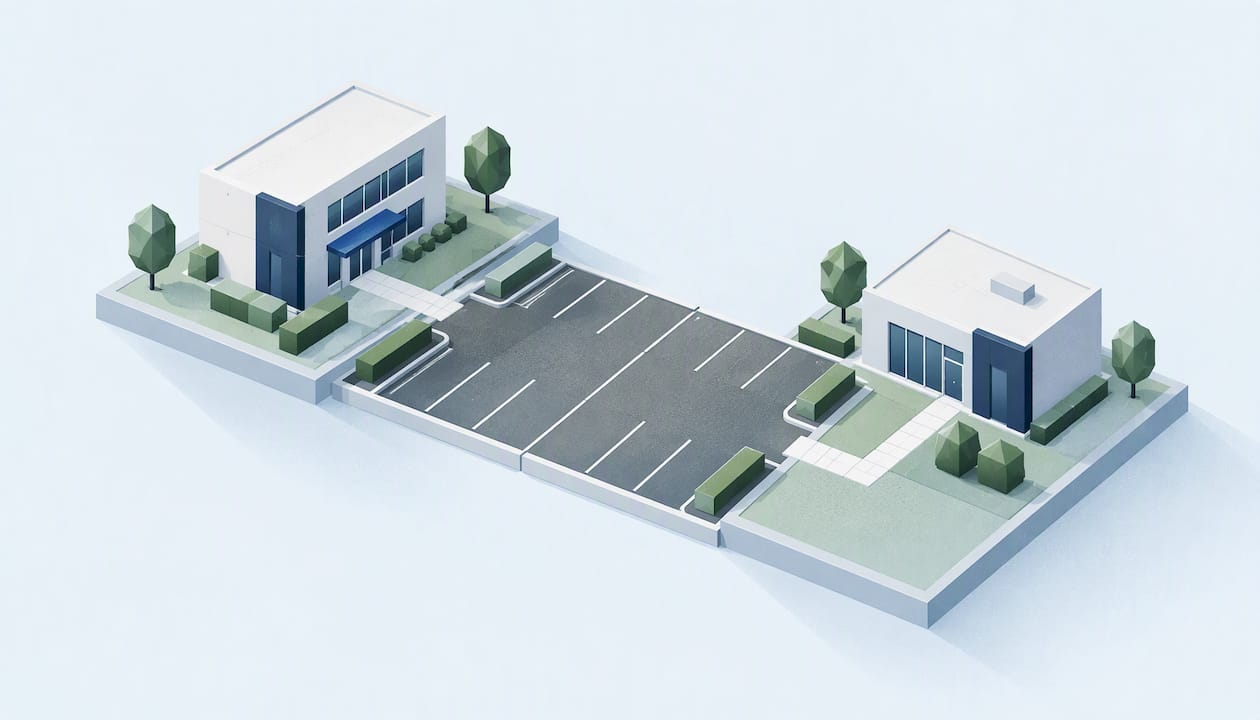
A shared parking agreement is a written contract that lets two or more properties or businesses use the same parking spaces, usually because their busiest hours don't overlap. A good one names the spaces, sets the hours, assigns costs and liability, and says how it ends. A great one also gets enforced after signing, which is where most arrangements quietly fall apart. This guide covers the legal form, the clauses that matter, the local approvals to expect, and how property managers run the arrangement day to day.
TL;DR
- A shared parking agreement is a contract. An easement is an interest in land that can bind future owners. A license is personal, revocable permission. Pick the form before you draft anything else.
- Sharing works when peak demand differs, such as an office by day and a restaurant or church by night or on weekends.
- Cover the properties and spaces, site plans, hours, maintenance, insurance, default, termination and amendments. Many cities also want it notarized and recorded.
- If the city granted you a parking reduction because of the agreement, losing the agreement can put your property out of compliance.
- Signing is the easy part. Permits, guest access, violations and towing need one clear record that both parties can audit.
Table of Contents
- What a shared parking agreement is
- Agreement, easement or license: choose the legal form first
- When sharing works, and when it doesn't
- Terms every agreement should include
- Local approvals: what cities ask for
- How to run the agreement after it is signed
- Our perspective: shared parking fails on records, not paper
- Run shared lots from one system
- A short checklist before you sign
- FAQ
- Sources
What a shared parking agreement is
California's statute describes a shared parking agreement as a document that sets the terms under which underutilized parking is shared among the parties to it. In plain terms, one owner has spaces that sit empty at certain hours, another needs spaces at those hours, and they put the deal in writing.
Typical pairings include:
- An office building and a restaurant next door.
- A church with a mostly empty weekday lot and a neighboring business.
- An apartment community and a nearby retail center.
- A hotel and a venue with different event hours.
- Mixed-use developments, where shared parking is often inherent because the uses complement one another.
Agreement, easement or license: choose the legal form first
People use these terms loosely, but they are different instruments with different lifespans. According to a legal explainer on shared parking terms, an easement is an interest in real property that can run with the land, while a license is personal permission that can usually be revoked and conveys no property interest.
| Form | What it is | Survives a sale? | Best for |
|---|---|---|---|
| License | Personal permission to use space | Usually not; typically revocable | Short-term or trial sharing, small numbers of spaces |
| Contract-based shared parking agreement | Binding terms between named parties | Depends on assignment and recording terms | Defined hours, fees and duties |
| Appurtenant easement | A property right attached to the land | Yes, it can bind future owners | Long-term arrangements a lender or city relies on |
The same source calls this choice the most important structural decision for long-term viability. The reasoning is simple. If your site plan, your lender or your parking approval depends on those spaces, a revocable license is a weak foundation. If you only need overflow parking for a season, an easement is more than you need.
Two practical notes on easements. First, they often reserve limited restrictions for the owner. One city easement document, for example, allows short-term limits such as 15 minutes for deliveries or ATMs inside the larger shared area. Second, shared spaces that look assigned may not be. Painted letters on pads, for instance, don't settle who may use what. The document does.
Ask a real estate attorney licensed in your state to choose and draft the form. Property law differs by state, and a mistake here outlasts everyone who signed.
When sharing works, and when it doesn't
A state model ordinance puts the principle plainly: properties can share when compatible uses have different demand patterns, and sharing is most effective when their peaks differ significantly.
A quick screen before you negotiate:
- Map each user's peak. Weekday 9 to 5, evenings, weekends, event nights, seasonal swings.
- Look for overlap, not averages. Two uses that are each half full on average can still collide on Friday at 7 p.m.
- Check distance. Walking distance matters to both tenants and the city. More on that below.
- Check use compatibility. Late-night noise, trash, security and lighting all become shared concerns.
- Plan for change. A tenant that extends its hours can break a deal that worked on day one.
If you want a method for the capacity side of this, our piece on parking capacity planning for property operators walks through counting demand before committing spaces.
How many spaces can you share?
Don't guess. California's statute calls for a parking analysis using peer-reviewed methodologies from a professional planning association, and says the local agency may set the number if the analysis isn't submitted. Some places are more relaxed: a state model ordinance notes a formal study may be waived for small developments where the land-use mix is well understood and the impact is expected to be minimal.
Even when no study is required, put your own numbers in the agreement: how many spaces, which ones, and during which hours.
Terms every agreement should include
Albuquerque's planning department publishes requirements and a sample template. They say an agreement should identify the properties and spaces, include site plans, and address how sharing works if business hours or peak periods change. Fair Lawn, New Jersey, goes further and expects agreements to cover maintenance, repairs and operations. Build your checklist from those and add the clauses below.
The core clauses
- Parties and properties. Legal names, parcel identifiers, and the owner of each.
- Spaces covered. A numbered count, a site plan with the spaces marked, and whether they are reserved, unreserved or a mix. A typical approach is first-come, first-served for unreserved spaces, with a fixed number set aside for a specific user.
- Hours and days. Exact windows, holiday and event rules, and what happens when a party's hours change.
- Permitted users. Employees, customers, residents, guests, vendors. State who is in and who is out.
- Identification. How a car proves it belongs: permit, hang tag, plate registration, validation.
- Fees. Whether anyone pays, how often, how increases work, and who keeps the revenue.
- Maintenance and capital costs. Striping, paving, lighting, snow removal, trash, and who pays for what.
- Signage. What goes up, who installs it, and what it says about towing.
- Enforcement authority. Who may issue violations, who may authorize a tow, and with which towing contractor.
The protective clauses
A legal explainer on these agreements advises parties to cover liability and insurance, default remedies, termination, and written amendments signed by all parties. Make each concrete:
- Liability and insurance. Required coverage, additional-insured status, and who bears the loss for damage, theft or injury on the shared area.
- Indemnity. Who covers claims caused by the other party's users.
- Default and cure. A written notice, a cure period, and what remedies follow.
- Termination. Notice length, conditions, and what happens to any city approval that depended on the agreement.
- Amendments. In writing, signed by every party, and recorded where the original was.
- Dispute resolution. Escalation steps, such as a meeting between property managers, then mediation, before litigation.
- Successors. Whether the agreement binds new owners, which is where the legal form matters again.
Local approvals: what cities ask for
Rules are local, so check your city or county planning office first. The research shows how much they vary.
- California. State law allows shared parking to count toward local requirements when the spaces are on the same or a contiguous parcel, within 2,000 feet by the shortest walking route, or farther with shuttle or other transportation accommodations. Local agencies may require recordation. Agencies must also allow sharing of underutilized parking when agreements and benefit information are submitted and the recipient isn't using it to meet local parking requirements.
- Albuquerque, New Mexico. The city requires a signed, notarized agreement recorded with the County Clerk before it takes effect. Required parking for certain uses may be located within 330 feet, and site plans must show the properties and the distances between them.
- Fair Lawn, New Jersey. The borough's code defines cooperative parking as spaces serving two or more uses without conflict and requires an agreement addressing upkeep and operations.
- Madison, Wisconsin. The city code authorizes parking reductions for developments with shared parking facilities.
Some cities are also trying to make this easier. Poulsbo, Washington, and Brockton, Massachusetts, have both pointed to ready-to-go templates as a way to lower the barrier for owners wary of shared parking contracts. Ask your planning office whether one exists before paying for custom drafting.
The compliance trap
If a city granted you a reduction in required parking because of the agreement, the agreement is now holding up your approval. A legal explainer warns that failure or revocation of the agreement could put the property in violation of its original building permits. So the termination clause should require notice long enough to find replacement parking, and the owner who depends on the spaces should want an easement rather than a license.
How to run the agreement after it is signed
Most guides stop at the contract. The day-to-day work is where disputes begin: a neighbor's employee parks in a resident space, a guest stays three days, a tow is disputed, and nobody can show who was authorized. Here is how we see the operating side.
Access: who is allowed in
Turn the permitted-users clause into records. Each user group gets a defined permit or pass type, a space allotment and valid hours. Residents, employees of the partner business, vendors and visitors each need their own rules. For visitor flows, see our walkthrough of visitor parking registration for multi-property managers, and for community settings, HOA guest passes and towing rules.
Payments
If the agreement involves fees, decide who collects and who reconciles. Tie every charge to a vehicle and a permit, so a monthly statement to the other party can be traced to specific records rather than a lump sum.
Violations and towing
The agreement should say who may cite and who may tow. In practice, you need a violation record with date, plate, photo and the rule broken, a consistent notice process, and a log of every tow authorization. When a vehicle owner disputes a ticket, the history decides the outcome. Our article on reports that defend your parking permit policy covers what records stand up to challenge.
Maintenance and audit
Shared cost clauses only work if both sides can see the numbers. Keep a record of who did what and when, and review the arrangement on a schedule. A yearly check against the original assumptions catches changed hours, added tenants and rising occupancy before they become a default.
Our perspective: shared parking fails on records, not paper
We build parking management software for property managers, hotels, HOAs and lot operators, and the same pattern shows up whenever two parties share a lot. The contract is usually fine. What breaks is the information: permits live in one spreadsheet, guest passes in another, violations in an inbox, tow requests on a phone. When a dispute arrives, nobody can reconstruct what happened.

Our view is that every shared lot needs one unified record tied to vehicle history. Permits, guest access, violations, payments and towing should live together, so that charges and enforcement actions trace back to what a vehicle actually did. That is how we designed the platform, and it is why we offer audit trails, customizable workflows and portfolio-level reporting rather than a rigid, one-size workflow.
We also think the agreement and the system should match. If the contract says unreserved spaces are first-come, first-served and 30 spaces are held for one party, your system should be able to show both facts. If the contract changes, the workflow should change with it. Deployment flexibility matters here too, since some organizations want hosted software, some want it on their own infrastructure, and some want a white-label option.
— MyParkingMgr
Run shared lots from one system
If you manage a lot that more than one party uses, we can help you turn the agreement into daily practice. MyParkingMgr covers guest parking management, violation management, towing management and multi-property reporting in a single record. Onboarding is free ($0, one-off), so you can see how your own rules would run before committing.
If your site mixes residential, retail and hospitality, our mixed-use development parking solution is the closest fit. When you're ready, request a proposal and tell us how your agreement is structured.
A short checklist before you sign
- Decide between license, contract and easement with your attorney.
- Run a demand analysis, even a simple one, for every peak period.
- Mark the spaces, hours and user groups on a site plan.
- Confirm whether your city requires notarization, recording or a parking study.
- Write insurance, indemnity, default, termination and amendment terms.
- Check what happens to your city approvals if the deal ends.
- Decide who issues permits, who enforces and who tows.
- Set up the records and reports both parties can see.
- Schedule an annual review.
FAQ
Is a shared parking agreement the same as an easement?
No. A shared parking agreement is a contract between named parties. An easement is an interest in real property that can run with the land and bind future owners. Some arrangements use both: a contract for operating details and a recorded easement for permanence.
Do I need to record a shared parking agreement?
It depends on your city. Albuquerque, for example, requires a notarized agreement recorded with the County Clerk, and California lets local agencies require recordation. Check with your local planning office, and ask your attorney about recording even when it isn't required, since it can help bind future owners.
How far away can shared spaces be?
There is no single national answer. California law counts spaces on the same or contiguous parcels, within 2,000 feet by the shortest walking route, or farther with shuttle or other transportation. Albuquerque allows required parking for certain uses within 330 feet. Your local code controls.
What happens if the other party ends the agreement?
That depends on the form and the termination clause. A license is usually revocable, while an easement can survive. If a city reduced your parking requirement because of the agreement, losing it could put you in violation of your original permits, so negotiate long notice periods and plan for replacement parking.
Who enforces parking rules on a shared lot?
The agreement should say. Most arrangements name one party, or a third-party manager, as the enforcement authority, with defined notice steps and an approved towing contractor. Keeping violations, permits and tow authorizations in one record makes disputes much easier to resolve.
Sources
- California Government Code 65863.1
- Model Shared Parking Ordinance, South Carolina
- Shared Parking Agreement Requirements, Albuquerque
- Cooperative Parking Plan, Borough of Fair Lawn
- Poulsbo Parking Implementation and Action Plan
- Walnut Creek easement attachment
- Madison, WI, Code of Ordinances
- Shared Parking Agreement: Key Terms and Requirements