
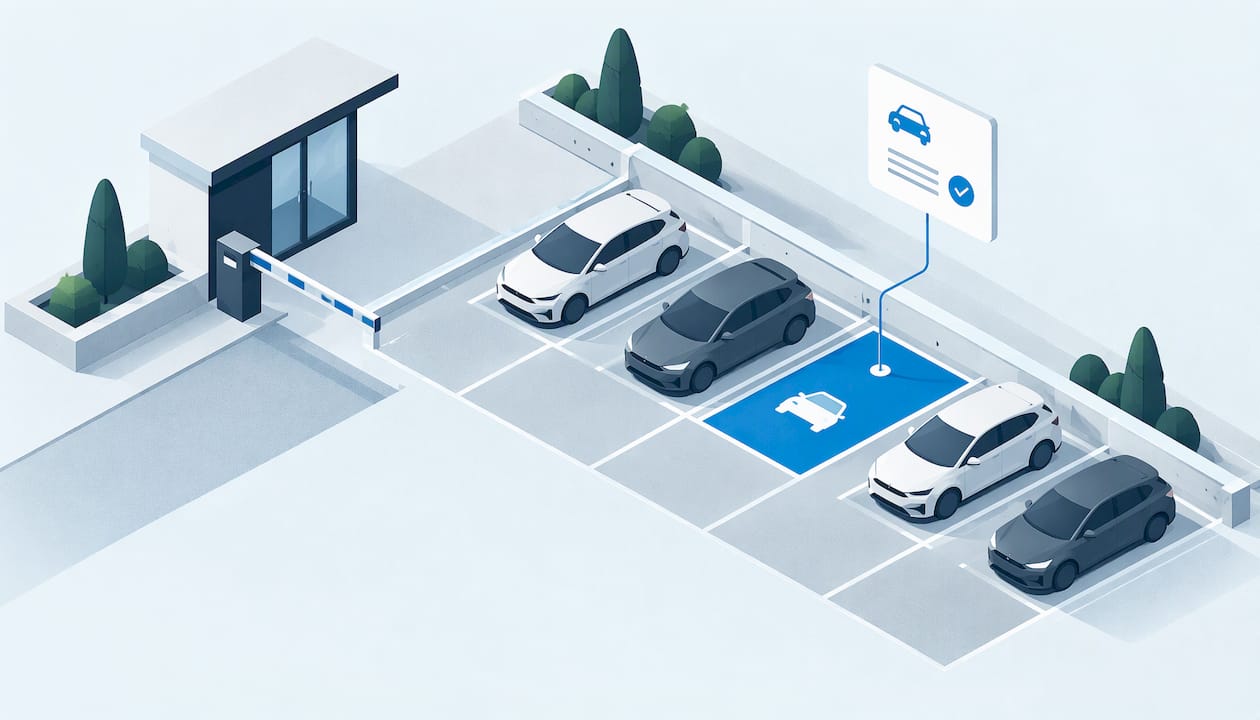
A car share parking policy is a written rule set that says which shared vehicles may park at your property, where, for how long, and what happens when one is in the wrong place. City rules cover only the public street. On private residential, hotel and commercial lots, you write the policy yourself, and it holds up only if you can prove who parked where and when. We built our platform for that record: one history for guest access, permits, violations and towing across every property you run.
TL;DR
- City car-share rules govern curbs and rights-of-way. Your garage or lot is private, so your policy and your signage decide what is allowed.
- Station-based car sharing needs reserved spaces. Free-floating needs a stated position on short and long stays, because those vehicles can sit for days.
- Set four things in writing: eligible operators, number and location of spaces, time limits, and the enforcement path up to towing.
- Towing is defensible only with adequate signs, a matching permit or emblem check, and a dated record of the violation.
- Verify local zoning and state vehicle code before you sign any operator agreement.
Table of Contents
- What a car share parking policy covers
- How cities regulate car-share parking on public streets
- Why public rules do not carry onto your property
- How to write your car share parking policy
- Enforcement and towing without disputes
- What to verify before you say yes
- Run it from one record
- Our perspective
- FAQ
- Sources
What a car share parking policy covers
Two models drive most of the questions. In station-based car sharing, users pick up and return vehicles at fixed parking spots. In free-floating car sharing, vehicles can end a trip in any eligible space within a service area. Researchers describe the trade-off this way: station-based systems tend to use parking spaces less efficiently, while free-floating systems carry higher parking and relocation costs.
For a property manager, that translates into two different policy problems:
- Station-based: you are asked to dedicate one or more spaces to one operator. The policy has to cover signage, who may use the space, what happens if a non-member parks there, and who keeps it clear.
- Free-floating: a vehicle may appear in your visitor spaces at any hour and stay. The policy has to say whether this is allowed at all, for how long, and how it differs from ordinary guest parking.
A complete policy has these parts: scope and definitions, eligible operators, space allocation, hours and time limits, signage, insurance and registration requirements, maintenance of the space, violation handling, towing, and review dates. Most of these mirror what cities already do on the street, so the public rules are a useful template.
How cities regulate car-share parking on public streets
City programs share a pattern: an operator qualifies, receives a permit, and gets either reserved spaces or relief from time limits. The details differ a lot, which is why a single national template does not work.
Dedicated spaces and free-floating permits
Sacramento requires a permit for each dedicated car-share space and each free-floating vehicle in the public right-of-way. Dedicated permits reserve a space for one qualified operator. Free-floating permits allow parking beyond posted limits in eligible metered and time-zone spaces, with exceptions. Its evaluation limits include no more than two dedicated spaces per block face across all operators, and spacing of an operator's spaces beyond a 1,000-foot radius.
Seattle assigns designated spaces to one operator, and only that operator's vehicles may use them. Free-floating vehicles may park in paid spaces without separate payment, in time-limited spaces regardless of the posted limit, and in Restricted Parking Zones. Seattle still prohibits parking anywhere longer than 72 hours.
Portland's non-reserved permit lets a permitted fleet park in metered and nonmetered spaces for extended periods without paying the meter, but only in legal, otherwise unrestricted spaces with a posted limit of two hours or more. Operators outside the program are treated as private automobiles.
In Washington, D.C., vehicles under a public-space permit may stay in Residential Parking Permit zones for up to 24 hours and in metered spaces beyond the posted limit, provided a carsharing permit is displayed on the windshield. Reserved-space vehicles must return to the pickup location.
New York City requires an annual permit application for each dedicated curbside site or renewal. Operators using ordinary spaces need no site permit but follow standard parking rules.

The legal basis in California
California shows how the authority works. Vehicle Code §22507.1 lets a local authority designate streets for exclusive or nonexclusive parking by vehicles in car-share or ridesharing programs. The ordinance must set participation criteria, may limit vehicle types, and may assign permits if necessary. Exclusive restrictions do not apply until adequate signs or markings are in place. That last point matters for your own lot too: a restriction nobody can see is hard to enforce.
Why public rules do not carry onto your property
Everything above applies to the public right-of-way. Your lot, garage or driveway is private. The city's permit does not entitle an operator to your space, and a city's time-limit exemption does not override your visitor-parking limit. Your lease terms, HOA covenants, hotel parking terms and signage are the controlling documents.
Some cities do speak to private facilities, mostly through zoning. Cambridge, Massachusetts permits carsharing in lawful conforming or nonconforming parking facilities. It requires vehicles to be properly registered and actively available rather than stored, and it prohibits sales, servicing, dead storage and repair, apart from occasional short-term maintenance. Principal-use and commercial parking facilities may host unlimited active-use vehicles. Accessory residential facilities may use carshare spaces up to 30% of spaces or two vehicles, whichever is greater. Single-family driveways are excluded, and additional spaces need a Planning Board special permit.
The lesson is not Cambridge's numbers. It is that zoning can cap how many car-share spaces a residential facility may host, so check your municipal code before you promise an operator anything.
Residential, hotel and commercial differ
| Property type | Typical question | Policy focus |
|---|---|---|
| Multifamily | Reserved spaces for residents who use a car-share service | Number of spaces, resident access, overlap with resident permits |
| Hotel | Guests arriving in shared vehicles, or an operator seeking spaces | Guest registration, length of stay, valet or garage rules |
| Commercial lot | Operator wants a station near transit or offices | Space allocation, hours, revenue terms, insurance |
In multifamily settings, a car-share vehicle used by a resident is still a vehicle that needs to be tied to someone. Our resident parking permits page shows how that record is kept per resident, and our guest parking management module handles visitors arriving in any kind of vehicle, including shared ones.
How to write your car share parking policy
These steps work whether you manage one building or a portfolio. At the steps where it applies, we note what our platform does.
1. Decide which model you will accept
Choose station-based only, free-floating only, both, or neither. Write the choice down in the policy's scope. If you accept station-based, you will deal with a defined operator and a defined space. If you accept free-floating, you are deciding whether shared vehicles may use visitor or open spaces and for how long. Where this goes wrong: leaving it silent, so a vehicle appears and staff improvise a response. Our platform runs guest access, permits, violations and towing in one place, so the model you choose applies the same way at every property.
2. Name eligible operators and require paperwork
Cities screen operators. Sacramento's applications include a business plan, parking proposal, insurance, an outreach plan and a data and monitoring plan, and San Francisco issues permits only to qualified vehicle-sharing organizations that commit to outreach, ongoing usage-data reporting and geographic coverage. You do not need that scale, but borrow the idea: ask for proof of insurance, a contact who answers around the clock, vehicle registration, and a written agreement. Our shared parking agreements guide covers the terms and legal forms behind this.
3. Allocate and mark spaces
Decide how many spaces, where, and for whom. D.C. marks reserved spaces with "No Parking Except Carshare Vehicle" signs and pavement stencils, and users remain responsible for parking legally. Copy that approach: a sign at each space, a stencil on the pavement, and a plain statement of which operator may use it. Seattle notes that operators differ on whether a vehicle must return to its original space, so state your rule in the agreement. Where this goes wrong: signage that does not name the operator, which makes later towing hard to justify.

4. Set time limits and hours
For reserved spaces, the operator has exclusive use, as Boston describes it: 24 hours a day, seven days a week. For free-floating vehicles in open spaces, set a maximum stay. Seattle's 72-hour cap is a sensible reference for how long a shared vehicle should be allowed to sit. Our time-limited parking enforcement guide explains how overstays are caught, and our platform records each vehicle's history so a repeat overstay is visible, not anecdotal.
5. Assign maintenance duties
San Francisco requires permittees to keep the designated space and 25 feet in front of and behind it clear of debris and obstacles. Persistent failures can lead to revocation or reassignment. Boston makes operators maintain spaces at the frequency of adjacent street-cleaning rules. Put a similar clause in your agreement: snow, debris, leaks and cleaning, with a deadline to respond.
6. Define the enforcement path
Write the sequence: identify, document, notify, tow. An unauthorized vehicle in a reserved space gets a violation notice, then towing if the policy and signage allow. Our parking violation management module tracks each violation against vehicle history, and our violation notice templates give you ready wording.
7. Review on a schedule
Set an annual review, the same cadence as New York City's annual permit renewals. Check usage, complaints and any change to local rules.
Enforcement and towing without disputes
Public agencies show what a defensible process looks like.
- Signs first. Santa Barbara may post notice that vehicles violating a designated carshare-space restriction can be removed and towed under California Vehicle Code §22651, and the restriction applies only after adequate signs or markings are in place.
- Match the operator. San Francisco's guidance says a vehicle in a designated space is acceptable when its visible operator emblem matches the emblem on the space sign. An unmatched or anonymous vehicle may be cited and towed.
- Exclusive means exclusive. Boston says non-carshare and illegally parked vehicles in operator spaces may be ticketed and towed.
Note that these are public-street programs. On private property, towing rules come from state and local law, so confirm your state's private-property towing requirements, including signage, before you act. If a dispute could reach a lawyer, ask your attorney to review your sign wording and tow procedure.
The practical rule is the same everywhere: a tow stands up when there are visible signs, a clear match or mismatch with the authorized operator, and a dated record. Our towing management tools keep that record with the vehicle's history, and our guide to building a defensible towing record walks through the evidence to collect.
What to verify before you say yes
Before allowing any operator on site, check:
- Zoning. Does your municipality cap or condition car-share use in residential, accessory or commercial facilities, as Cambridge does?
- State vehicle code. Does it set signage requirements for restricted spaces or towing from private property?
- Accessibility. Shared spaces must not take away required accessible spaces. See our ADA parking requirements checklist.
- Existing commitments. Leases, HOA covenants, and permit allocations may already limit how many spaces can be reassigned. Our parking permit policy reports guide shows how to document that.
- Insurance and indemnity. Confirm coverage with your insurer and counsel.
- Local equity or outreach conditions. NYC DOT requires operators to allocate 20% of their on-street curbside allotment to designated equity zones. That binds operators on the street, not you, but it shows that cities treat curb allocation as a public-policy decision.
Run it from one record
A car share policy fails in the gaps between tools: permits in one system, guest passes in another, tow calls in a spreadsheet. We built MyParkingMgr as a single platform for guest access, permits, violations, payments and towing, with audit trails, customizable workflows and portfolio reporting across multiple properties. It runs as hosted SaaS, client-hosted, or white-label, and onboarding is free (0 USD, one-off).
If you are writing a car-share policy now, see the full feature set and set up the workflow so each space, vehicle and violation sits in one history.
Our perspective
Most car-share requests reach a property manager as an informal favor: a space near the entrance, a verbal yes. Six months later nobody remembers the terms.
We think a car-share policy is a records problem as much as a rules problem. The rule can be one page. What makes it enforceable is that every vehicle, permit, notice and tow is tied to one history, so a manager can show what happened and when.
That is why we built one platform for guest access, permits, violations, payments and towing, with audit capabilities and workflows that follow your policy rather than forcing you into a template. Whether you run one building or a portfolio, the same record applies everywhere.
MyParkingMgr
FAQ
Does a city car-share permit let an operator park on my private lot?
No. City permits cover the public right-of-way, such as curb spaces and metered streets. Private lots follow your own agreement, lease terms and signage, along with local zoning and state law. Put the operator's rights in a written agreement.
How long should a shared vehicle be allowed to stay in open spaces?
There is no universal number. Seattle prohibits parking longer than 72 hours anywhere, which is a useful reference point. Set your limit in the policy and apply it the same way to every vehicle.
Can I tow a vehicle parked in a reserved car-share space?
Often, but the rules depend on your state and city. Public programs such as Boston's allow ticketing and towing of non-carshare vehicles in reserved spaces, and signs must be in place first. Check your state's private-property towing rules and keep dated records.
How many car-share spaces can a property host?
It depends on local zoning. Cambridge, for example, allows accessory residential facilities up to 30% of spaces or two vehicles, whichever is greater. Ask your municipality whether any cap applies to your property type.
Sources
- Station-Based or Free-Floating? An Integrated Carsharing System with Dual Service Types
- City of Sacramento Car Share Framework Terms and Conditions
- Seattle: Car Sharing and Parking Regulations
- Portland TRN-3.309 Carsharing Parking Administrative Rules
- DDOT: Carsharing Frequently Asked Questions
- NYC DOT Carshare Program package
- California Vehicle Code §22507.1
- Cambridge Carsharing Zoning Petition Text
- SFMTA On-Street Shared Vehicle Parking Permit Program
- SFMTA Shared Vehicle Enforcement Memo
- Boston: Car Share Boston
- Santa Barbara Chapter 10.73: Carshare Vehicle Permit Program