
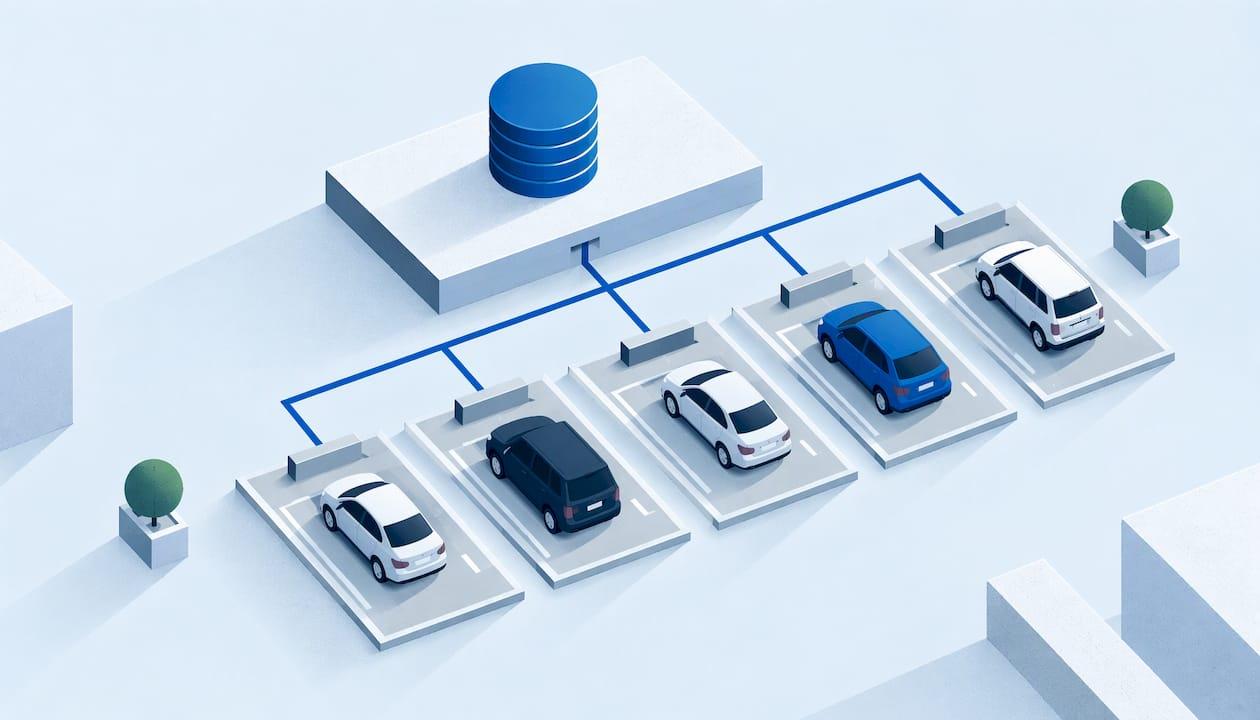
Parking cost allocation means working out what each space really costs to provide, then assigning that cost to the people or properties that use it. The fair way to do it is to start with a full per-space cost, charge for parking separately from rent, and tie every charge to a verified record of who holds which space. When permits, guests, violations and payments sit in one system, that record exists and the allocation holds up when a resident or tenant questions a bill.
TL;DR
- Start with the full cost per space: operating costs plus a capital reserve, and debt or land cost where you carry them. Published US figures run from about $600 to more than $5,000 per space per year.
- Charge for parking separately from rent, so residents who do not drive are not paying for an amenity they do not use.
- Pick one allocation method per cost pool (per space, pro rata, or by usage) and write it into leases and permit terms.
- Review occupancy and pricing on a schedule. Unused spaces are a cost you still carry.
- Allocation only survives a dispute if every space, permit and charge traces back to one record.
Table of Contents
- What counts as a parking cost
- From total cost to cost per space
- Four ways to allocate parking cost
- Pricing, occupancy and what unused spaces cost
- Where allocation breaks down in practice
- A step-by-step routine
- Putting it into practice with MyParkingMgr
- Our perspective
- FAQ
- Sources
What counts as a parking cost
A parking space has two kinds of cost. Operating costs recur: lighting, electricity, cleaning, striping, insurance, security, management and routine repairs. Capital costs are the build or purchase price of the space and the later replacement of surfaces, elevators and equipment.
Published benchmarks show how wide the range is. The Victoria Transport Policy Institute puts annualized parking costs per space at roughly $600 for basic surface parking on inexpensive land and more than $5,000 for high-amenity structured parking, averaging about $1,200 a year. A 2023 CREDA article states operating expenses of $150 to $1,000 or more per space per year, and the same article puts the total monthly cost of a space between $51 for a simple surface lot and $1,074 for a $100,000-per-space multilevel structure.
For structured parking, a Walker database of 303 above-grade garages reports a median operating cost of $783 per space per year. That figure covers lighting, cleaning, minor repairs, insurance and routine maintenance, but not debt service or major rehabilitation. That exclusion matters: if you allocate only the operating figure, you are quietly leaving the largest cost out.
A line-item list for your own budget
Build your per-space figure from your own ledgers, using categories like these:
- Utilities and lighting
- Cleaning, sweeping and snow removal
- Repairs, striping and equipment maintenance (gates, elevators, signage)
- Insurance and property taxes attributable to the parking area
- Staff or management time
- Security and patrol, a recurring line that is easy to under-budget. This facility manager's guide to garage security patrols shows what that line covers
- Enforcement, towing coordination and permit administration
- A capital reserve. CREDA recommends setting aside 0.5% to 1.5% of initial development cost each year, for example $300 per space on a $30,000-per-space facility
- Debt service or amortized construction cost, where the property carries it
The 2014 Right Size Parking memo gives a worked 100-space example: estimated annual operations and maintenance of $20,950 for a surface facility and $23,100 for a structure, with repairs and maintenance the largest single line. Use it as a template for categories, not as your numbers.
From total cost to cost per space
The arithmetic is simple. Add the annual cost pool, divide by the number of spaces you actually manage, and divide by twelve for a monthly figure.
Worked example: a 150-space surface lot costs $45,000 a year to operate, with a $15,000 reserve for resurfacing and lighting. That is $60,000, or $400 per space per year, about $33 a month. If only 120 of those spaces are in use, the cost per used space is $500 a year. The 30 empty spaces do not disappear from the budget. They shift cost onto someone, which is why the allocation method and occupancy review below matter.

Two cautions on method. Count spaces from a verified inventory, not from the original site plan. And keep guest, vendor, ADA and reserved spaces in the count, because they carry the same cost even when they produce no permit revenue. Numbering every space in a system also prevents billing losses, as covered in our piece on digital parking space numbering.
Four ways to allocate parking cost
| Method | How it works | Best fit | Watch for |
|---|---|---|---|
| Flat per space | Each assigned space carries the same monthly charge | Residential communities with numbered, assigned stalls | Needs an accurate space inventory |
| Pro rata share | Cost split by square footage or unit share, as with CAM | Commercial leases, mixed-use buildings | Lease must define the pool and the formula |
| Usage based | Charge by permit type, hours or visits | Hotels, guest parking, shared lots | Needs reliable access and vehicle records |
| Portfolio allocation | Shared costs split across properties by space count or occupancy | Multi-property operators | Requires consistent data from each site |
Pro rata and CAM-style allocation
In commercial settings, parking costs often ride along with common area maintenance (CAM). IREM's guidance explains that CAM charges are typically defined in the lease as additional rent based on each occupant's pro-rata share or square footage, estimated at the start of the year, billed monthly, and reconciled afterward, with tenants paying any shortfall or receiving a refund. The property manager builds a pool that excludes expenses unique to a single tenant. If a tenant has reserved spaces, handle those outside the shared pool.
What to check in a lease before you bill: how the parking charge is defined, whether the allocation is by space count or square footage, whether reserved and unreserved spaces are priced differently, and what records the tenant may request.
Unbundling for residential properties
The Metropolitan Area Planning Council advises charging for parking separately from rent, so car-free residents do not pay for an amenity they do not use, and setting the charge to reflect the full cost to build, operate and maintain parking. King County Metro's research explains why: when developers recover only about 6% of parking's 10% to 20% share of construction cost through parking charges, the rest is spread across all residents, including those who do not own cars.
For a residential community director, this makes permit oversight a financial matter, not just a rules matter. Each permit is a billable line tied to a space.
Pricing, occupancy and what unused spaces cost
Allocation is not a one-time exercise. Demand moves, and so should your review.
The Association of Bay Area Governments' playbook describes demand-responsive pricing as charging the lowest rate that meets availability goals, with target occupancy around 90% to 95% for off-street facilities. VTPI's implementation guide cites expert advice to price for 85% to 90% occupancy where parking is congested. Those targets come from public parking, but the logic carries over: a lot that is always full is underpriced, and one that is mostly empty is costing you money.
Oversupply is common in multifamily. King County's research found parking oversupplied by an average of 0.4 stalls per dwelling unit, roughly $400,000 in unused parking cost per average development. The same research found a price elasticity of -0.47 in urban market-rate projects: a 10% price increase cut use by about 5%. Before raising a charge, model that response so you do not push residents onto the street and lose revenue.
A 3 to 6 month data pilot is a sensible way to ground those decisions in your own occupancy, which we describe in parking data analytics for better pricing and parking capacity planning.

Where allocation breaks down in practice
Most disputes are not about the formula. They are about the record behind it. Common failure points:
- Spaces without owners. Unassigned or unnumbered spaces mean nobody is billed.
- Permits that outlive tenancies. A former resident's permit stays active and a current one is never charged.
- Guest and vendor use with no log. Cost is real, revenue is zero, and the pool is spread across everyone else.
- Violations and fees in a separate tool. Fines, towing and permit charges cannot be reconciled with the space they relate to.
- Different rules per property. A portfolio cannot compare sites when each calculates cost differently.
The fix is a single record of space, permit, vehicle, guest access, violation and payment. Our guides on permit policy reports and multi-property parking management cover how that looks across sites.
A step-by-step routine
- Inventory every space by type: resident, guest, vendor, reserved, accessible. Number them.
- Build the cost pool from your ledgers, operating and capital separately.
- Compute cost per space and per used space.
- Choose the allocation method for each pool and write it into leases, permit agreements and house rules.
- Bill from the permit record, not from a spreadsheet kept on the side. With MyParkingMgr, charges are tied to historical vehicle records and to the audit trail.
- Reconcile estimated against actual costs at least annually, and explain differences in writing.
- Review occupancy each quarter and adjust prices or supply.
Step 5 is where most teams lose accuracy. Our platform keeps guest access, permits, violations, payments and towing in one interface, so the charge for a space is traceable to the vehicle and permit behind it. Role-based user management lets onsite staff record activity while portfolio managers see the roll-up, and audit capabilities show who changed what.
Putting it into practice with MyParkingMgr
If you manage multifamily communities, hotels or lots, allocation is only as good as the system that records who parks where. MyParkingMgr is parking management software for multi-property environments, with permits, guest access, violation tracking, payments and towing management in one place, plus multi-property portfolio reporting and custom workflows. It deploys as hosted SaaS, client-hosted or white-label, and onboarding is free at 0 USD. See the platform overview or request a proposal.
For related workflows, see guest parking management and the parking permit management guide.
Our perspective
Parking cost allocation fails at the record, not at the math. Any manager can divide a budget by a number of spaces. The hard part is knowing that the number is right, that each space has a holder, and that every charge, fine and guest visit ties to the same vehicle history.
We built MyParkingMgr around that idea. Fragmented tools make you reconcile permits in one place, violations in another and payments in a third. A unified record lets you defend a charge with the history behind it, and lets a portfolio manager compare sites on the same basis.
Flexible deployment and custom workflows matter here because no two properties allocate cost the same way. A hotel with guest turnover and an HOA with assigned stalls need different rules, but both need an audit trail. That is the standard we hold ourselves to.
MyParkingMgr
FAQ
How do I calculate the cost of one parking space?
Add your annual operating costs and a capital reserve (and debt service if you carry it), then divide by the number of spaces and by twelve for a monthly figure. Published US ranges run from about $600 to more than $5,000 per space per year, so use your own ledgers rather than an average.
Should parking be included in rent?
Charging separately is the approach recommended by regional planning guidance, because residents without cars do not subsidize those with cars. Whichever you choose, state it in the lease and tie each charge to an assigned space or permit.
How do I split parking costs among commercial tenants?
Usually by pro-rata share or square footage through the CAM provisions in the lease, estimated at the start of the year and reconciled afterward, as IREM's guidance describes. Exclude costs unique to one tenant, such as reserved spaces, from the shared pool.
How often should I review parking charges?
Review occupancy quarterly and reconcile costs at least once a year. If a lot runs consistently above or below your target occupancy, adjust pricing or supply, using your own permit and access data as the basis.
Sources
- Comprehensive Parking Supply, Cost and Price Analysis (VTPI)
- Rightsizing Parking in Support of Sustainability and ROI (CREDA)
- Estimated Cost to Build and Operate a Parking Structure (Saugatuck)
- Right Size Parking revenue and cost memo
- CAM reconciliation (IREM)
- Perfect Fit Parking (MAPC)
- Right Size Parking article (King County Metro)
- Parking Policy Playbook (ABAG)
- Parking Pricing Implementation Guide (VTPI)
- Parking garage security patrol guide