
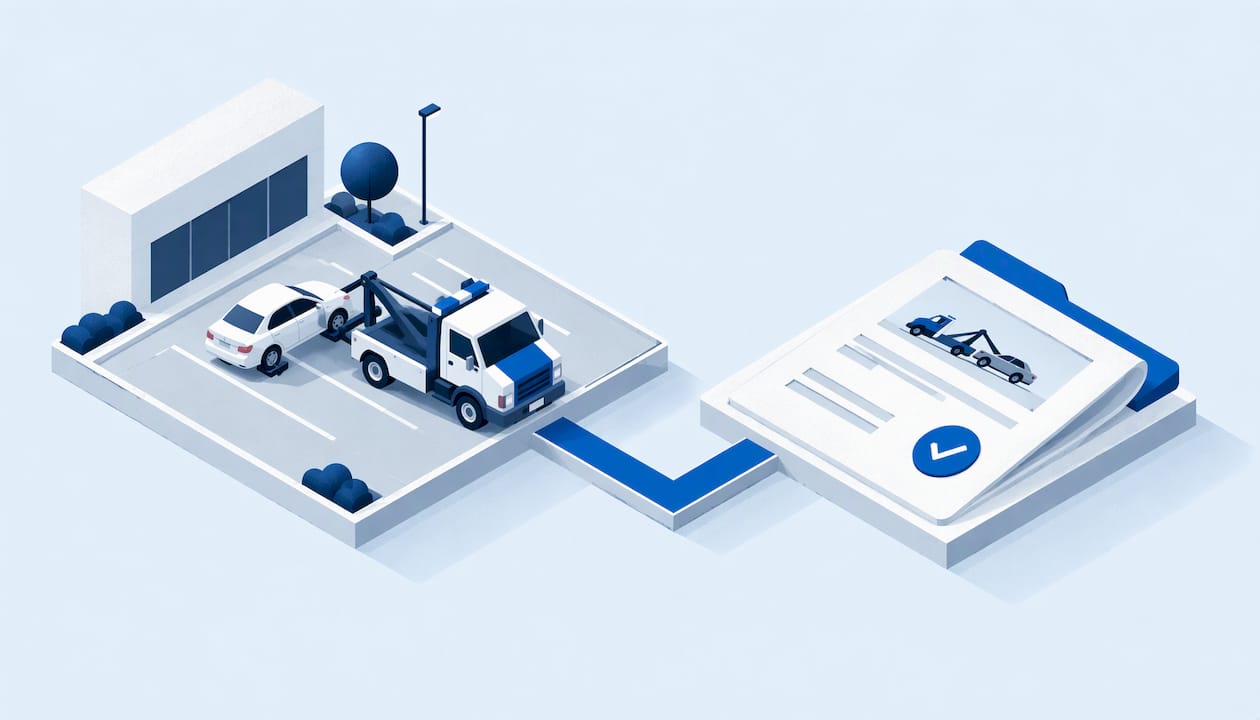
On private property, the vehicle owner pays for the tow. In most states the law names the owner as liable for reasonable towing and storage, and the tow operator bills them directly. Your job as a property manager is to make sure the tow was valid in the first place. Notice, written authorization, police notification and photos decide whether those charges can be collected, or whether your property ends up owing money instead. A unified record of every violation, permit and tow is what makes that proof available in minutes, and that is the system we build at MyParkingMgr.
TL;DR
- State laws generally make the registered owner liable for reasonable towing and storage fees, but only when the tow followed the rules for signage, authorization and notification.
- The bill grows with storage days, after-hours fees and drop fees, and many jurisdictions cap each line. Know your local caps before you authorize a tow.
- A defective tow can turn the cost around. In California, an HOA that skips prior notice can be liable for double the charges.
- Recovery is a records problem: one file per tow with the violation, permit status, sign, authorization and photos, kept the same way across every property.
Table of Contents
- What towing cost recovery means on private property
- Who pays: what state law says
- How the bill grows
- What makes a tow collectable
- The cost of getting it wrong
- A cost recovery routine for every tow
- Where MyParkingMgr fits
- Our view: the file is the asset
- FAQ
- Sources
What towing cost recovery means on private property
For a property manager, "cost recovery" rarely means your company pays the tow operator and later bills the driver. It usually means three things:
- The driver pays the towing and storage charges to the operator, and the law backs that up when the tow was valid.
- Your property avoids paying anything when a tow is challenged, because you can show it was authorized and properly noticed.
- Your staff time spent on violations, calls and disputes shrinks because the file is already complete.
The first point is the legal foundation. The second is where most of the money at risk sits. The third is what multi-property operators feel every week.
Two terms help here. A nonconsensual tow is a tow the vehicle owner did not agree to, which is what a private-property tow is. A tow authorization is the property's own sign-off, usually a signed form, that tells the operator to remove a specific vehicle.
Who pays: what state law says
The rule is consistent in outline and different in detail. Here is how several states put it.
| State | Who pays | Key condition |
|---|---|---|
| Wisconsin | Vehicle owner pays reasonable removal and storage charges directly to the towing service | Operator made a good-faith effort to notify local law enforcement before removal; unpaid for 30 days without a written installment agreement, the vehicle is deemed abandoned |
| New Hampshire | Last registered owner is responsible for reasonable towing and storage | No charges for a lot or garage tow unless conspicuous notice is posted that illegally parked vehicles are towed at the owner's expense |
| Massachusetts | Registered owner is liable for towing, transportation and storage | Fair notice by direct information or a posted tow-away sign at each entrance; police notified before removal |
| Arizona | Owner of a vehicle removed under the towing chapter is liable for reasonable towing or storage costs | Tow falls under the state towing chapter |
| Nevada | Registered owner is presumed to have left the vehicle and is responsible for removal and storage | Requester is the property owner or authorized agent, signs a specific request, area is posted, law enforcement is notified |
Notice the pattern in the right-hand column. In every state, owner liability is paired with a condition on the property or the operator. The charge is collectable when the process was followed. That is why the process, not the invoice, is where cost recovery is won.
Massachusetts adds a direct consequence for the property side: the police procedure summarizing Chapter 266 §120D notes fines of up to $100 for noncompliance by the property owner or their employer. Michigan, for its part, lets a towing service recover towing fees and capped storage fees from the last titled owner in abandonment and anti-theft situations, which is a different category from a routine lot tow.
These are examples, not a complete map. Towing law also varies by county and city, so confirm your local rules with a licensed attorney in your state before you set policy.
How the bill grows
A tow is not a single charge. The total the owner faces is the base tow plus add-ons, and add-ons accumulate every day the vehicle sits.
Arlington County, Virginia, is a useful illustration because its code is public. Its private-property towing chapter, as updated in February 2020, capped tow fees between $135 and $500 depending on vehicle weight. It allowed up to two after-hours or weekend fees of up to $35 each, and it capped storage at $50 per 24-hour period after the first 24 hours free. The county later recommended amendments effective March 1, 2025, including a $150 base tow fee, a $20 drop fee and a permitting system. Local schedules like these are amended, so check the current county page before you quote any figure to a resident.
Florida shows another side. Under section 715.07, a towing firm that wants payment before releasing a vehicle must file its current rates with local law enforcement and post the same schedule at the storage site. Towed vehicles must be stored within 10 miles of the removal point in counties of 500,000 or more people (15 miles in smaller ones), and the site must be open for redemption from 8 a.m. to 6 p.m. on every day the firm is open. An owner who arrives mid-tow can get the vehicle back by paying a service fee of no more than half the posted tow rate.
Why this matters to you: charges that fall outside the posted or capped schedule are the ones residents dispute, and disputes land on the property manager's desk. Knowing what the operator may lawfully charge lets you answer a resident's call accurately.
Payment rules also vary. Arlington requires operators to accept cash, insurance company checks, money orders and any debit or credit card they are authorized to take, and to make change up to $100 for cash. Whether a driver can pay at the lot is often set by local code, not by your lease.

What makes a tow collectable
Four pieces of documentation recur across states. If you hold all four for every tow, you are positioned to recover costs for the owner's account and defend the tow if challenged.
1. Signage that meets the local specification
Signs are not decoration. Florida's statute requires a permanently installed sign at each driveway access or curb cut within 10 feet of the road. It must state in 2-inch light-reflective letters that unauthorized vehicles will be towed at the owner's expense, show "tow-away zone" in 4-inch letters, carry the towing firm's name and phone number, hang 3 to 6 feet above ground, and be in place at least 24 hours before any tow. Other states have their own sizes and wording. Our guide to towing signage, authorization and records walks through the common elements.
2. A per-tow authorization
Connecticut's 2025 reform (PA 25-55) requires a written or electronic DMV-prescribed form for each private-property tow. It lists the vehicle, reason, authorizer's name, title, address and phone, the date and time, and confirmation that required signage was installed. Towing companies must keep the forms at least three years. Colorado goes further: its Division of Real Estate states that permission for nonconsensual tows may not be automated or preapproved. It must be per tow, signed by an authorized person on a state form, retained three years and given to the vehicle owner on request. Nevada likewise requires a specific signed request. A blanket "tow anything" instruction does not meet these standards.
3. Notification to law enforcement
Wisconsin bars collection of removal or storage charges unless the towing service made a good-faith effort to notify local law enforcement before removal. Massachusetts requires notice to police with the tow address, storage facility, vehicle description and authorizing party. Nevada requires notifying the appropriate law enforcement agency. This step is often given to the tow operator, so confirm in your agreement who sends it and who logs it.
4. Photos and a clear reason
Connecticut now requires towing companies to take at least two high-resolution photos before connecting a vehicle, showing the reason for the tow and its condition, and to keep them for at least three years. Photos from your own enforcement staff, taken at the time of the violation, add your side of the story: the expired permit, the fire lane, the guest pass that ran out.
The cost of getting it wrong
A tow that skips a step is not just uncollectable. It can create liability. Berding Weil, a California law firm that advises community associations, explains that an HOA that fails prior notice requirements can be liable for double the towing or storage charges. For discretionary tows (fire lane, fire hydrant or access violations) without a written general towing agreement, the penalty can include misdemeanor exposure and liability for four times the charges. The firm also notes that a tow can be disputed on the association's authority to tow and the basis for that particular tow, even if the vehicle was in violation.
Colorado shows how rules tighten. After its 2022 revisions, HOAs and other common interest communities may not tow from a common parking area solely for expired tags, or with less than 24 hours' notice after posting. Virginia's 2024 laws added written authorization at removal and 48 hours' notice for certain expired-registration or inspection-sticker tows from multifamily properties, as the Arlington board report summarizes.
The lesson for multi-property operators: a policy that was fine in one state may be non-compliant in another, and a rule that was fine last year may have changed. Our HOA parking management and parking policy enforcement guides cover how to write rules that hold up.

A cost recovery routine for every tow
Use the same sequence at every property, adjusting only the state-specific details.
- Confirm the rule was published. The resident handbook, lease addendum or HOA rules must state what is prohibited and that violators are towed at their own expense. Where it goes wrong: rules that live in three different documents and contradict each other. In MyParkingMgr, permits, guest access and violations sit in one system, so the rule and the record of who was authorized to park are in the same place.
- Verify the vehicle's status. Check permits, guest registrations and vendor passes before you flag anything. Where it goes wrong: towing a guest or vendor who was actually authorized. Our platform ties access to historical vehicle records, so the check is a lookup, not a phone call to three people.
- Document the violation. Date, time, location, vehicle details and photos. Where your state requires a waiting period (24 hours in Colorado after posting, 48 hours' written notice in certain Virginia cases), record when the clock started. A well-built parking violation letter captures the fields you need.
- Verify signage. Confirm the sign is posted where the code requires, with the operator's current name and number. Where it goes wrong: the operator changes and the signs still show the old company.
- Authorize the tow per vehicle. Use the form your state requires, signed by a person with authority, and store it with the violation record. This is the document that protects you in a wrongful-tow claim.
- Confirm notification. Make sure the police or local agency was notified as the law requires, and keep the confirmation.
- Let the owner pay the operator, and keep your side clean. The operator collects its charges at release. Your involvement should be limited to answering questions with the documents in hand. If your property charges its own violation fines, a fine payment workflow keeps those separate from the tow charges.
- Review across the portfolio. Look at tows by property, reason and operator. Repeated disputes at one site usually point to a signage or notice gap. Our towing partner selection guide covers what to ask of the operator.
The defensible towing record page lays out what a complete file contains.
Where MyParkingMgr fits
MyParkingMgr is a parking management platform for multifamily properties, hotels and parking lot operators. It handles guest access, resident and vendor permits, violations, payments and towing management in one interface, with audit trails and custom workflows so each property's authorization steps match its local rules. Portfolio reporting shows tows and violations across properties, and the platform can be run as hosted SaaS, client-hosted or white-label. Onboarding is free ($0, one-off).
See how the pieces connect on the features page, or look at multi-property parking management if you run several sites. To talk through your setup, start at myparkingmgr.com.
Our view: the file is the asset
Most towing disputes we think about are not arguments about whether a car was parked wrongly. They are arguments about paperwork: was there a sign, who authorized this tow, when, and on what basis.
That is why we built one record for guest access, permits, violations, payments and towing. When these live in separate tools, someone has to reassemble the story after the complaint arrives. When they live together, the history of the vehicle is already attached to the tow.
Cost recovery follows from that. The owner pays reasonable charges when the process was followed, and a clear audit trail is how you show it was. Custom workflows matter because states differ: a per-tow signed form in one place, a waiting period in another. Portfolio reporting matters because the weak property is the one that costs you.
We would rather a property manager tow less often and with a complete file than tow often and hope nobody asks.
MyParkingMgr
FAQ
Can a property manager bill the vehicle owner directly for a tow?
Usually the tow operator collects towing and storage charges from the owner at release, and state statutes such as those in Wisconsin, Arizona and Massachusetts frame the owner's liability in those terms. Your property's own violation fines are separate and follow your rules and local law. Ask your attorney how your state treats any fee your property adds.
How long can storage charges keep building?
It depends on the local schedule. In Arlington's code, storage was capped at $50 per 24-hour period after the first 24 hours free. In Wisconsin, a vehicle unpaid after 30 days without a written installment agreement is deemed abandoned and may be disposed of. Check your own state and county.
What happens if the tow was improper?
The owner generally is not required to pay charges for a tow that skipped required steps, and the property can face penalties. In California, an HOA that fails prior notice requirements can be liable for double the charges, and certain discretionary tows can bring four times the charges plus misdemeanor exposure.
Do the same rules apply in every state?
No. Signage specifications, authorization forms, waiting periods and fee caps differ by state and often by county or city. Connecticut and Colorado require per-tow signed forms retained for three years, while other states emphasize police notification or posted rate schedules. Build your workflow so each property can follow its own local rules.
Will insurance reimburse a driver for a private-property tow?
That depends on the driver's policy and is a question for their insurer. For you, the practical point is the same: a complete, accurate record lets the driver and the insurer see why the tow happened.
Sources
- Florida Statutes 2025, Chapter 715, Section 07
- Wisconsin Legislature: 349.132
- New Hampshire RSA 262:40-a
- Falmouth Police: Private Tow Information and Procedures
- Arizona Revised Statutes 28-4837
- Nevada NRS 706.4477
- Michigan Compiled Laws 257.252i
- Connecticut PA 25-55 summary
- Colorado Division of Real Estate: 2024 legislative updates
- Berding Weil: How to Tow
- Arlington County Code Chapter 14.3
- Arlington County Board Report on towing amendments