
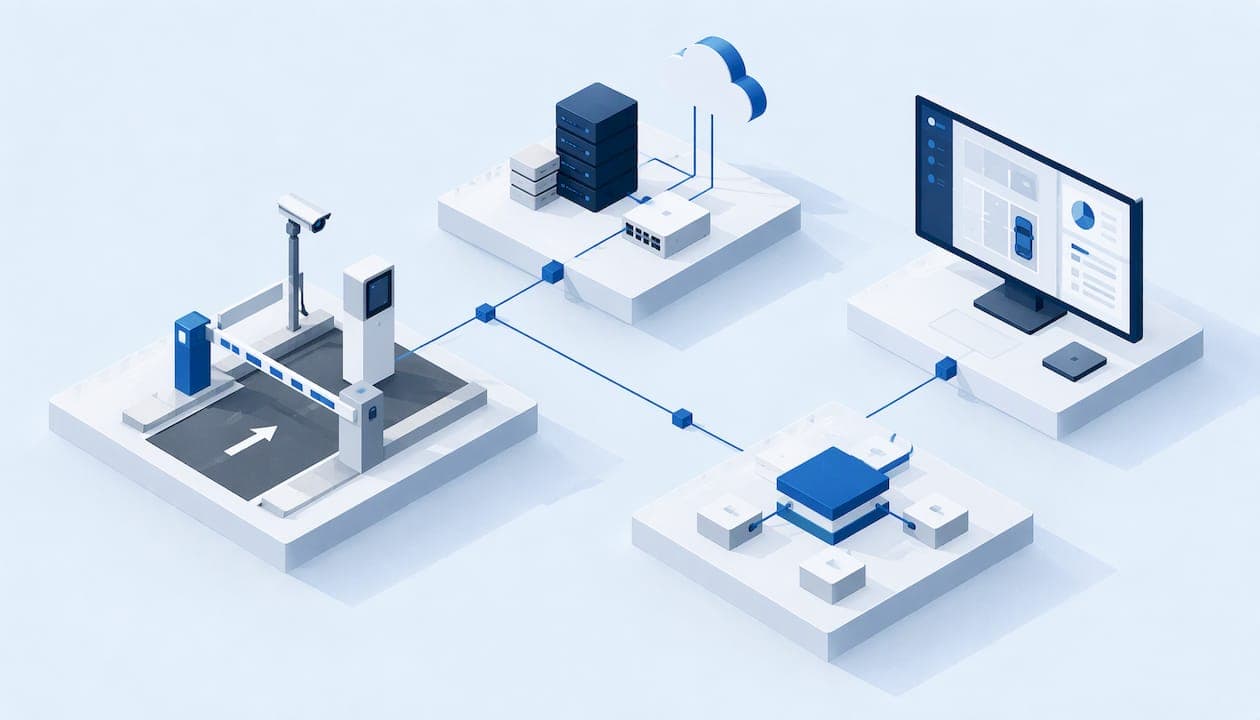
Parking hardware integration means connecting the devices in your lots and garages (gates, license plate recognition cameras, card readers, pay stations, sensors and signage) to one software platform. That way every vehicle event lands in a single record you can act on. For property managers, the practical questions are which devices can connect, what to verify before you commit, and how to roll the work out without disrupting residents, guests or staff. This guide covers all three, including the enforcement side.
TL;DR
- Integration links field hardware, a network and a management platform. The software is where permits, guests, violations and payments are decided.
- License plate recognition (LPR) and credential readers are the usual bridge between a vehicle at the curb or gate and a permit record in your software.
- Before buying or connecting anything, check documented APIs, supported standards, data export and what happens when the network drops.
- Payment devices need extra care: approved hardware, encrypted card capture and routine tamper inspection.
- Roll out in phases: one pilot property, a written test plan, a fallback procedure, then the rest of the portfolio.
Table of Contents
- What parking hardware integration actually covers
- How cameras, readers, gates and sensors work together
- Enforcement hardware integration
- What to check before you integrate existing hardware
- Payment hardware: secure and reliable
- A rollout plan for one property or fifty
- How MyParkingMgr fits
- FAQ
- Sources
What parking hardware integration actually covers
The field equipment on a typical site includes barrier gates, ticket dispensers, card readers, LPR cameras, pay stations, lane controllers, signage and sensors. Integration is the work of getting those devices to exchange data with a management platform over a network, so a single decision (admit, flag, charge, cite) is applied consistently.
The same guide describes a common architecture in four layers: field hardware, networking (Ethernet, fiber or wireless), a cloud or on-premises management platform, and an integration layer of APIs, middleware and data connectors. If you picture it that way, most buying and troubleshooting questions get simpler. A gate that will not open for a valid permit holder is a problem in one of those four layers, and you can check them in order.

A public-sector view agrees on the grouping. The North Central Texas Council of Governments groups parking technologies into input, information, and management and enforcement technologies. Cameras, entrance-detection sensors, space-availability sensors and LPR are the common inputs. Signs and apps inform drivers. The management and enforcement layer is where rules get applied.
Access and revenue control systems
Off-street facilities often run what the industry calls a parking access and revenue control system (PARCS). NCTCOG defines it as gates, ticket machines and cameras combined with software that coordinates access and payment for off-street parking. In multifamily and hospitality settings the same idea applies at a smaller scale: a gate or a patrol vehicle is the sensor, and the permit and guest records are the source of truth.
How cameras, readers, gates and sensors work together
The flow is simple once you separate input from decision.
- A device captures something: a plate image, a credential tap, a sensor trip.
- The platform looks that input up against its records.
- The platform sends an instruction back (open the gate, log a guest arrival, flag a vehicle) and writes the event to history.
With LPR, the system reads a plate and matches it against authorized plates to open a gate, or it associates a transient vehicle with a ticketless session. Credential readers can trigger the same gate access. NCTCOG notes that cameras can count vehicles, track utilization and read plates to verify payment, and that LPR can serve permits, payment, enforcement and occupancy counting from the same camera and software.
| Device | What it sends to the platform | What the platform decides |
|---|---|---|
| LPR camera | Plate read, image, time | Permit valid, guest registered, or flag for review |
| Credential reader | Card, fob or code presented | Admit or deny, log the entry |
| Barrier gate | Open/closed state, cycle events | Confirm the instruction was carried out |
| Pay station or payment terminal | Transaction request and result | Mark the session paid or the fine settled |
| Space or entrance sensor | Occupancy or entry count | Update capacity and availability views |
| Signage | Nothing, it receives data | What to display to drivers |
Keep access working when the network does not
Sites lose connectivity. Parking Professional notes that local lane controllers manage real-time operations during a temporary network interruption, continuing gate cycling, credential validation and payment processing. When you evaluate any integration, ask where the decision is made when the connection to the central platform is gone, and how the queued events sync once it returns.
Enforcement hardware integration
Enforcement is where integration pays off for operators who have to prove what happened. The goal is a chain that runs from detection to evidence to a record you can defend: a plate is read, matched to permit or guest data, a possible violation is flagged, and the photos and timestamps are attached to the case.
NCTCOG describes a real example. In San Marcos, the LPR enforcement system captures two photos, GPS coordinates and timestamps, and alerts officers when a vehicle exceeds a posted time limit. That is a municipal deployment, but the same evidence pattern is what a property needs: image, place, time, and the rule that applied.
A few principles hold across residential, hotel and lot settings:
- Match against live permit data. An LPR read is only as good as the permit and guest list behind it. Digital permits that update in seconds reduce wrong tickets, which we cover in our guide to digital parking permits.
- Keep a person in the loop. An automated alert is a lead, not a verdict. Our piece on why ALPR alerts need human review explains the review step, and our LPR enforcement policy guide covers verification.
- Tie every action to history. Violations, notices, payments and tows should all attach to the same vehicle record, so a dispute can be answered from one screen. See how that works in parking violation management and towing management.
Gates and access control
If your hardware includes gates or controlled doors, the standards matter as much as the cameras. We wrote a separate guide on gate access integration covering OSDP, UL 325 and zero trust for facility teams.
What to check before you integrate existing hardware
Most integration problems are decided before installation. Use this checklist when you are connecting hardware you already own, or choosing new devices to work with your platform.
Documentation and standards
Parking Professional's interoperability guidance recommends documented open APIs, verified integrations, specific standards versions and certification evidence, plus unrestricted data export in CSV, JSON or XML. Ask each vendor for those in writing.

If a vendor references the Automated Parking Data Standard, know what it specifies. The APDS 4.1 API specification uses REST over HTTPS, JSON responses, path-based versioning and idempotent requests, recommends OAuth2-based authentication, and defines 401 and 403 responses for authentication and authorization failures. You do not need to be a developer to use this: ask whether a device or platform follows a published spec, and which version.
Network and architecture
- Does the device connect over Ethernet, fiber or wireless, and who owns that link at each property?
- Where does the decision happen when the central connection drops?
- Is data exchanged in real time or in batches, and what does that mean for guest registration or permit changes?
- Can the platform handle differently formatted plate numbers from different devices?
Failure handling and monitoring
Integrations fail in small ways: a camera reboots, a certificate expires, a controller drifts out of sync. Decide up front who is alerted, how events are retried and how a missed event gets recovered by hand. Operators with many sites often add dedicated network monitoring for multi-location sites so a dead device is noticed before a resident calls. If your integration needs go beyond what a configurable platform offers out of the box, custom system integration work is another route to bridge unusual equipment.
Data ownership and audit
Ask where event data lives, how long it is kept, who can see it and whether every change is logged. Role-based access and an audit trail matter when several staff, vendors and a towing partner all touch the same records.
EV charging and other add-ons
If EV charging may come to your lots, the IPMI EV Readiness Resource Guide says charging equipment should be flexible enough to integrate with other parking technologies, load-management software and asset-management systems. It also advises assessing hardware, software, pricing and payment integration before deployment. Raise this now, not after the conduit is poured.
Payment hardware: secure and reliable
Where fines, guest fees or permit fees are paid at a terminal, card security becomes part of the integration. The PCI Security Standards Council's DSS v4.0 summary of changes notes that Requirement 9.5.1 calls for point-of-interaction devices used in card-present transactions to be on the approved PTS list, and that Requirement 9.5.1.2 requires periodic physical inspection of those devices for tampering. The inspection frequency is set by a targeted risk analysis.
In practice, that means three habits for unattended devices: buy approved hardware, keep card data out of your own systems by using a processor that encrypts at capture, and put device inspections on a recurring schedule with a named owner. Your payment processor or a qualified security assessor can confirm what applies to your setup.
If fines are paid online instead of at a device, the card-handling burden shifts to the payment flow. See online parking fine payments for how that fits into the platform.
Our perspective on hardware integration
We built MyParkingMgr around one idea: the hardware is only useful when it feeds a single record. Gates, cameras and readers produce events. Permits, guests, violations, payments and towing are the decisions that follow. When those live in separate tools, someone ends up reconciling spreadsheets after a dispute.
That is why we put guest access, permits, violations, payments and towing in one interface tied to historical vehicle records. It is also why we support hosted SaaS, client-hosted installs and white-label deployment: a portfolio with strict IT rules should not have to bend its architecture to fit a vendor.
Our approach to hardware is to start from your workflow, not from a device catalog. Custom workflows, role-based users and audit trails mean the same integration can serve a hotel front desk, an HOA board and a lot operator with different rules.
MyParkingMgr
A rollout plan for one property or fifty
The research above tells you what to verify. Sequencing the work is a matter of discipline, and this order works well across property types.
- Inventory what exists. List every device per property: make, model, firmware, network connection, who services it. Note which ones are enforcement tools and which control access.
- Define the rules first. Write down who gets access, for how long, how guests register, what counts as a violation, who reviews alerts and how tows are authorized. Configure workflows from that document.
- Confirm compatibility in writing. Use the checklist above. Get API documentation, supported standards versions and data export terms from each device vendor.
- Pilot at one property. Pick a site with typical traffic, not the easiest one. Run the new integration alongside your current process for a defined period.
- Test the failures. Unplug the network. Present an expired permit. Register a guest at the last minute. Read a plate in poor light. Confirm each outcome is logged and recoverable.
- Train by role. Front desk, patrol, board members and managers see different screens. Train each group on theirs.
- Roll out in waves. Move to the next properties in batches, with the same checklist and a named owner per site.
- Review monthly at first. Look at violation disputes, device uptime and guest registration problems, and adjust workflows.
Capacity planning belongs in the early steps too: sensors and counts only help if you know your limits. Our parking capacity planning guide walks through that for operators.
How MyParkingMgr fits
If you manage several properties and want hardware, permits, enforcement and payments tied to one record, MyParkingMgr is built for that. The platform supports hardware integration for enforcement activities, multi-property portfolio reporting, role-based user management, audit trails and custom workflows. Deployment can be hosted SaaS, client-hosted or white-label.
Onboarding is free ($0, one-off). Browse the full feature list or look at guest parking management if hotels or multifamily communities are your focus.
FAQ
What is the difference between parking hardware integration and enforcement hardware integration?
Parking hardware integration is the broad term: any gate, reader, camera, sensor, signage or payment device connected to your platform. Enforcement hardware integration is the part focused on checking permits and recording violations, usually LPR cameras and handheld or vehicle-mounted devices that attach images, time and location to a case. Both should feed the same vehicle record.
Do I need to replace my existing gates and cameras?
Not necessarily. Start with the inventory and ask each device vendor for documented APIs, supported standards versions and data export terms. If a device offers a documented interface, it can often be connected. If it does not, that is the moment to talk with your software provider about options before buying anything new.
What happens if the internet goes down at a property?
Well-designed systems keep working locally. Industry guidance says that lane controllers can continue gate cycling, credential validation and payment processing during a temporary network interruption. Confirm how your specific setup behaves and how events sync after reconnection.
Is LPR alone enough to issue violations?
An LPR read is evidence that a plate was seen at a place and time. Matching it to current permit and guest data, and having a person review the alert before a notice or tow, protects both residents and your property. Our LPR enforcement guide covers the policy side.
How long does a rollout take?
It depends on the number of properties, the condition of existing devices and how clear your rules are. A single-site pilot with written rules and a failure test plan is the quickest way to learn your real timeline before you commit the rest of the portfolio.
Sources
- The Complete Guide to Parking Control Systems, Parking Professional
- Parking Technology Guide 2025, North Central Texas Council of Governments
- Parking Interoperability Standards, Parking Professional
- APDS API specification, parkingdata on GitHub
- EV Readiness Resource Guide, IPMI
- PCI DSS v3.2.1 to v4.0 Summary of Changes
- Hardware-driven network monitoring, Netverge
- System integration case studies, CoreWorx